
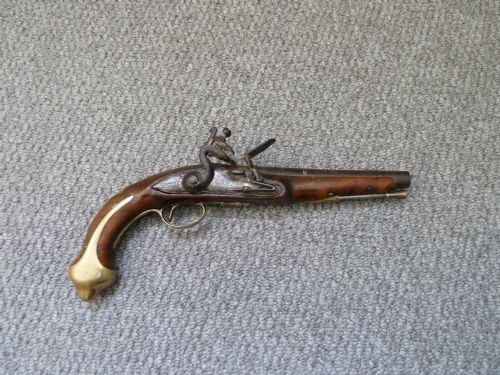
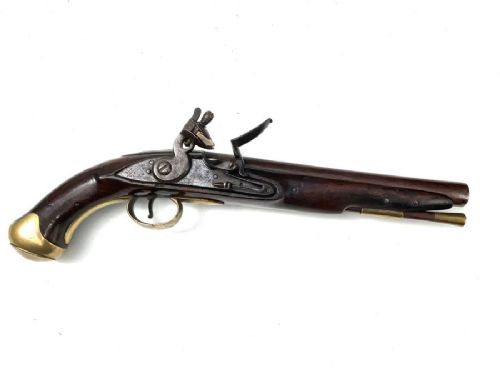


Brass Mounted Flintlock Pistol
A brass mounted flintlock pistol combines utilitarian military mechanics with decorative metalwork, offering collectors a tangible piece of centuries-old European and Ottoman craftsmanship.
Brass Mounted Flintlock Pistol
A brass mounted flintlock pistol is typically a firearm from the seventeenth, eighteenth, or nineteenth century, encompassing military service arms, civilian duelling pieces, and regional Ottoman or Balkan holster weapons. The pieces found on this page range from regulation British dragoon and cavalry sidearms to ornate Balkan flintlocks and London-made pocket or turn-off pistols.
The most common examples encountered here hail from the Georgian and Napoleonic eras, reflecting standard military procurement alongside civilian craftsmanship. Buyers frequently meet British Tower service arms, alongside distinct Ottoman forms featuring characteristic mountings and regional stocks.
Forms vary from heavy military dragoon and light cavalry patterns to smaller greatcoat and pocket variants designed for personal defence. Each piece demonstrates how eighteenth and nineteenth century armourers adapted mechanical firing systems to diverse tactical and decorative requirements.
How they were made
Makers constructed these arms using forged iron and steel for barrels and lock mechanisms, paired with stocks carved from walnut or other dense hardwoods. Brass featured heavily for mountings, trigger guards, and butt caps, providing a durable and decorative contrast to the dark wood.
Surface ornamentation involved intricate brass engraving, silver wire inlay, and occasionally mother-of-pearl panel accents, particularly on pieces originating from the Ottoman Balkan region. Lock mechanisms relied on precise spring tension and flint striking against a hardened steel frizzen to generate the ignition spark.
Some nineteenth-century makers evidently decided that a pistol simply wasn't finished until it wore a tasteful mother-of-pearl tuxedo.
What varies in quality
Quality rests upon the crispness of the mechanical action, the original integrity of the lock and stock, and the execution of any decorative engraving or metal inlay. Military regulation pieces from known arsenals show standardised utility, whereas bespoke civilian or regional workshop pieces demonstrate individual artistic ambition in their brass mounts and woodwork.
The survival of original surface finishes, unpolished brass mounts, and matching components across the lock and stock distinguishes higher-grade survivals from those altered or heavily restored over subsequent centuries.
HARRISON OF LONDON·Henry Nock·Thomas Henshaw·Thomas Anelli·BRASHER·I Parr
The Brass Mounted Flintlock Pistol Glossary
- Flintlock
- A firearm ignition mechanism that uses a piece of flint held in a cock to strike a steel frizzen, creating sparks to ignite the priming powder. This system dominated European and military small arms design for over a century.
- Frizzen
- The vertical steel plate struck by the flint to produce sparks and cover the priming pan. Its hardened surface is crucial for reliable ignition.
- Snaphaunce
- An early type of flintlock mechanism precursor featuring a separate steel pan cover. It represents an intermediate step in firearm evolution before standard flintlocks took precedence.
- Miquelet
- A distinctive form of snaplock mechanism common in Spain, Italy, and the Ottoman Empire. It employs an external mainspring and a combined steel and pan cover.
- Turn-off barrel
- A barrel designed to be unscrewed from the breech for easier loading. This configuration appears frequently on eighteenth-century pocket and greatcoat pistols.
Brass Mounted Flintlock Pistol: Frequently Asked Questions
How do I care for a flintlock pistol?
Keep the metal components lightly oiled with a microcrystalline wax or gun oil to prevent active corrosion. Store the piece in a stable, dry environment away from direct heat sources and extreme humidity.
Avoid aggressive cleaning agents on the brass mounts or wooden stock to preserve the patination accumulated over centuries of existence.
Were these pistols used in combat?
Many examples on this page served a military function, issuing to British cavalry, dragoons, and infantry during the Georgian and Napoleonic conflicts. Regulation patterns saw active service across European battlefields and colonial frontiers.
Other pieces served civilian roles, including personal protection for travellers or officers requiring reliable sidearms for self-defence during journeys.
What is the difference between military and civilian pistols?
Military pieces conform to strict government contract standards, often bearing arsenal inspection marks, crown stamps, and regulation barrel lengths. They prioritise robust utility over ornamentation.
Civilian and regional variations allow for artistic expression, featuring silver wire inlay, mother-of-pearl accents, and more elaborate brass engraving tailored to individual clients.
How can I tell an Ottoman pistol from a British one?
Ottoman and Balkan pieces generally exhibit distinctive stock shapes, pronounced rat-tail grips, and extensive brass or silver mountings with intricate geometric or floral engraving. They often utilise miquelet or rat-tail snaphaunce locks.
British arms typically display Tower markings, crown ciphers, standardised walnut stocks, and conventional flintlock mechanisms designed for military service or civilian trade.