



Brass Inlaid Server Table
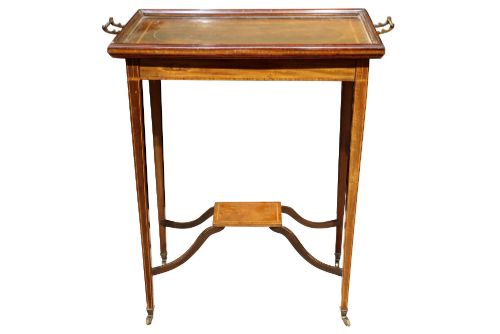
These brass inlaid server table pieces offer timeless dining room storage and display, bringing classic timber and metalwork into your home.
Brass Inlaid Server Table
A brass inlaid server table typically takes the form of a sideboard, serving table, or occasional table designed for dining and entertaining spaces. These pieces span periods from the Georgian and Regency eras through to the Edwardian and Victorian times, reflecting changing interior tastes over two centuries.
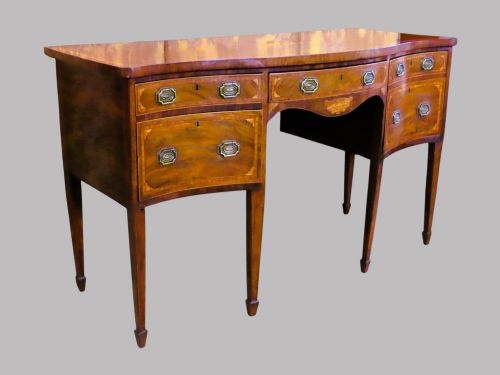
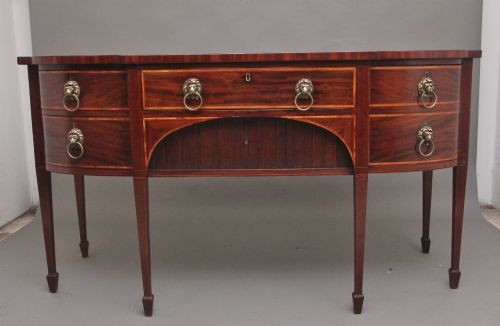
The versions most commonly found here are mahogany sideboards with serpentine, bow front, or breakfront silhouettes. They frequently incorporate satinwood and boxwood inlay alongside brass detailing, creating distinct focal points for a dining room or hallway.
Assessing quality and craftsmanship
Quality in these pieces rests upon the crispness of the cabinetwork and the integration of the inlay. Superior examples display tight, seamless joins in the boxwood and satinwood stringing, with brass work that sits flush to the surrounding timber surface.
The choice of primary wood also dictates the tier of the piece, with heavily figured mahogany veneers and well-balanced proportions marking out finer workshop production. Simpler constructions utilise plain mahogany or oak with more basic linear stringing.
The listings span multiple centuries, ranging from eighteenth-century George III pieces to Edwardian revivals.
Robson And Sons·Howard And Sons
The Brass Inlaid Server Table Glossary
- Breakfront
- A piece of furniture where the central section projects forward from the flanking outer sections. This architectural arrangement creates depth and shadow across the front elevation.
- Serpentine front
- A furniture front curving inward in the middle and outward at the ends, forming an undulating line. It demands advanced woodworking skill to shape accurately.
- Stringing
- Thin strips of contrasting wood inlaid into channels in the primary surface to form decorative borders. It frequently frames drawer fronts and tabletops on these pieces.
- Pedestal sideboard
- A form featuring distinct outer pedestals or cupboards flanking a central serving area. This layout gained popularity during the Georgian and Regency periods.
Brass Inlaid Server Table: Frequently Asked Questions
What is a brass inlaid server table used for?
These tables served primarily in dining rooms for holding dishes, silverware, and serving platters during large meals.
Today, they function well as sideboards, hall tables, or drinks tables, offering useful surface space and concealed storage.
How do I distinguish Georgian from Edwardian pieces?
Georgian pieces date from the eighteenth and early nineteenth centuries, relying on proportion and restrained timber figuring for their elegance.
Edwardian items, made around one hundred years later, often revive earlier Sheraton styles with lighter proportions and decorative satinwood inlay.
How should I care for mahogany and brass inlay?
Keep these items away from direct sunlight and heat sources to prevent the timber veneers from drying out or splitting.
Apply a traditional beeswax polish occasionally and buff with a soft cloth to maintain the lustre of both the wood and the metal.
What does bow front mean?
A bow front describes a cabinet or table front that curves outward in a convex arc across its entire width.
This shape softens the rectangular appearance of traditional dining furniture and provides extra internal depth in the central drawers.