

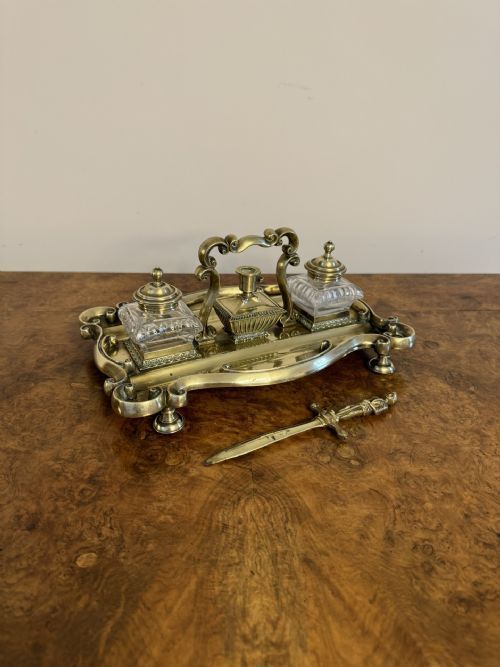
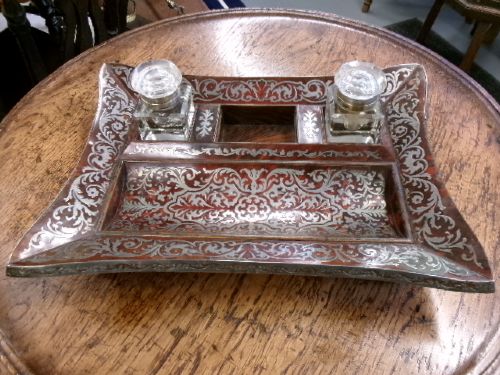
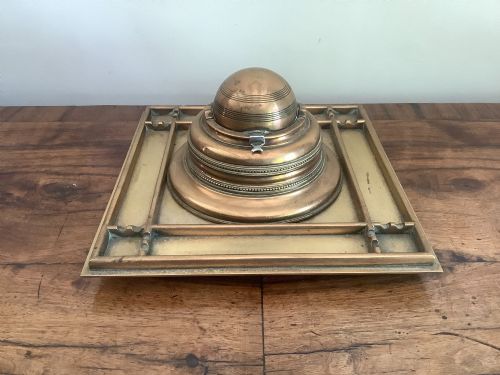


Brass Inkstand Tray
A brass inkstand tray organises the writer's desk, holding inkwells and pens in solid metal, wood, or marble.
Brass Inkstand Tray
A brass inkstand tray forms the structural base for desk accessories, designed to hold inkwells and provide a rest for pens.
The pieces on this page span the eighteenth, nineteenth, and early twentieth centuries, taking the form of desk sets, stands, and tidies.
Victorian and Edwardian examples predominate, alongside earlier Regency and Georgian pieces, often combining brass with glass, ceramic, or timber.
Materials and Technique
Foundations combine cast brass, gilt bronze, and ormolu with wooden bases in oak, walnut, coromandel, and rosewood.
Decorative elements incorporate Boulle work, mother-of-pearl inlay, tortoiseshell, champlevé enamel, and agate cabochons.
Glass and porcelain components form the inkwells themselves, fitted into metal frames alongside dedicated pen rests.
Listings feature French Empire, Regency, and Art Nouveau designs alongside heavy Victorian oak and brass desk sets.
Grading Quality
The distinction between standard items and the finest pieces rests on the crispness of the brass casting and the richness of the secondary materials.
Compositions featuring intricate Boulle work, enamel, or carved animal figures demonstrate higher workshop ambition than plain metal trays.
Completeness dictates standing: sets retaining their original matching glass inkwells and bell inserts command greater interest.
James Cartland & Sons·Elkington·Geschutz
The Brass Inkstand Tray Glossary
- Standish
- A portable tray or stand holding writing equipment, including inkwells, sanders, and pen compartments.
- Ormolu
- Gilded bronze mounted upon furniture or desk wares, popular in French and English nineteenth-century pieces.
- Champlevé
- An enamelling technique where troughs are dug into metal and filled with vitreous paste before firing.
- Boulle work
- Marquetry of tortoiseshell and brass inlay, developed in seventeenth-century France and revived in the nineteenth century.
- Cabochon
- A gemstone or piece of glass polished to a convex, hemispherical form rather than faceted.
Brass Inkstand Tray: Frequently Asked Questions
What is a brass inkstand tray?
A brass inkstand tray is a desk accessory designed to hold inkwells, blotters, and writing instruments while protecting the writing surface.
These trays range from simple metal dishes to elaborate multi-piece sets incorporating wood, glass, and enamel.
How were desk stands used?
In the nineteenth century, these stands sat upon writing tables to keep dip pens, ink, and blotting sand orderly and accessible.
Wealthy households maintained multiple sets across libraries, studies, and drawing rooms for correspondence.
How do I date a brass inkstand?
Dating relies on stylistic clues, such as the sinuous lines of Art Nouveau pieces versus the heavy ornamentation of Victorian examples.
Materials also help, as coromandel and tortoiseshell mountings point directly to mid-nineteenth-century Napoleon III taste.
Can I still use an antique inkstand?
Original glass and ceramic inkwells can hold modern ink if their liners remain free of cracks or chips.
Many collectors prefer to keep them dry as decorative desk sculptures rather than functional writing tools.
What woods appear on these trays?
Nineteenth-century makers mounted brass trays onto dense exotic timbers like coromandel, rosewood, walnut, and ebonised wood.
Solid oak also appears frequently, particularly on larger late Victorian and Edwardian desk stands.