
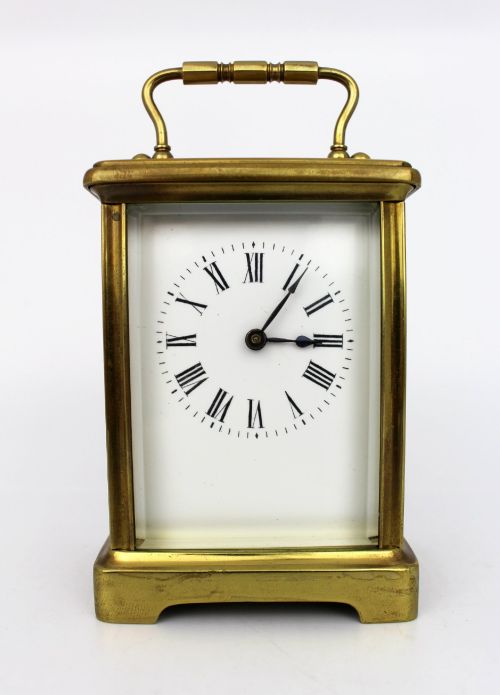


Brass Glass Clock Case
A brass glass clock case houses precision timekeeping behind clear panels, offering a clear view of intricate internal movements.
Brass Glass Clock Case
A brass glass clock case typically encloses carriage clocks, mantel pieces, and crystal regulators from the nineteenth and twentieth centuries. These housings allow light to pass through panels surrounding metal frames, displaying dials and escapements from multiple angles.
Carriage clocks and four-glass mantel designs appear most frequently in this collection. Originating from French and English workshops, these items range from portable travel timepieces to substantial desk and mantel ornaments.
How they were made
Craftsmenship relies heavily on cast and gilt brass combined with bevelled glass panes. Many housings incorporate enamel dials, steel components, and occasionally mahogany, rosewood, or burr walnut elements to support the metallic framing.
Makers shaped heavy brass into gorge, corniche, or serpentine profiles, securing individual glass panels into rebates using traditional joinery and precise metalfitting techniques.
The selection includes portable travel timepieces alongside large Edwardian longcase clocks and delicate desk barometers.
What varies in quality
The standard of a brass glass clock case depends on the crispness of the brass casting and the depth of any hand engraving. Finer examples display sharp architectural details on corniche or gorge mouldings rather than soft, rounded edges.
The clarity and thickness of the bevelled glass panels also separate standard production from superior maker output. Heavy, flawless glass fitted tightly into solid brass frames indicates higher workshop standards.
Samuel Marti·Drocourt·Jaeger LeCoultre·William Evans·John Massey
The Brass Glass Clock Case Glossary
- Gorge case
- A stepped rectangular brass carriage clock housing with a distinctive fluted top. This style is frequently found on nineteenth century French pieces.
- Corniche case
- A simple rectangular brass housing featuring flat top and bottom pillars. It provides a clean architectural framework for viewing internal movements.
- Crystal regulator
- A mantel clock enclosed entirely by glass panels on all four sides. This design showcases the pendulum and movement clearly.
- Platform escapement
- A small self-contained regulating assembly mounted near the top of the movement. It replaced the traditional pendulum in portable carriage clocks.
- Fusee
- A conical pulley used in mechanical clocks to maintain even power delivery as the mainspring unwinds. It represents higher mechanical complexity in older timepieces.
Brass Glass Clock Case: Frequently Asked Questions
How do I wind a brass carriage clock?
Insert the key into the winding square located on the backplate and turn it gently clockwise until you feel resistance. Stop immediately to avoid over-tensioning the internal spring.
Ensure you support the brass case firmly with your other hand while winding to prevent the glass panels from shifting or striking hard surfaces.
What is a four glass clock?
A four glass clock is a mantel timepiece featuring heavy bevelled glass panels on the front, back, and both sides. This construction allows unrestricted light and visibility into the movement.
These pieces usually sit on decorated brass or gilt bases and often house mercury or pendulum escapements.
How do I tell an English case from a French one?
English brass clock cases often utilise heavier rosewood or mahogany elements and specific platform escapements suited to library or desk use. French variants frequently employ gilt brass gorge or corniche framing with delicate enamel dials.
Maker signatures on the backplate or dial typically confirm the country of origin.
Where should I place an Atmos clock?
Place your Atmos clock on a sturdy, vibration-free surface away from direct sunlight and heating vents. Temperature fluctuations drive the sealed bellows inside, so a stable room environment keeps the movement running accurately.
Avoid high traffic shelves where accidental bumps might disturb the delicate torsional pendulum.