


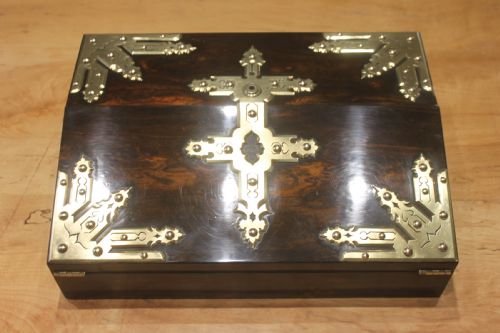


Brass Coromandel Box
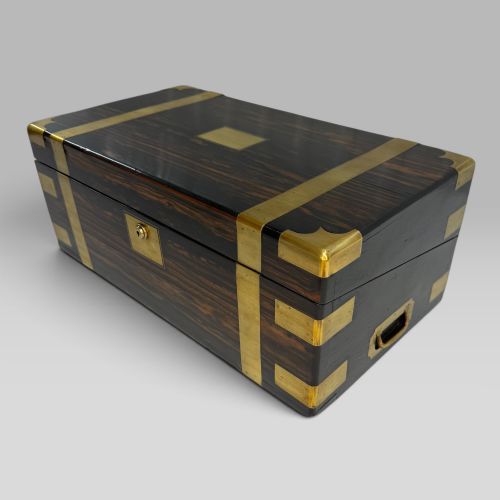
A brass coromandel box brings dense tropical wood and heavy metal banding together to organise correspondence and valuables in the nineteenth-century study.
Brass Coromandel Box
A brass coromandel box is a portable repository created to hold writing equipment, jewellery, stationery, or bottles during the Victorian era. The form includes folding writing slopes, fitted vanity cases, stationery cabinets, and tea caddies constructed primarily during the nineteenth century.
Most examples originate from the middle and late Victorian periods, showing robust brass binding or inlay across dense timber surfaces. Makers adapted the containers for domestic desks or carriage travel, producing compact caskets as well as large double-action cabinets.
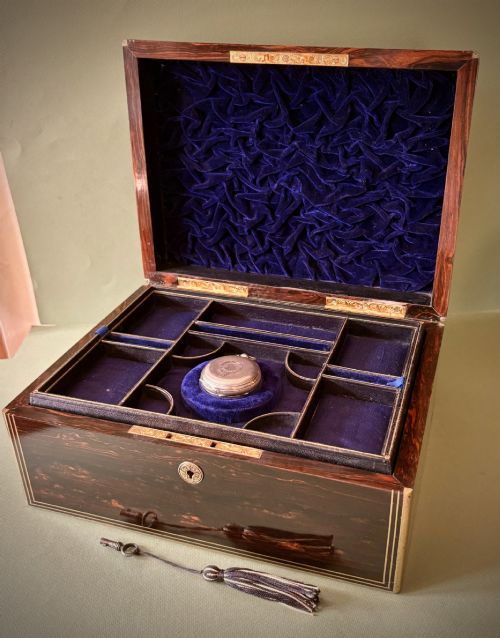
The objects served affluent households where private papers, correspondence, and personal adornments required secure, decorative storage. Interiors often incorporate velvet linings, secret drawers, glass decanters, and fitted compartments tailored to specific domestic rituals.
How They Were Made
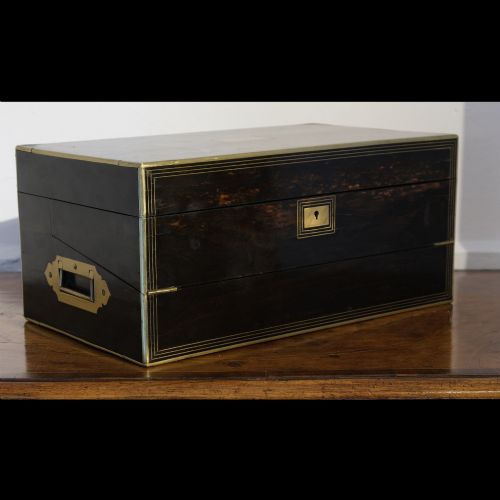
Cabinet makers constructed the foundational carcase from heavy coromandel wood, valued for its striking dark grain, and faced exterior surfaces with brass strapwork or flush inlay. Heavy brass corners and edge banding protected vulnerable joints during transport.
Interiors relied on secondary woods lined with velvet or leather, featuring precision joinery for secret drawers and folding slopes. Metal mounts were secured with small brass pins, while glass inserts, mother of pearl accents, and ormolu mounts completed the decorative scheme.
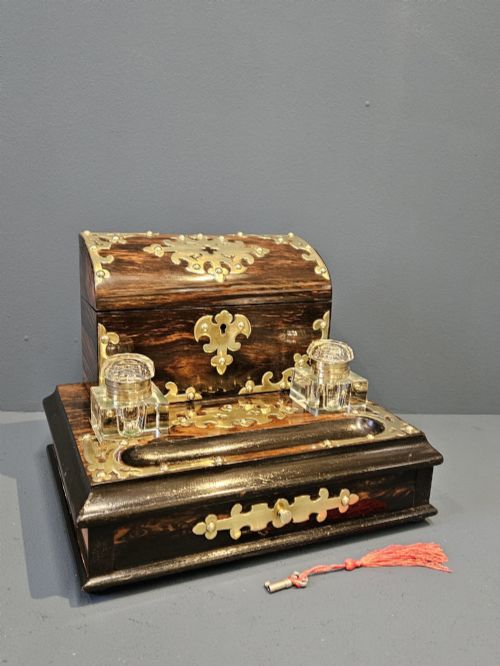
The archive demonstrates diverse forms including decanter boxes, tea caddies, and stationery cabinets from the nineteenth century.
What Varies In Quality
The density and figuring of the coromandel timber set the visual baseline for each piece, with straight, highly marked grain commanding greater attention. The weight and execution of the brass mounts, from simple flush banding to elaborate pierced Gothic strapwork, indicate the maker's investment in the object.
Internal complexity separates standard boxes from masterwork pieces fitted with secret mechanisms, removable trays, and complete sets of matched crystal bottles or gilded accessories. Signed locks and retailer plates from established London firms confirm high workshop standards.
H Mitchell·Briggs·Houghton and Gunn·Mechi and Bazin·Lund of London·C.G. Hope Hastings·Cormack Brothers·Leuchars of London·Parkins and Gotto·Howell James and Co
The Brass Coromandel Box Glossary
- Coromandel
- A dense, heavy tropical hardwood featuring rich dark brown colour with dramatic black figuring. It was imported from South Asia and utilised for luxury nineteenth-century cabinet work.
- Writing Slope
- A portable desk featuring a hinged, sloping lid that opens to reveal a leather-lined writing surface and compartments for ink and paper. Many incorporate hidden drawers beneath the stationery wells.
- Stationery Box
- A desk accessory designed to hold folded writing paper and envelopes, often featuring a tiered interior or a domed lid. Some examples include integrated calendars or ink stands.
- Tantalus
- A locking beverage cabinet that secures glass decanters within a metal framework, preventing access to the contents without a key. The design displays the cut crystal while keeping the bottles safe.
- Pietra Dura
- An artistic technique involving the inlay of cut and fitted polished coloured stones to form pictures or ornamental designs. It appears on select Victorian desk boxes.
Brass Coromandel Box: Frequently Asked Questions
What is a coromandel wood box used for?
These containers were built to house valuables, writing equipment, correspondence, and personal grooming items in the nineteenth-century home.
Owners utilised the fitted interiors to keep writing paper, inkwells, jewellery, and decanters organised and secure.
How do you identify a Victorian writing slope?
A writing slope opens along a central hinge to form an inclined writing plane covered in leather or velvet.
Lifting the folding surfaces reveals compartments for pens, stamps, and ink bottles, often accompanied by secret release buttons for hidden drawers.
What makes coromandel different from other woods?
Coromandel is a heavy, exotic timber characterised by deep brown tones and dark, contrasting grain patterns that create a dramatic visual texture.
Cabinet makers reserved the material for high-end luxury goods due to its scarcity and superior hardness compared to domestic woods.
Are keys usually included with these antique boxes?
Many surviving boxes retain their original working locks and keys, though some rely on modern replacement mechanisms.
Working locks were essential for securing private correspondence and valuable items during the Victorian period.