

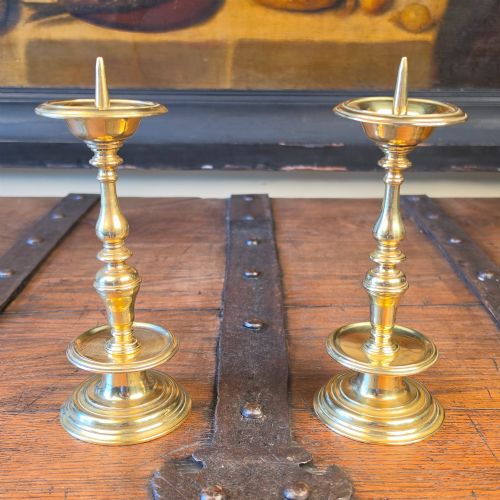
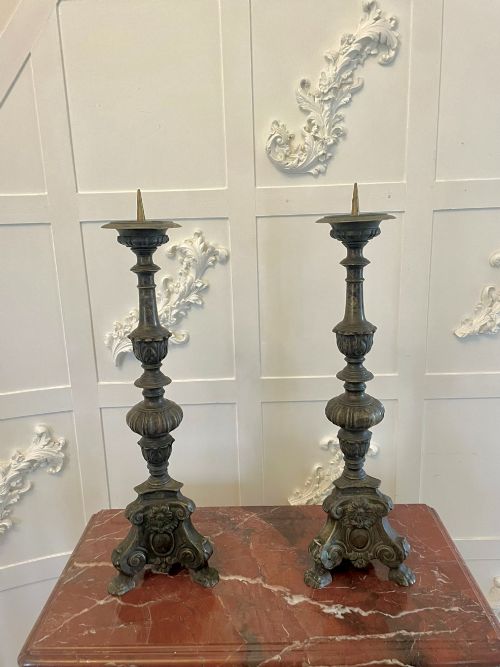
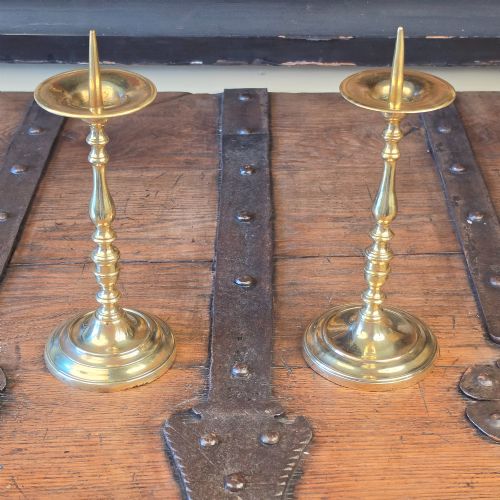
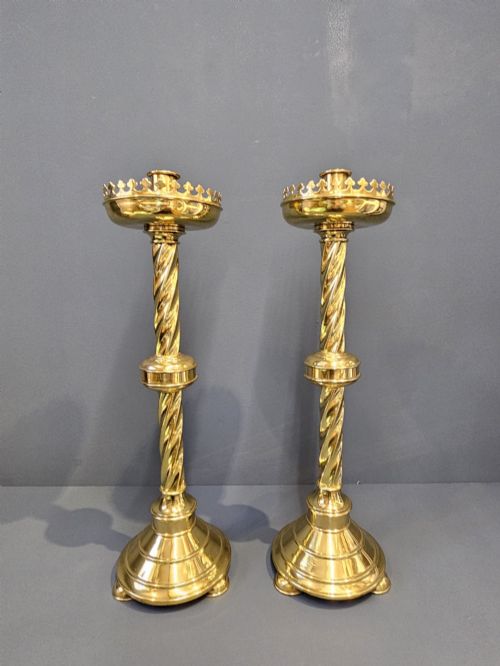
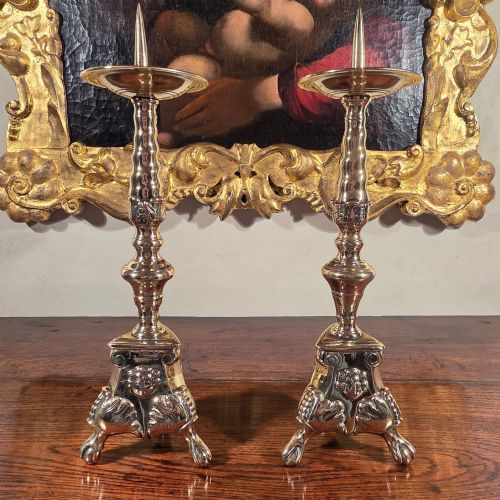


Brass Church Pricket Candlesticks
Brass church pricket candlesticks are striking altar fittings that bring ecclesiastical drama and architectural height to any room.
Brass Church Pricket Candlesticks
Brass church pricket candlesticks are substantial ecclesiastical candle holders featuring a central spike, known as a pricket, to secure large candles rather than a standard socket. When searching for brass church pricket candlesticks, buyers encounter a diverse selection ranging from Victorian Gothic Revival interpretations to earlier 17th century styles and Amsterdam School designs.
The pieces available span multiple centuries, including 18th century examples, Edwardian gilt-brass pieces, and robust floor-standing candle holders. Most items appear in pairs or sets of four, heavily influenced by Gothic ornamentation or straightforward structural iron and brass combinations.
How they were made
Makers utilised cast brass, bronze, and wrought iron to construct these heavy ecclesiastical items. Many incorporate gilt-brass or gilt metal finishes alongside components of wood or glass.
The construction relies on sturdy casting and joining techniques to support the considerable height and weight required for altar service. Ornate detailing is achieved through moulded metalwork and decorative turning.
Brass Church Pricket Candlesticks Retail Price Guide 2026
Typical asking prices for brass church pricket candlesticks among the pieces listed under this phrase on Sellingantiques today, from the lower quarter to the upper quarter. They describe what is for sale here now, not the wider market.
Listings span from the 17th century through to the 20th century, incorporating materials like cast brass, bronze, wrought iron, and wood.
What varies in quality
The distinction between ordinary and superior pieces rests on the weight of the metal and the crispness of the cast ornament. Heavier, more substantial castings command greater presence and demonstrate superior foundry work.
Design complexity also defines the range, moving from plain utilitarian forms to highly ornate Victorian Gothic Revival or Amsterdam School variations. Original patination and completeness of the pricket mechanism further distinguish the finer examples.
The Brass Church Pricket Candlesticks Glossary
- Pricket
- A sharp metal spike projecting upwards from the centre of the drip pan to hold a candle in place. This method predates the common socket candlestick.
- Gothic Revival
- An architectural and decorative style popular during the 19th century that revived medieval forms, pointed arches, and ecclesiastical motifs. It heavily influences many Victorian candlesticks.
- Amsterdam School
- An architectural and design movement from the early 20th century characterised by expressive forms and combinations of materials like brass and iron. Pieces from this tradition show distinct modernist departures from strict historical revivals.
- Altar
- A consecrated table used for religious rites, upon which these large candlesticks originally stood. Floor-standing variants were positioned directly on the sanctuary floor.
Brass Church Pricket Candlesticks: Frequently Asked Questions
What is a pricket candlestick?
A pricket candlestick uses a sharp metal spike at the top to impale and secure a large candle, rather than holding it inside a socket.
This traditional design was standard for altars and churches, where thick candles provided illumination during long services.
How do I date these candlesticks?
Dating relies on examining the casting methods, metal composition, and decorative style, such as Gothic Revival motifs or Amsterdam School characteristics.
Victorian and Edwardian pieces often display heavier machine-assisted casting, while 17th or 18th century examples show more hand-finished irregularities.
Where were they originally used?
These pieces served liturgical functions on church altars or stood upon the floor of sanctuaries to provide ceremonial light.
Their substantial height and heavy construction were specifically engineered for visibility in large ecclesiastical spaces.
How do I clean antique brass?
Most collectors prefer to leave a natural, aged patination on antique brass rather than polishing it to a bright shine.
Gentle dusting with a soft cloth is usually sufficient to maintain the surface without removing historical character.