


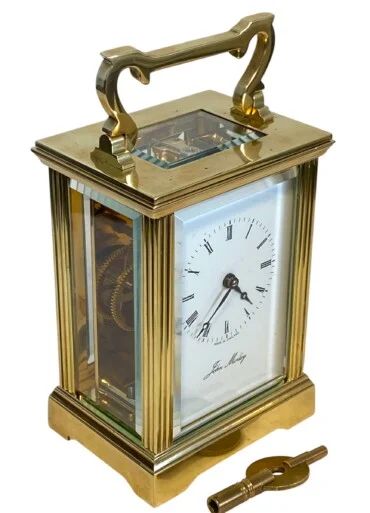


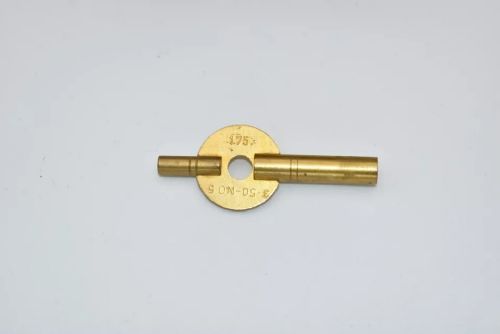
Brass Carriage Clock Key
A brass carriage clock key is the small winding tool needed to keep a portable timepiece running, typically formed in brass or gilt metal.
Brass Carriage Clock Key
When you search for a brass carriage clock key, you are looking at the winding tools and replacement parts associated with portable timepieces from the nineteenth and twentieth centuries. These small implements accompany carriage clocks and mantel clocks dating from periods such as the Victorian era and the mid-twentieth century.
The pieces you are most likely to meet on this page include examples in brass, gilt brass, and gilt bronze, often linked to French and English makers. They serve both functional winding purposes and act as collector accessories alongside items featuring enamel dials and glass panels.
The inventory spans diverse stylistic revivals, including Neoclassical and Georgian, reflecting the broader scope of clock accessories preserved alongside movements by makers such as John Morley, Drocourt, Duverdrey & Bloquel, and Bernard Freres.
How they were made
The materials recorded in the evidence centre on brass, gilt brass, and gilt bronze, occasionally accompanied by leather cases and glass components. These metals provided the necessary rigidity and durability for winding mechanical spring-driven clock movements.
Techniques relied on metalworking methods common to nineteenth-century and twentieth-century workshops, producing both simple utilitarian winders and ornate, engraved components designed to match high-grade carriage clocks.
Listings feature items from the Victorian period, Edwardian era, and the mid-twentieth century, constructed in brass, gilt bronze, and glass.
What varies in quality
Quality in these accessories relates to the precision of the metalwork, the finish of the gilt surface, and whether a piece matches the specific period style of the clock it winds. Finer examples display crisp engraving and heavier metal gauge consistent with high-end nineteenth-century French and English production.
Simpler, later twentieth-century iterations contrast with earlier Victorian or Edwardian pieces through plainer finishing and simpler manufacturing methods, aligning with the broader manufacturing standards of their respective decades.
John Morley·Drocourt·Duverdrey & Bloquel·Bernard Freres·Asprey
The Brass Carriage Clock Key Glossary
- Carriage clock
- A small, portable spring-driven timepiece originally designed for travel during the nineteenth century. These clocks typically feature brass and glass cases enclosing eight-day movements.
- Gilt brass
- Brass coated with a thin layer of gold or a gold-coloured alloy to improve appearance and resist tarnishing. This finish appears frequently on nineteenth-century clock cases and associated keys.
- Grand sonnerie
- A complex clock striking mechanism that chimes the hours and quarters automatically on the hour. Pieces with this complication represent advanced horological work.
- Platform escapement
- The miniature regulating assembly visible through the top glass of many carriage clocks. It replaced the traditional pendulum to allow portable timekeeping.
- Repeating movement
- A mechanism that repeats the last hour and quarter-hour strikes when a button or lever is pressed. This feature is often found on higher-quality nineteenth-century examples.
Brass Carriage Clock Key: Frequently Asked Questions
What is a carriage clock key used for?
A carriage clock key is used to wind the mainsprings of mechanical timepieces, powering both the timekeeping train and any additional complications such as alarm or striking functions.
These tools fit onto the square arbors projecting from the movement plates or the base of the clock.
How do I know the correct size?
Determining the correct size requires measuring the dimension of the winding square on the clock movement. Keys must match this internal gauge precisely to engage the arbor without slipping.
Materials such as solid brass and gilt bronze provide the structural strength needed for regular winding.
Are original keys important?
Original keys associated with specific makers or fitted cases add historical completeness to a clock. Collectors value pieces that retain their period accessories.
Matching the material, such as gilt brass or bronze, helps maintain historical consistency with the clock.