
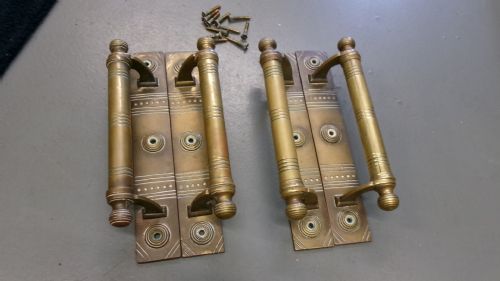


Brass Backplate Handles
These brass backplate handles are dependable period ironmongery that ground a door or drawer with solid weight.
Brass Backplate Handles
Brass backplate handles encompass a focused range of functional door and drawer hardware designed to operate with a distinct period character. When you search for brass backplate handles, you encounter functional items built to handle daily use while maintaining decorative appeal. The pieces you meet on this page span Victorian, Regency, Edwardian, and Arts and Crafts periods, alongside later 1930s examples.
Victorian and Regency examples dominate the selection, bringing crisp oval profiles and centre door knob designs. Art Nouveau and Arts and Crafts variants introduce bolder linear motifs and bronze casting. Each piece reflects the functional requirements of its era, whether fitted to a heavy entrance door or a refined walnut chest on stand.
Methods of construction
Makers produced these fittings using traditional metalworking techniques, combining cast brass and bronze with turned timber and glass elements. Cast brass forms the backbone of the backplates and handles, offering durability and a smooth surface that takes patination well. Bronze appears in several Arts and Crafts and Regency pieces, providing a darker, richer tone than standard brass.
Makers paired the metal components with contrasting materials like ebony wood, oak, burr walnut, and amber glass. Turning wood for knobs and centring glass inserts required careful lathe work to ensure a flush fit against the metal collars. Simple screw fixings through the backplate secured the entire assembly to the timber substrate.
A Victorian amber glass door knob catches the hallway light just enough to make finding the keyhole an aesthetic experience.
Evaluating the standard
Quality rests in the crispness of the casting and the density of the chosen material. Superior handles show sharp detail in the backplate moulding without soft edges or surface pitting from poor foundry work. Heavy gauge brass and bronze resist bending under daily pressure, whereas lighter alternatives flex during use.
The integration of mixed materials reveals the maker's hand. Well-fitted wooden grips or securely seated amber glass inserts remain firm within their metal mounts over decades of turning. Substantial fixing plates and clean screw countersinking distinguish better workshop output from utility hardware.
The Brass Backplate Handles Glossary
- Centre door knob
- A stationary handle placed in the middle of a front door rather than near the edge. It serves for pulling the door closed rather than operating a latch.
- Door hardware
- The collective term for operational metal fixtures fitted to doors, including handles, knobs, backplates, and pulls. It unites security and function.
- Art Nouveau
- A design style spanning the late nineteenth and early twentieth centuries characterised by flowing, organic lines and plant-inspired asymmetry. It appears here in bronze door handles.
Brass Backplate Handles: Frequently Asked Questions
How do I clean antique brass?
Wash the metal gently with warm soapy water and a soft cloth to remove surface dirt. Avoid harsh commercial polishes that strip away historical patina and wear down the raised details of the casting.
Dry the piece thoroughly with a lint-free cloth after washing. Leaving moisture on brass causes spotting and encourages unwanted corrosion.
Can I use these on modern doors?
Many of these handles fit standard modern door thicknesses and spindle sizes with straightforward installation. Check the spindle dimensions and backplate fixings against your door setup before fitting.
Keep in mind that older hardware may require minor adjustments to existing bore holes. A careful measurement ensures the backplate covers any previous latch marks.
What is the difference between brass and bronze?
Brass is an alloy of copper and zinc, yielding a bright yellow metallic tone that mellows with age. Bronze is an alloy of copper and tin, producing a deeper, warmer brown colour with greater natural strength.
Both metals were used across different periods for durability. Bronze pieces often command attention for their darker patination and heavier weight.
How do I identify a Regency handle?
Regency hardware typically displays restrained classical proportions with smooth oval profiles and clean geometric lines. The brass work is often bright and precise, reflecting early nineteenth-century taste.
Look for paired oval door knobs and simple rectangular or oval backplates. These details align with the architectural style of the Regency period.