
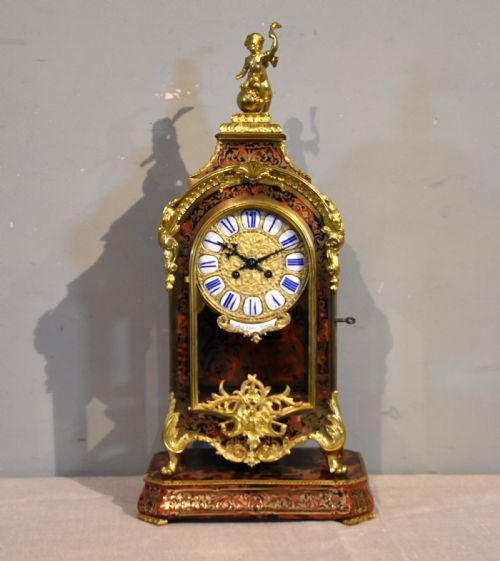


Boulle Work Table
A boulle work table brings French marquetry of brass and tortoiseshell directly into a room, offering grand historic presence and striking surface detail.
Boulle Work Table
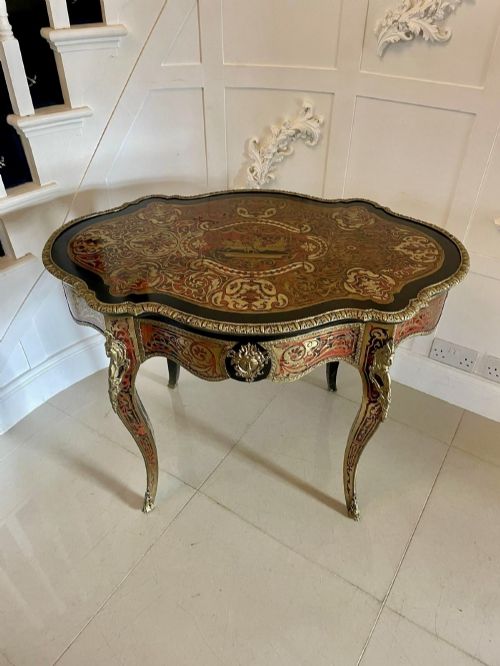
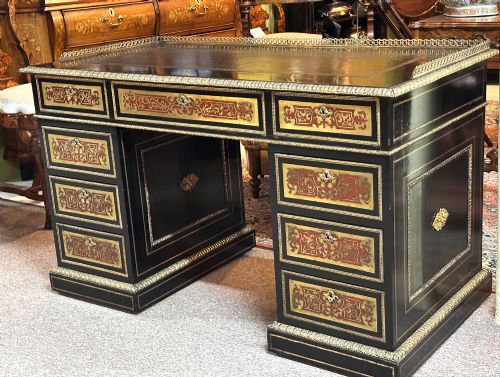
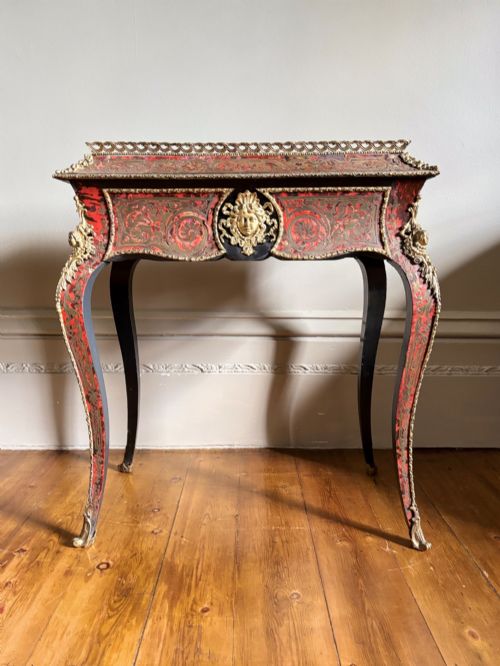
A boulle work table is a piece of furniture decorated with intricate marquetry formed from brass and tortoiseshell, predominantly appearing from the nineteenth century in various French revival styles. Buyers searching this phrase encounter centre tables, side tables, desks, and smaller occasional pieces that showcase this distinctive technique.
The pieces on this page span the nineteenth century, including specific dates such as eighteen eighty and eighteen sixty, alongside Victorian eras and Napoleon III aesthetics. Centre tables and writing desks emerge as the most frequent forms, often combining ebonised wood with ornate metal mounts.
Many examples draw heavily upon Louis XV and Louis XVI revivals, adopting curved cabriole legs or restrained neoclassical lines. Alongside traditional tortoiseshell and brass, variations include green finishes, black lacquer Chinoiserie interpretations, and scarlet red tortoiseshell.
How they were made
The distinctive marquetry relies on precise sawing where sheets of brass and tortoiseshell are glued together and cut simultaneously to create matching positive and negative motifs known as premier-partie and contre-partie. Craftsmen then mounted these delicate panels onto timber carcases, frequently utilising ebonised wood to frame the glowing metallic patterns.
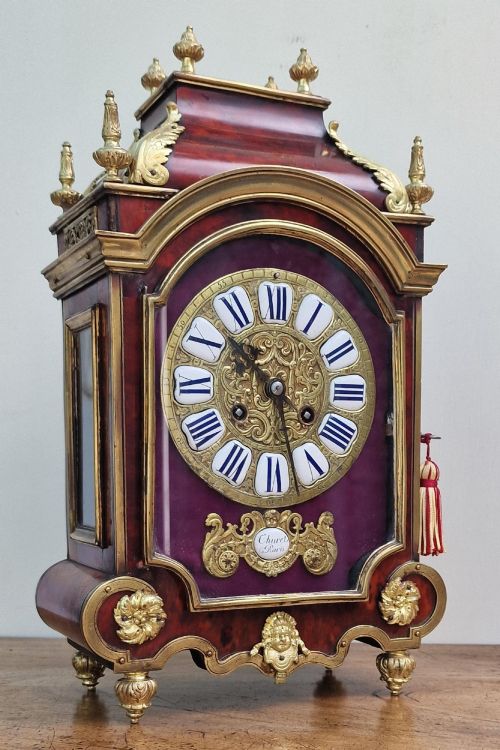
Ormolu and gilt bronze mounts protect vulnerable edges and accentuate the structural curves of the furniture, fixed securely with small pins or screws. Artisans polished the assembled surfaces to a high gloss, ensuring the contrast between the dark shell and the bright metal caught the candlelight effectively.
Tortoiseshell veneer was sometimes backed with coloured foil to make the translucent shell gleam like amber under candlelight.
What varies in quality
The distinction between ordinary and exceptional pieces lies in the precision of the brass cutting and the depth of the engraving within the metal elements. Finer examples display hair-thin joints between the shell and the brass, whereas lesser pieces show wider filler lines where the materials have shrunk or drifted apart over time.
The quality of the underlying carcase wood and the crispness of the gilt bronze mounts dictate the overall success of the piece. Heavy, solid timber construction combined with lively, hand-chased ormolu elevates an object far above standard mass-produced nineteenth-century workshop output.
Thuret Paris·Maison Millet·Payne London
The Boulle Work Table Glossary
- Boulle work
- A style of marquetry using brass and tortoiseshell, named after André-Charles Boulle, cabinetmaker to Louis XIV. This technique creates a rich, contrasting surface pattern popular in nineteenth-century French furniture.
- Ormolu
- Gilded bronze used for decorative mounts and feet on furniture and clocks. It provides a bright metallic accent that frames the intricate marquetry panels.
- Ebonised wood
- Timber treated to resemble ebony, usually through staining or painting. It creates a dark, uniform background that makes the brass and tortoiseshell inlay stand out sharply.
- Centre table
- A freestanding table designed to be viewed from all sides rather than pushed against a wall. These often feature elaborate marquetry across the entire top surface.
- Napoleon III
- A nineteenth-century French design period characterised by lavish revivals of earlier royal styles. It heavily embraces eclectic ornamentation, including extensive boulle work and gilt mounts.
Boulle Work Table: Frequently Asked Questions
Where should I place a boulle work table?
These tables suit prominent positions where their reflective surfaces catch natural light, such as the centre of a reception room or an entrance hall. They function well as standalone decorative statements.
Keep them away from direct sunlight and strong heat sources to protect the delicate tortoiseshell and wood from drying out and warping.
How do I care for tortoiseshell and brass inlay?
Dust the surface regularly with a soft, dry cloth to prevent grit from scratching the polished shell and metal. Avoid chemical sprays and harsh cleaning agents entirely.
Apply a microcrystalline wax occasionally to nourish the wood and protect the metal from tarnishing, buffing it gently with a clean cloth.
How do I tell a nineteenth-century piece from a later copy?
Examine the construction methods underneath and inside the drawers, looking for hand-cut joints, timber shrinkage, and older secondary woods. Nineteenth-century pieces often show natural signs of age in the brass oxidation and the patina of the tortoiseshell.
Check the quality of the engraving on the brass elements, as modern reproductions frequently lack the sharp, hand-tooled lines found on period work.