



Bone China Tea Service
A bone china tea service brings set proportions and painted surfaces to the table, uniting cups, saucers and teapots in matching ceramic.
Bone China Tea Service
When you search for a bone china tea service, you are looking at matched sets designed for serving tea, often comprising cups, saucers and sugar bowls alongside teapots. These groupings survive from the Georgian, Victorian and Edwardian eras, through to the Art Deco period.
The most common versions on this page span the nineteenth and early twentieth centuries, reflecting changing domestic habits around afternoon tea and large gatherings. Sets range from small solitaire groupings to complete services intended for ten or more guests.
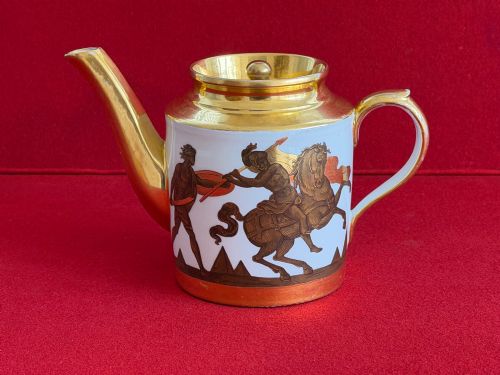
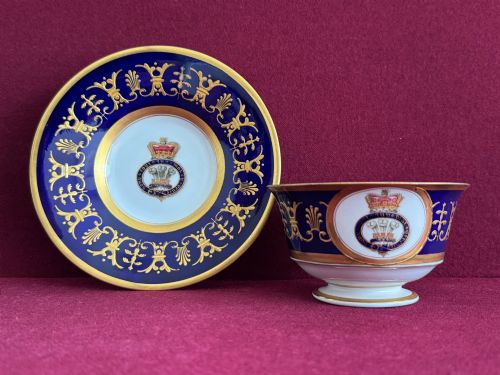
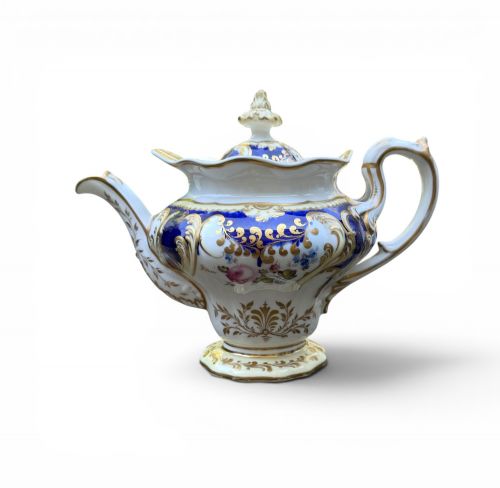
Makers from Staffordshire and beyond produced these wares using porcelain and bone china, frequently applying hand-painted motifs and gilt accents. The forms vary from rococo revival shapes to clean twentieth-century lines.
Materials and technique
Potteries manufactured these pieces using bone china and porcelain bodies, which provided a fine, bright white base for decoration. Potters shaped the vessels on wheels or in moulds before firing them in kilns.
Decorators applied enamel colours by hand, often incorporating gold leaf, gilt and gilding to highlight handles, rims and panels. Protective glaze sealed the painted surfaces during a final firing.
Bone China Tea Service Retail Price Guide 2026
Typical asking prices for bone china tea service among the pieces listed under this phrase on Sellingantiques today, from the lower quarter to the upper quarter. They describe what is for sale here now, not the wider market.
A tiny solitaire set lets one person drink tea in solitary splendour.
What varies in quality
The standard of a set rests upon the precision of the modelling and the crispness of the hand-painted details. Early pieces show careful brushwork in patterns like Imari or Kakiemon, while mass production later brought printed outlines filled with flat colour.
The preservation of the gilding and enamel decoration dictates how well a service has survived decades of use. Uniformity across every cup and saucer in a large service distinguishes ambitious studio output from simpler commercial output.
Royal Doulton·Royal Crown Derby·Coalport·Hicks, Meigh And Johnson·Royal Davenport·Shelley·Royal Albert Crown China·Doric China·Ridgway·Minton·Royal Worcester·Wileman Foley Shelley·Sutherland·Gladstone Potteries
The Bone China Tea Service Glossary
- Bone china
- A type of porcelain containing bone ash, known for its strength and translucent finish. It allows for thinner walls than standard earthenware.
- Gilt
- A thin layer of gold applied to the ceramic surface for decoration. It is often found highlighting handles, spouts and rims.
- Sucrier
- A covered container designed to hold sugar as part of a matching tea or coffee service. These vessels usually mirror the shape of the teapot.
- Imari
- A decorative style featuring rich blues and iron red with gold detailing, originating in Japan and copied by European potteries. Victorian versions adopted these bold palettes on tea wares.
- Glaze
- A glassy coating fused to the ceramic body during firing to seal the porous clay. It gives the tea service its smooth, glossy finish.
Bone China Tea Service: Frequently Asked Questions
How many pieces make up a standard service?
Services vary widely in size depending on their original intended use, ranging from small miniature solitaire sets to twenty-piece settings for multiple guests.
Individual listings record everything from three-piece settings to large dinner and tea combinations for ten people.
What is the difference between porcelain and bone china?
Bone china incorporates bone ash into the ceramic paste, creating a lighter, more translucent body than traditional hard-paste porcelain.
Both materials accept hand-painted enamel and gilt decoration successfully, though bone china became the dominant medium for British tea wares.
How do I identify the period of a set?
Dating relies on stylistic clues such as rococo curves from the nineteenth century or geometric Art Deco forms from the interwar years.
Potters often used specific pattern numbers and body shapes that correspond to documented eras like the Georgian or Edwardian periods.
Can these tea services be used daily?
While these ceramics were built for functional use, their age and delicate enamel or gilt decoration mean many owners prefer display or careful handling.
Hand washing preserves the painted surfaces and gold leaf far better than mechanical dishwashing.