
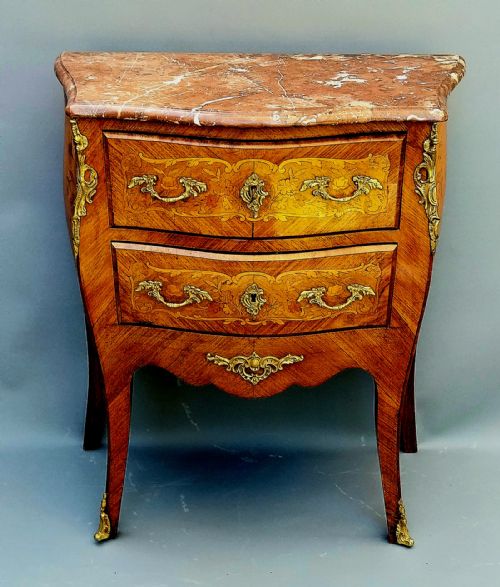


Bombe Bedside Cabinets
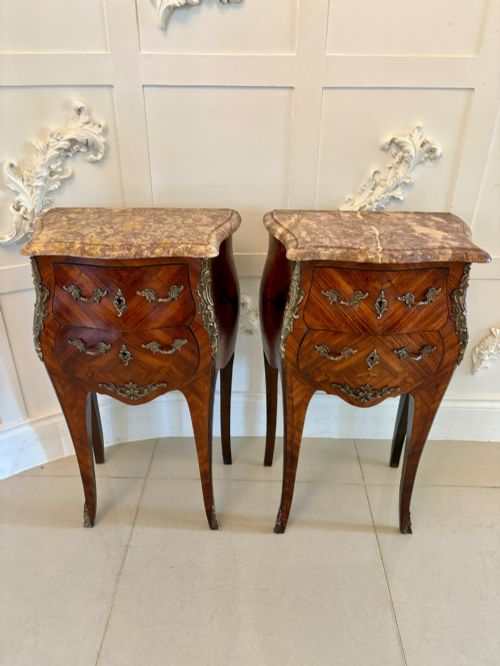
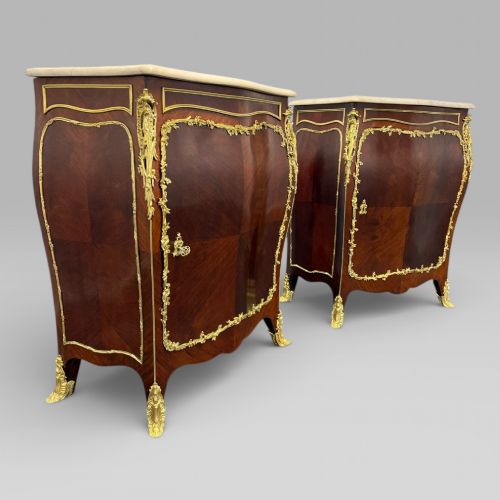
These bombe bedside cabinets are curved, swelling pieces of antique bedroom furniture that bring Continental elegance to a room.
Bombe Bedside Cabinets
When searching for bombe bedside cabinets, buyers encounter swelling, convex forms rooted in eighteenth-century Continental designs. The listings on this page show these pieces appearing primarily as bedside tables, commodes, and side cabinets originating from the nineteenth and early twentieth centuries.
The prevalent styles seen here draw heavily from French Rococo Revival and Louis XV traditions, often featuring pairs designed to flank a bed. Alongside dedicated bedside cabinets, the record includes larger bedroom suites and individual chests of drawers sharing the same characteristic rounded profile.
How they were made
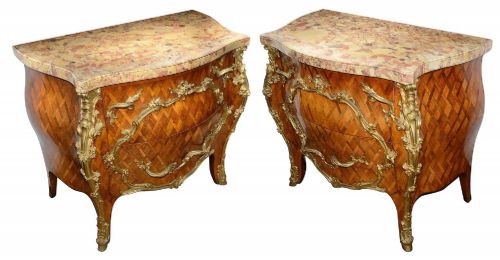
Cabinetmakers constructed these pieces using dense timber carcases overlaid with decorative veneers such as kingwood, walnut, burr walnut, rosewood, and tulipwood, frequently arranged in parquetry or marquetry patterns. The distinctive bulging shape required skilled shaping of the wood rather than straight joinery.
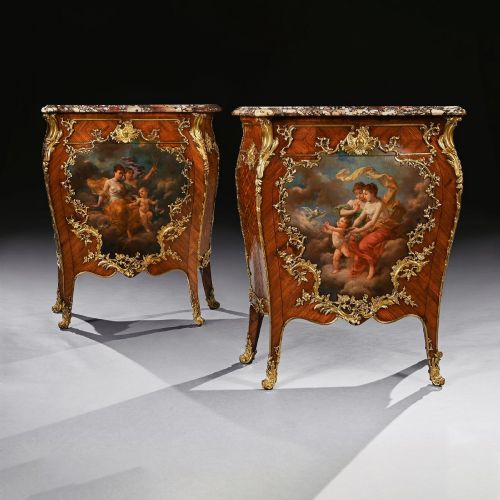
Finished examples incorporate cast or chased ormolu and gilt bronze mounts to accent the corners and handles. Many pieces also feature fitted marble tops cut to follow the undulating contours of the wooden structure below.
The listings on this site show periods ranging from the early nineteenth century through the nineteen-thirties, with a strong concentration of nineteenth-century examples.
What varies in quality
The distinction between standard and superior pieces rests upon the precision of the veneer work and the crispness of the cast mounts. Finer cabinets display continuous, matched wood grains across the swelling drawer fronts alongside heavily chased ormolu rather than plain cast brass.
Structural integrity and the quality of the marble top further divide the range. Superior examples maintain tight joints along curved surfaces and utilise heavy, thick marble slabs shaped exactly to the carcase.
E. Kahn
The Bombe Bedside Cabinets Glossary
- Bombe
- A French term describing furniture with outward-swelling, convex sides and fronts. This curved profile requires complex carpentry to execute successfully.
- Ormolu
- Gilded bronze used for decorative mounts and feet on nineteenth-century furniture. The technique involves applying a gold amalgam to a bronze base.
- Marquetry
- Inlays of different woods arranged in pictorial or geometric patterns across the surface of the carcase. This technique showcases the maker's skill with contrasting veneers.
- Parquetry
- Geometric wood inlay patterns such as lozenges or squares applied to furniture surfaces. It differs from marquetry by sticking strictly to repeating geometric motifs.
- Vernis Martin
- A type of simulated Japanese lacquer developed in France during the eighteenth century. It employs multiple layers of varnish to create a glossy, decorative finish.
Bombe Bedside Cabinets: Frequently Asked Questions
What is a bombe bedside cabinet?
A bombe bedside cabinet is a small, curved storage piece with swelling sides inspired by Continental design traditions. These cabinets provide functional surface space while introducing distinctive ornamental curves to a bedroom.
Most examples found in this category date from the nineteenth or early twentieth centuries and pair well with traditional or eclectic interiors.
How do I spot Louis XV style?
Louis XV style furniture is characterised by asymmetrical curves, naturalistic ornamentation, and sweeping cabriole legs. In these listings, the style manifests through the characteristic bulging profile and decorative ormolu mounts.
Cabinetmakers working in revival periods during the nineteenth century adopted these distinct design signatures.
Are these cabinets usually found in pairs?
Many of the listings on this page comprise matched pairs intended to sit on either side of a bed. Single cabinets also appear frequently as standalone accent pieces.
Matching pairs often command higher interest among collectors looking to balance a bedroom layout symmetrically.
What woods were used for these cabinets?
Cabinetmakers utilised a variety of decorative hardwoods over solid carcases, including kingwood, walnut, burr walnut, rosewood, and tulipwood. These timbers were selected for their rich grain patterns and suitability for veneering.
Surfaces were frequently enhanced with contrasting parquetry or detailed marquetry inlay.