
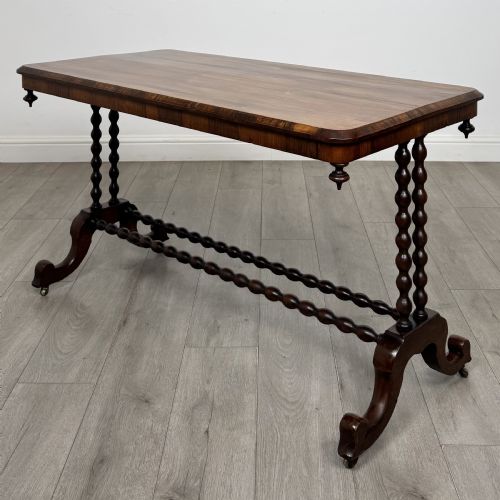
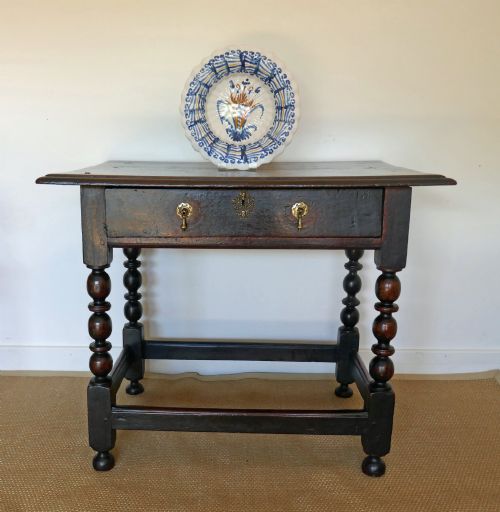
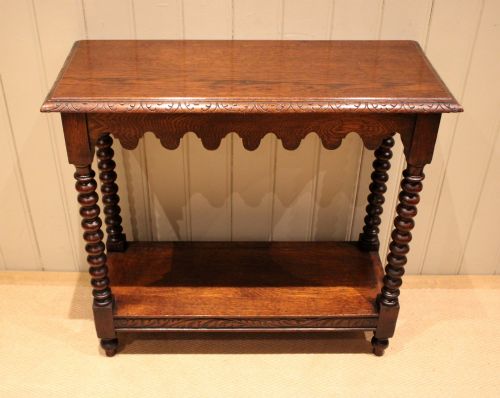
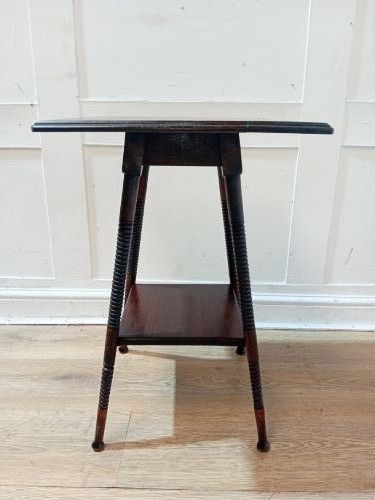
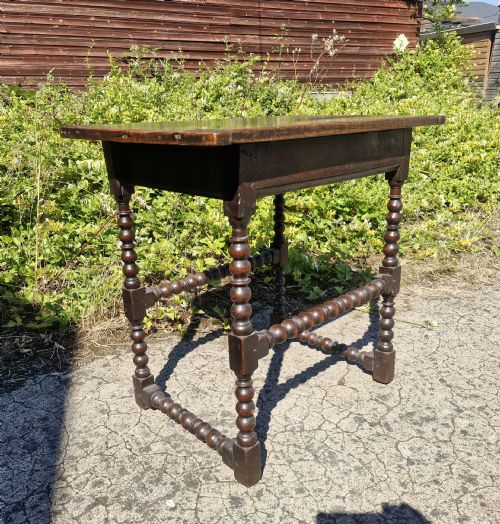
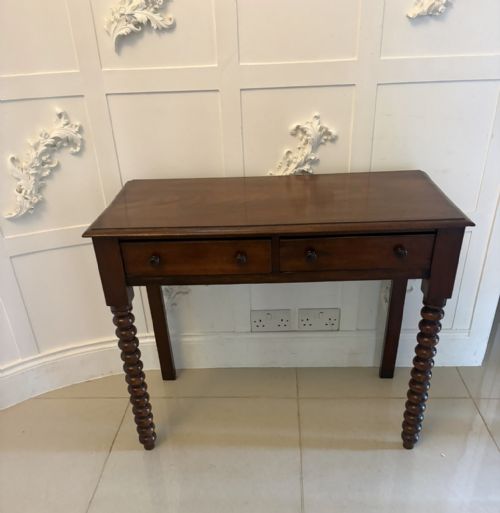


Bobbin Leg Hall Table
These bobbin leg hall table examples bring historic turned woodwork into modern entrances, offering practical surfaces defined by distinctive spool-turned supports.
Bobbin Leg Hall Table
A bobbin leg hall table provides a narrow surface suited for narrow corridors, landings and entrance spaces. These pieces function primarily as side tables, console tables and lamp tables within domestic interiors.
The selection ranges from seventeenth-century oak examples to nineteenth-century revival interpretations and Victorian pieces. Buyers encounter various forms including side tables with drawers and simpler country house variants.
Originating largely from British and English vernacular traditions, these tables also appear in French provincial and later Arts and Crafts iterations. Oak remains the predominant timber, accompanied by mahogany, cherry, yew and ebonised wood.
How they were made
Makers constructed these tables predominantly from solid oak, mahogany, cherry and yew wood, often combining primary timbers with secondary woods like elm for drawer linings. Timber selection dictated the structural stability and weight of the frame.
The defining bobbin or spool turning was executed on a lathe, shaping cylindrical wooden shafts into repetitive globular or disc-like profiles. Joinery typically involved traditional mortise and tenon joints secured by wooden pegs.
Turners once spent hours reproducing symmetrical spool shapes by eye, ensuring no two bobbins matched with robotic precision.
What varies in quality
The crispness and uniformity of the lathe-turned bobbin legs distinguish finer examples from simpler provincial work. Precision in the spool profiles demonstrates the skill of the original turner.
Timber selection and surface patination heavily influence the character of each piece. Tables retaining uncompromised grain structures and deep natural colour demonstrate superior material quality.
Liberty of London·William Birch
The Bobbin Leg Hall Table Glossary
- Bobbin turning
- A form of lathe-turned decoration consisting of a series of rounded, spool-shaped segments resembling bobbins of thread. This technique gained prominence in seventeenth-century furniture design.
- Console table
- A table designed to stand against a wall, frequently supported by brackets or legs at the front. These pieces serve narrow entranceways and reception rooms.
- Patina
- The surface sheen and colour developed on wood over decades of handling, exposure to light and waxing. It indicates age and depth of finish.
- Mortise and tenon
- A traditional woodworking joint where a projecting tongue fits snugly into a corresponding cavity. This method provides robust frame construction without modern fasteners.
Bobbin Leg Hall Table: Frequently Asked Questions
Where should I place a bobbin leg hall table?
These narrow tables suit entrance halls, narrow corridors and landings where floor space is limited. Their shallow depth allows them to sit flush against walls without obstructing movement.
They also function effectively as side tables or lamp tables in living rooms, providing a surface for lighting and small decorative objects.
How do I care for an antique oak hall table?
Maintain the timber by applying traditional beeswax periodically to nourish the wood and preserve the surface finish. Avoid placing the table near direct heat sources or in strong sunlight.
Dust regularly with a soft, dry cloth rather than using silicone-based sprays. This protects the historic patination accumulated over centuries.
Are these tables sturdy enough for daily use?
Solid timber construction and traditional joinery give these tables inherent structural stability for everyday placement. Their primary function involves supporting lamps, mail and small decorative items rather than heavy loads.
Checking that the frame remains tight and the turned legs are secure ensures reliable performance in busy hallways.
How can I tell a seventeenth-century table from a later revival?
Early pieces display hand-tooled joinery marks, distinct timber shrinkage patterns and deep period patination. Tool marks left by early saws and adzes differ significantly from later mechanical manufacturing.
Revival pieces from the nineteenth century often utilise harder, more uniform machinery-cut timbers and cleaner internal construction methods.