




Blue Topaz Necklace
A blue topaz necklace brings together crisp ice-blue stones and warm gold settings, offering a striking flash of colour against the collarbone.
Blue Topaz Necklace
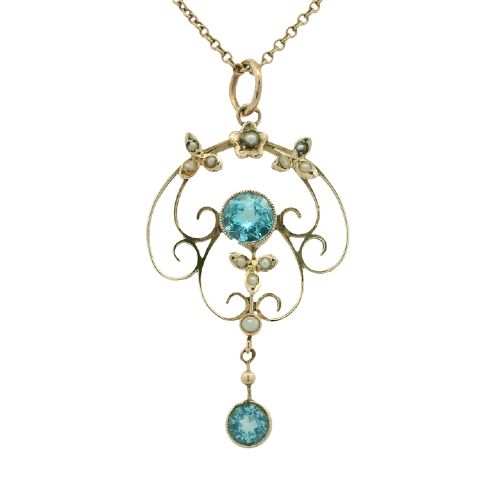
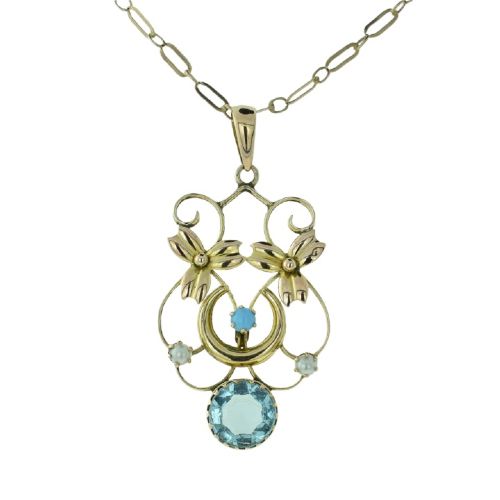
When searching for a blue topaz necklace, a buyer encounters pieces ranging from delicate Victorian pearl clusters to bold mid-century modernist designs. The stones appear in various cuts including round, pear, emerald and trillion shapes, often paired with diamond accents or contrasting gemstones like turquoise and amethyst.
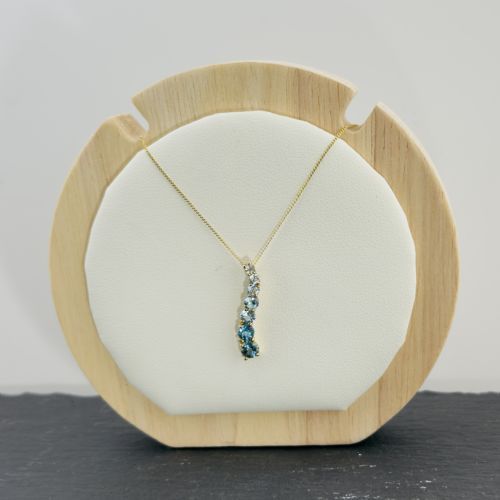
The most common examples on this page are mounted in nine-carat yellow, white or rose gold, alongside sterling silver settings. Pendants take forms such as simple solitaires, halo clusters and crosses, suspended from fine matching chains.
Materials and construction methods
Goldsmiths set natural blue topaz alongside diamonds, seed pearls and aquamarines into precious metal mountings using traditional prong, bezel and cluster techniques. Chains and pendants are fabricated from sterling silver, platinum and nine-carat or ten-carat gold.
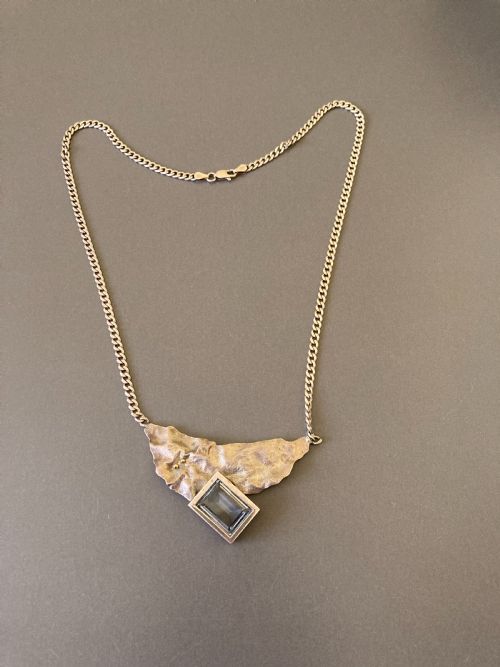
Early twentieth-century pieces utilise delicate openwork wire frames and millegrain edges, whilst later twentieth-century items favour cleaner cast gold profiles and structured wave motifs.
One cheerful cross pendant mixes blue topaz with citrine, garnet, peridot and amethyst in a colourful multi-gem arrangement.
Distinguishing quality in craftsmanship
Quality rests upon the depth of stone saturation, the precision of faceting and the structural integrity of the precious metal setting. Finer examples display clean gemstone clarity coupled with robust claw work that secures each stone firmly.
Pendants showing superior execution integrate secondary stones such as diamonds with balanced symmetry, whilst simpler mass-produced mounts rely on plain bezels and lighter gauge gold chains.
C'est Laudier
The Blue Topaz Necklace Glossary
- Solitaire
- A single gemstone mounted alone on a pendant or ring. This setting focuses attention entirely upon the cut and colour of the central blue topaz.
- Halo
- A ring of smaller diamonds or stones encircling a larger central gem. This setting maximises overall brilliance and presence at the centre of the necklace.
- Millegrain
- A decorative technique featuring tiny raised metal beads along the edges of a setting. It creates a soft texture typical of Edwardian and art deco jewellery.
- Trillion
- A triangular gemstone cut with curved or straight sides and numerous facets. This modern geometric shape creates bright flashes of light across the blue topaz.
- Cluster
- A tight arrangement of multiple gemstones grouped closely together. In these necklaces, blue topaz is frequently surrounded by pearls, diamonds or contrasting coloured stones.
Blue Topaz Necklace: Frequently Asked Questions
What periods do these necklaces span?
The pieces available range from Victorian and Edwardian examples through to art deco, mid-century modernist and 1960s designs.
Each era brings distinct mounting styles, moving from delicate seed pearl clusters to bold geometric gold work.
Are the chains original to the pendants?
Many antique and vintage pendants retain compatible chains from their period of manufacture, whilst others are paired with later matching metal chains.
Buyers should examine the suspension bail and clasp for hallmarks that indicate the metal purity of the chain.
How do I care for a blue topaz necklace?
Clean your necklace gently using warm soapy water and a soft brush, avoiding harsh ultrasonic cleaners that might damage softer stones like pearls.
Store the piece flat in a lined jewellery box to prevent the chain from tangling and the topaz from scratching adjacent items.
What gold purities are used in these pieces?
The mountings predominantly utilise nine-carat yellow, white and rose gold, alongside occasional ten-carat gold and sterling silver settings.
These alloys provide the necessary durability to securely hold larger gemstone carat weights without bending during daily wear.