
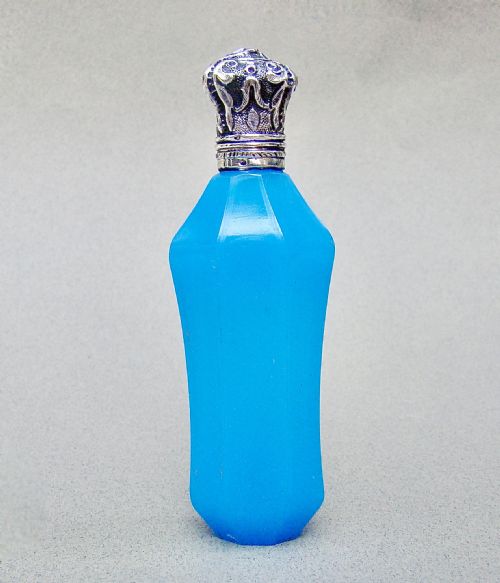


Blue Glass Perfume Flask
A blue glass perfume flask is a portable vessel for scent that brings rich colour and tactile weight to a dressing table.
Blue Glass Perfume Flask
A blue glass perfume flask is a portable vessel designed for holding scent, spanning periods from ancient Roman glass unguentaria to twentieth-century Art Deco creations. Collectors encounter Victorian opaline glass examples alongside French opalescent pieces and mid-century Murano glass.
The material appears in shades from deep teal and turquoise to pale opalescent tones. These pieces take the form of scent bottles and glass vessels, often fitted with silver mounts or enamel stoppers for daily use.
Materials and construction
Makers shaped these flasks from glass, utilising opaline, cut, murrine, and triple overlay techniques. Molten material was blown or moulded, sometimes overlaid with contrasting layers to permit detailed wheel-cutting.
Mounts and closures incorporate sterling silver, silver, and guilloche enamel. Metal collars and hinged caps were fitted securely to the glass necks to hold cork stoppers and prevent evaporation.
Markers of distinction
The standard of a blue glass perfume flask rests on the clarity and depth of the glass body, alongside the precision of any surface cutting or overlay work. Superior examples show crisp facets and harmonious integration between the glass and its metal mounts.
Makers' signatures and identifiable studio attributions elevate certain pieces, particularly within French Art Deco and Murano works. The preservation of original enamel work, stoppers, and silver hallmarks also distinguishes finer specimens.
Rene Lalique·Franchini & Bigaglia·Sabino
The Blue Glass Perfume Flask Glossary
- Opaline glass
- An opaque or translucent glass developed in France during the nineteenth century, often tinted in shades of blue or turquoise. It provides a smooth, porcelain-like surface that absorbs light softly.
- Guilloche enamel
- A decorative technique where a geometric pattern is engine-turned into metal and covered with translucent enamel. It adds depth and fine detail to silver bottle caps and collars.
- Murrine
- A method of producing patterned glass rods by heating and pulling glass bundles, sliced to reveal cross-sectional designs. It appears in nineteenth-century Venetian glasswork.
- Chatelaine scent bottle
- A small flask suspended from a belt hook or chatelaine chain, designed for portable use in the nineteenth century. These pieces usually feature secure screw caps or hinged stoppers.
- Unguentarium
- A small ancient glass vessel used for holding oils or perfumes, typically associated with Roman burials and domestic contexts. Examples date back to the early centuries of the common era.
Blue Glass Perfume Flask: Frequently Asked Questions
How do I date a blue glass perfume flask?
Dating relies on stylistic markers, glass technology, and metal mounts. Victorian pieces often combine opaline glass with heavy sterling silver collars, while Art Deco examples display geometric lines or moulded signatures.
Assay marks and silver hallmarks provide precise years for mounted pieces. Pre-industrial Roman vessels are identified by their characteristic iridescence and archaeological form.
Were these flasks meant to be carried?
Many nineteenth-century examples were designed for chatelaine wear, featuring secure hinged lids or screw caps to prevent leaks while moving. Smaller pocket-sized bottles fitted easily into evening bags.
Larger dressing table bottles remained stationary on trays. Their stoppers were fitted to seal the contents during daily use in the bedchamber.
How should I clean a vintage perfume flask?
Cleaning requires gentle methods to preserve old glass surfaces and delicate silver mounts. Warm water and mild soap suffice for removing interior residue without damaging ancient patinas or enamel.
Harsh chemical dips must be avoided on silver parts to protect hallmarks and coloured glass. Cork stoppers should be kept dry to prevent disintegration.
What is the difference between opaline and opalescent glass?
Opaline glass is an opaque or semi-opaque material with a dense, milky body that diffuses light evenly. It was widely used in Victorian boudoir accessories for its rich colour saturation.
Opalescent glass is semi-transparent and milk-like, scattering light to show milky blue or amber glows at the edges. This effect was favoured by Art Deco glassmakers to create dimensional depth.