
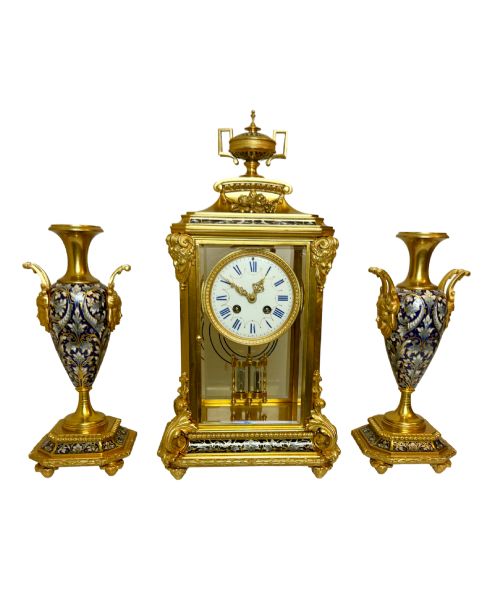


Blue Enamel Table Clock
A blue enamel table clock brings rich colour and precise timekeeping to a desk or mantel, uniting fine metalwork with vibrant glass finishes.
Blue Enamel Table Clock
A blue enamel table clock covers a varied group of timepieces spanning the Victorian, Edwardian, and early twentieth-century periods. These objects range from French carriage clocks and crystal regulators to Arts and Crafts designs and miniature bedside clocks.
The pieces on this page heavily feature French origins alongside English and Swiss examples. Buyers frequently encounter mantel clocks, carriage clocks, and small strut or desk timepieces housed in gilt bronze, ormolu, or pewter.
Stylistic influences span from Napoleon III and Louis XVI revivals to Belle Epoque and Art Deco. The shared characteristic across these diverse forms is the incorporation of blue enamel, whether applied in champleve cells, guilloche patterns, or Delft dials.
How they were made
Maker's workshops cast mounts in bronze, brass, or ormolu, often applying fire gilt or champleve techniques to create recessed channels for enamel. Artisans fused powdered glass to metal surfaces at high temperatures to achieve rich blue tones.
Pewter was utilised in specific Arts and Crafts creations, worked alongside enamel plaques to produce distinct metal textures. Crystal regulators combined heavy glass panels with delicate enamel dial rings to let light pass through the movement.
Listings feature pieces from the 1870s through the 1920s, showing materials from champleve enamel and ormolu to Tudric pewter.
What varies in quality
The refinement of the metal casting and the depth of the enamel separate standard timepieces from exceptional examples. Finer pieces display crisp chasing on gilt bronze mounts and flawless fusing in the enamel panels.
The complexity of the clock movement also determines the standard, with repeating mechanisms and matched garnitures representing higher levels of period craftsmanship.
David Veasey·Liberty and Co·Archibald Knox·Leroy and Fils
The Blue Enamel Table Clock Glossary
- Champleve enamel
- A technique where troughs or cells are hollowed out of a metal surface and filled with vitreous enamel powder before firing. This method creates bold patterns bounded by metal lines.
- Guilloche
- A decorative technique in which a precise, intricate repeating pattern is mechanically engraved into a metal substrate. Translucent blue enamel is then layered over the engraving to catch the light.
- Ormolu
- A method of applying finely ground high-carat gold to an object of bronze through a mercury amalgamation process. It produces a rich, warm metallic lustre popular in nineteenth-century French pieces.
- Crystal regulator
- A mantel clock featuring glass panels on all sides that reveal the internal movement and pendulum. These clocks often incorporate painted or enameled dials.
- Garniture
- A set of matching decorative objects, typically comprising a central clock flanked by two matching side pieces like urns or vases. They were designed to sit on a mantelpiece.
- Strut clock
- A small portable timepiece supported by a hinged prop or stand attached to the rear. They were intended for desks, bedside tables, or travel.
Blue Enamel Table Clock: Frequently Asked Questions
How do I wind an antique clock?
Most antique timepieces use a dedicated key inserted into winding squares on the dial or movement backplate. Turn the key gently until you feel firm resistance, taking care not to overwind the mainspring.
Keep the original key with the clock if possible, as modern replacements can damage the winding squares over time.
Where should I place a table clock?
Position your clock on a stable, level surface away from direct sunlight, draughts, and damp areas. Mantelpieces, desks, and bedside tables provide ideal settings where the decorative enamel and metalwork remain visible.
Ensure the surface does not suffer from heavy vibrations, which can disrupt the delicate balance of the pendulum or escapement.
How do I identify the period?
Examine the stylistic cues, materials, and any marks stamped on the movement backplate or case. Victorian and Edwardian pieces often feature registration numbers or maker signatures, while revival styles point to mid-to-late nineteenth-century French production.
Comparing the font of the numerals and the shape of the hands helps narrow down whether a piece belongs to the Arts and Crafts era or the later Art Deco period.
Can these clocks run accurately?
Many vintage and antique timepieces keep reliable time if they have been recently serviced by a professional horologist. Enamel dials and delicate escapements require careful handling during any mechanical adjustments.
Regular cleaning and oiling prevent the older brass gears from wearing down, ensuring the clock continues to function smoothly for daily use.