

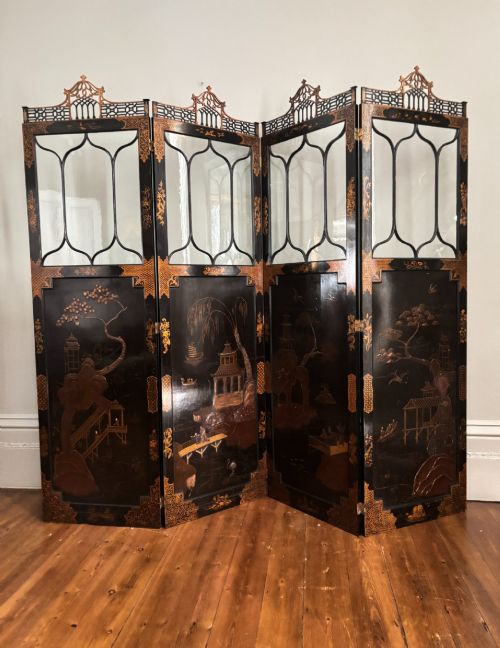
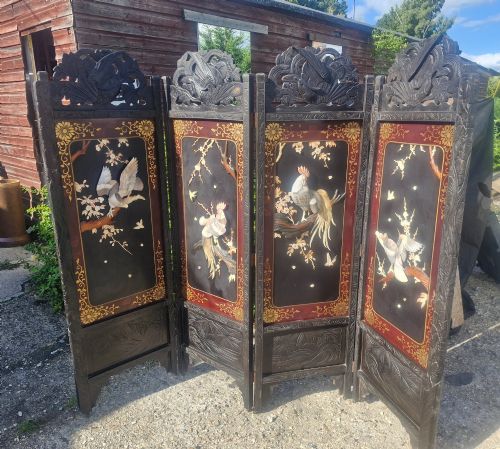


Black Screen Divider
A black screen divider creates instant architectural division, bringing dark lacquer, intricate inlay and dramatic folding panels into a room.
Black Screen Divider
A black screen divider acts as both a functional partition and a decorative focal point within an interior space. These pieces emerge in various forms, from imposing multi-fold room dividers to more intimate dressing screens and compact table screens.
The selection on this page draws heavily from 19th-century and early 20th-century craftsmanship. Buyers frequently encounter folding screens and room dividers featuring distinct oriental influences, Chinoiserie motifs, and occasional Arts & Crafts interpretations.
Origins span across China, Japan, and Burma, alongside British iterations inspired by Eastern design. Whether designated as room dividers, dressing screens, or wall art panels, each piece serves to segment a space or anchor a wall.
Materials and construction
Lacquered wood forms the structural backbone of these pieces, applied in deep black finishes that sometimes incorporate ebonised oak or standard hardwood frames. Craftsmen layered multiple coats of lacquer to achieve a durable, glossy surface suitable for intricate surface decoration.
Surface ornamentation relies on contrasting elements such as gold leaf, painted pigments, and inlaid materials. Artisans utilised carved bone, hardstone mounts, and glass to build raised pictorial scenes across the folding panels.
Brass hinges and hardware join the individual panels together, allowing the screens to articulate smoothly into various configurations. Textile panels also appear occasionally, stretched within wooden frameworks to soften the rigid geometry of the room divider.
Black Screen Divider Retail Price Guide 2026
Typical asking prices for black screen divider among the pieces listed under this phrase on Sellingantiques today, from the lower quarter to the upper quarter. They describe what is for sale here now, not the wider market.
Several panels feature deep carved bone figures that quietly watch the room from their dark lacquer perches.
Assessing quality
The depth and execution of the surface decoration dictate the standing of a piece. Deeply carved lacquer, precise bone inlay, and hand-applied gold leaf represent a higher tier of workmanship than flat painted designs.
Panel count and scale alter the physical presence of the divider, with larger multi-fold configurations requiring sturdier wooden frameworks to prevent warping. The integrity of the foundational lacquer and the smoothness of the brass folding hinges indicate the original standard of manufacture.
The Black Screen Divider Glossary
- Chinoiserie
- European interpretation and imitation of Chinese and East Asian artistic traditions. This style heavily influences the black lacquer and decorative motifs found on many screens.
- Coromandel
- A type of Chinese incised lacquer ware where designs are cut into a dark ground and filled with colours or left natural. It frequently appears on large multi-fold screens.
- Ebonised
- Wood treated to mimic the dense, dark appearance of ebony. This finish surfaces on Arts & Crafts examples.
- Meiji
- A period in Japanese history spanning from 1868 to 1912, known for intricate craftsmanship in folding screens involving lacquer and bone inlay.
- Papier Mâché
- A composite material made of paper pulp and binder, moulded and lacquered for decorative Victorian items like dressing screens.
Black Screen Divider: Frequently Asked Questions
How do I use a room divider at home?
A room divider helps segment open-plan spaces, create private dressing areas, or soften bare corners.
Position the folding panels at slight angles to ensure stability and to catch the light across the lacquered surfaces.
What is the difference between a dressing screen and a room divider?
Dressing screens traditionally functioned as private partitions for changing clothes in bedrooms.
Room dividers tend to be larger multi-fold pieces intended for permanent placement across broader living spaces.
How do I identify a Chinoiserie screen?
Chinoiserie screens feature European-derived interpretations of Chinese landscapes, figures, and architectural motifs.
They typically employ black lacquer grounds highlighted with gold leaf or painted details.
Are these screens suitable for wall mounting?
Certain smaller formats, such as table screens or individual panels, are designed for static display.
Larger multi-fold screens rely on their hinged structure to stand independently rather than hanging flat on a wall.