






Black Marble Pendulum Clock
A black marble pendulum clock brings monumental presence to a mantelpiece, combining heavy stone architecture with the steady tick of a mechanical movement.
Black Marble Pendulum Clock
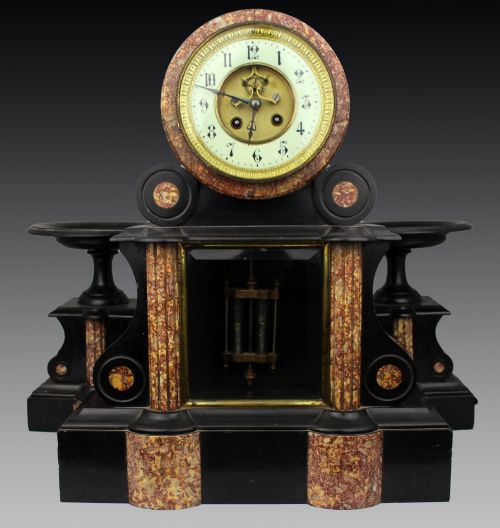
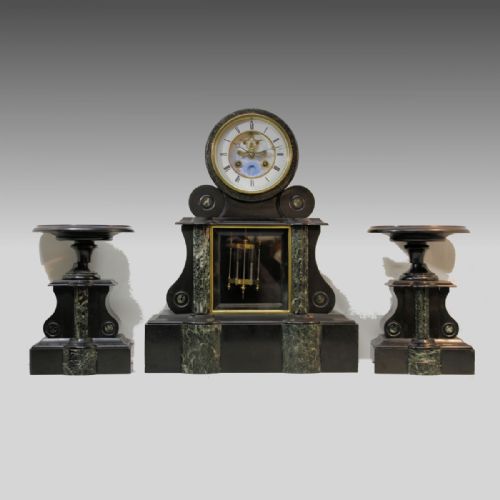
A black marble pendulum clock is a substantial timekeeper typically designed for the mantelpiece or shelf, originating predominantly from the nineteenth century. These clocks frequently appear as part of garniture sets accompanied by matching side ornaments, or as grand standalone architectural forms.
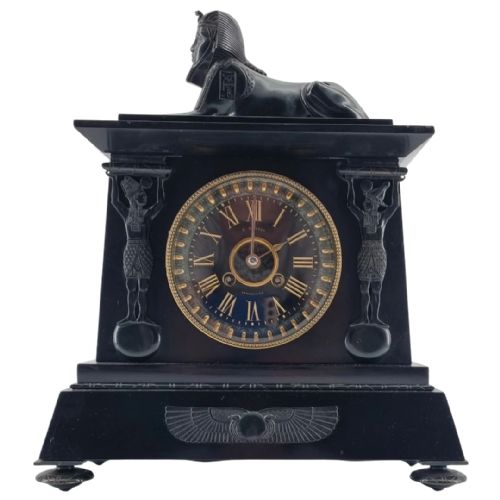
The aesthetic draws heavily on classical revival styles, including French Second Empire, Egyptian Revival, and High Victorian designs. Makers utilised the dense, dark stone to mimic monumental architecture, often incorporating contrasting inlaid marbles or patinated bronze mounts.
Most examples encountered date from the Victorian era and the mid-to-late nineteenth century, reflecting a period of industrial confidence and domestic ostentation. The forms range from strict architectural portico shapes to heavy block cases dominated by incised decoration and polished surfaces.
How they were made
The primary structural material is black marble or black slate, which was shaped into architectural cases and polished to a deep lustre. Workshops integrated contrasting variegated marble inlays and incised details filled with gilt or coloured compounds.
Metal ornamentation played a crucial role in the construction, utilising cast brass, ormolu, and bronze mounts to accent the heavy stone bodies. Glazed bezels protected white enamel or specialist dials, such as those displaying phases of the moon, while brass movements regulated the time via a pendulum.
Some dials track the lunar cycle with a tiny painted moon, proving that nineteenth-century mantelpieces possessed astronomical ambitions.
What varies in quality
The distinction between standard domestic timepieces and superior examples lies in the ambition of the architectural case and the refinement of its decoration. Finer pieces incorporate complex bronze mounts, intricate incised stone inlay, or complete matching garniture sets rather than standalone cases.
Quality also rests in the sophistication of the dial and movement, particularly when signed by known makers or retailers such as Japy Frères, Baby and Jannings, D. Munsey, or Pinchon, Fils, Paris. The crispness of the stone cutting and the presence of unusual dial complications elevate certain specimens above standard production.
Japy Freres·Baby and Jannings·D. Munsey·Pinchon, Fils, Paris
The Black Marble Pendulum Clock Glossary
- Garniture set
- A central clock flanked by matching ornamental side pieces such as urns or vases, designed as a unified mantel display.
- Portico clock
- An architectural clock case supported by pillars or columns, resembling a classical portico structure.
- Ormolu
- Gilt bronze ornamentation applied to furniture and clock cases to provide decorative contrast against dark stone.
- Bezel
- The metal ring that holds the glass protecting the clock face in place.
- Slate
- A fine-grained metamorphic rock frequently utilised interchangeably with black marble in nineteenth-century clockmaking.
Black Marble Pendulum Clock: Frequently Asked Questions
Do these clocks require special winding?
Most nineteenth-century examples utilise an eight-day mechanical movement driven by a spring or weight system. They require a key to wind the striking and going trains periodically.
Setting the pendulum in beat after moving the clock is essential for the movement to keep accurate time.
What is a clock garniture set?
A garniture set comprises a central mantel clock accompanied by matching decorative side pieces, such as ornamental urns or vases. These were designed to create a symmetrical arrangement across a fireplace mantel.
The pieces share identical materials, marble inlays, and bronze mounts to unify the display.
How do I identify the period of the clock?
Dating relies on stylistic clues such as architectural proportions, the presence of Egyptian Revival motifs, or specific brass movement stamps. Nineteenth-century examples often display maker signatures on the enamel dials or backplates.
Variations in marble inlay techniques and the style of the bronze mounts also help narrow the decade of manufacture.