


Black Lacquered Panel Screen
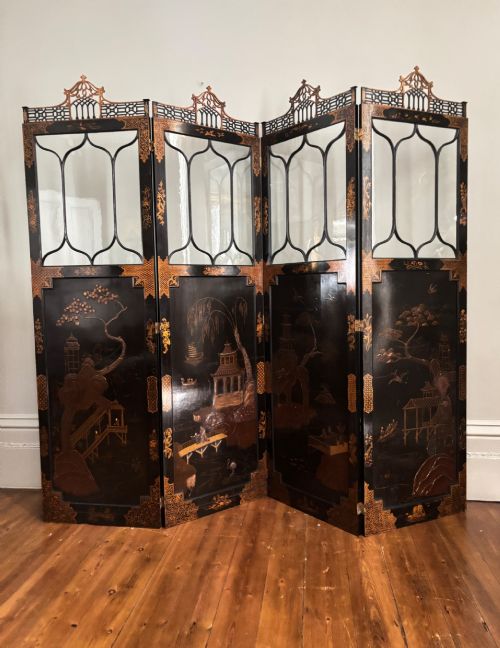
A black lacquered panel screen divides a room with deep, dark surfaces and painted or inlaid ornament.
Black Lacquered Panel Screen
A black lacquered panel screen functions as a freestanding room divider, a folding dressing screen, or a wall-mounted plaque. These pieces emerge from periods spanning the Regency era through the mid-twentieth century, drawing on Chinese Qing, Chinese Chippendale, and Japanese Meiji traditions.
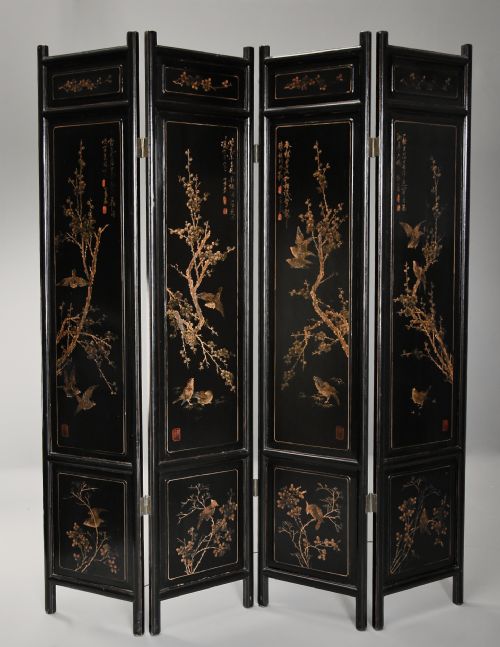
The multi-fold folding screen dominates the selection, appearing in configurations ranging from three folds up to eight folds. Smaller variants take the form of pole screens or framed wall panels meant for display.
Origin points visible in the record span China, Japan, and Burma, alongside British interpretations in the Regency and Victorian Chinoiserie styles. Each piece relies on dark surfaces to frame pictorial scenes of figures, birds, and foliage.
How they were made
Construction rests on a wooden armature coated in layers of lacquer to build a deep, polished ground. Artisans reinforced these panels with brass hinges to allow multi-fold movement across rooms.
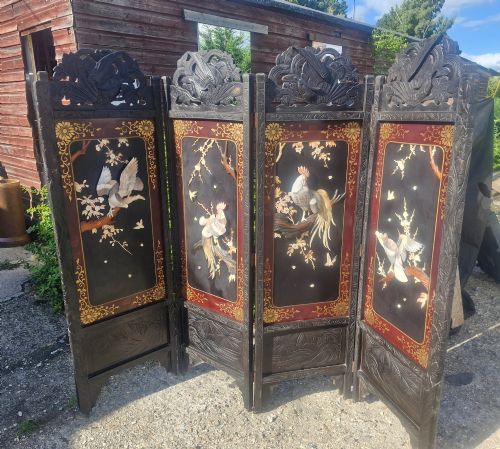
Ornamentation incorporates gold leaf, paint, and detailed inlays of bone, mother of pearl, abalone, and hardstone. Certain examples employ deep carving into the lacquer layers to reveal contrasting colours beneath, echoing traditional coromandel techniques.
Several screens depict birds perched among delicate foliage, frozen in perpetual motion across dark wooden folds.
What varies in quality
The depth of the lacquer finish and the precision of the applied details dictate the standing of a panel. Superior execution shows crisp delineation in the painted motifs and secure, flush placement of inlaid bone or mother of pearl.
The structural integrity of the folds and the weight of the supporting wood separate standard decorative items from more substantial architectural dividers. Richness in the layered surfaces and complexity in the pictorial narrative elevate the work.
The Black Lacquered Panel Screen Glossary
- Coromandel
- A type of Chinese incised lacquer where the carved design is filled with colours or left natural against a dark ground. This technique creates a textured surface across multiple folding panels.
- Chinoiserie
- European artistic styles that reflect Chinese decorative motifs and landscape tropes. This aesthetic appears frequently in British Regency and Victorian pieces.
- Meiji
- A period of Japanese history spanning the late nineteenth and early twentieth centuries associated with intricate decorative arts. Pieces from this era often feature detailed bone and ivory inlay.
- Pole screen
- A small vertical panel mounted on a standard with an adjustable height, designed to shield a person's face from the heat of a fireplace. These sit on a single weighted base rather than folding legs.
- Papier mâché
- A composite material made of paper pulp reinforced with glue or resin, moulded into decorative objects. Victorian makers utilised this ground to receive black lacquer finishes.
Black Lacquered Panel Screen: Frequently Asked Questions
How do I use a folding screen in a modern room?
A multi-fold screen stands independently to partition a corner, mask a doorway, or soften a blank wall. It provides a movable architectural element without requiring permanent installation.
Position the panels at gentle angles to ensure stability on flat flooring. This allows the hinges to support the weight evenly across the folds.
What is the difference between a dressing screen and a room divider?
Dressing screens typically feature fewer, taller folds designed to create a private enclosure for changing clothes. Room dividers often span wider configurations to segment larger living spaces.
Both types rely on black lacquer panels, though dressing screens frequently appear in nineteenth-century British interpretations.
How should I care for lacquered wood and inlaid surfaces?
Dust the panels gently with a dry, soft cloth to prevent abrasive particles from scratching the polished lacquer. Avoid harsh chemical cleaners and keep the screen away from direct sunlight and excessive humidity.
Stable indoor temperatures protect the wooden core from warping and prevent the mother of pearl or bone inlays from loosening over time.
How can I tell a Chinese coromandel screen from a Japanese export screen?
Chinese coromandel pieces feature incised lacquer work where designs are carved directly into the dark ground and filled with pigment. Japanese examples from the Meiji era frequently showcase raised elements such as carved bone and detailed textile mounts.
Examining the reverse side and the style of the pictorial narrative helps clarify the regional origin and manufacturing tradition.