



Black Lacquer Tea Chest
A black lacquer tea chest brings rich surface depth and historic craft to any room, holding the character of the Regency and Victorian eras.
Black Lacquer Tea Chest
A black lacquer tea chest stands as a tangible link to global trade and domestic ritual, capturing the fascination with Eastern aesthetics that swept Britain during the nineteenth century. These items encompass tea caddies and decorative boxes shaped by Chinese export workshops and English makers alike.
Buyers browsing this selection will most frequently encounter nineteenth century examples, spanning the Regency and Victorian periods. The forms range from simple lidded boxes to double compartment containers designed for storing precious dry leaves.
The aesthetic bridges several distinct movements, including Chinese Export styles alongside English Chinoiserie and penwork interpretations. Each piece reveals how Regency and Victorian cabinet-makers adapted foreign motifs into domestic receptacles for the tea table.
Construction and materials
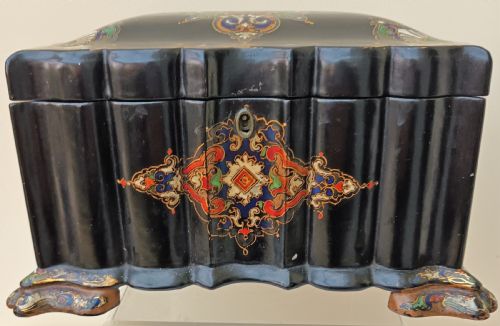
Wood serves as the foundational core for these pieces, often overlaid with papier-mâché to create smooth, stable surfaces suited to intricate surface decoration. Artisans applied layers of lacquer to build up a deep, lustrous finish that could be polished to a high sheen.
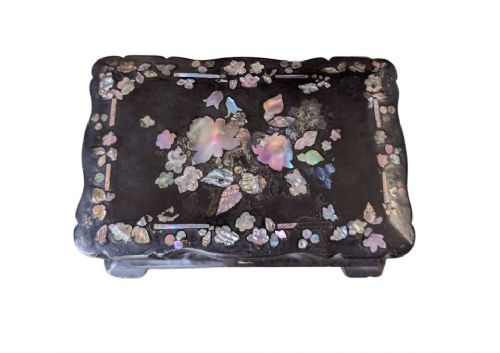
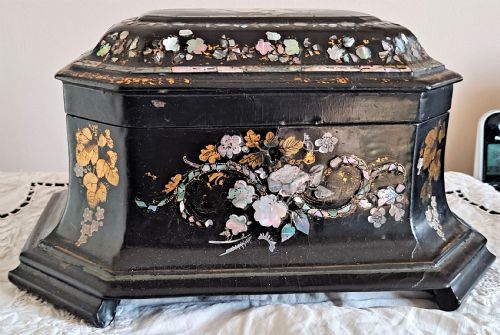
Decoration relied heavily on gold leaf, which catches the light against the dark background, alongside meticulous penwork detailing. Inlaid materials such as mother of pearl, bone, and brass add tonal contrast and tactile variety to the exterior panels.
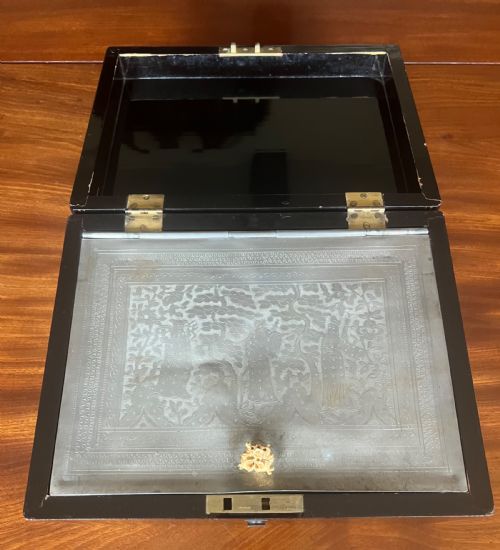
Some nineteenth-century tea caddies include hidden compartments that require pressing secret wooden springs to reveal where the owner concealed the spare key.
Judging quality and execution
The refinement of the surface decoration largely dictates the distinction between standard and superior pieces. Fine penwork and delicate gold leaf application demand immense steadiness of hand, separating basic production from exceptional artistry.
The integration of inlaid elements such as mother of pearl or bone reveals the maker's precision in fitting materials flush with the lacquered ground. Superior examples maintain structural integrity in the wood and papier-mâché body while preserving the crispness of their original ornamental schemes.
The Black Lacquer Tea Chest Glossary
- Lacquer
- A durable resin finish applied in multiple coats to wooden or papier-mâché surfaces. It creates a smooth, glossy barrier that protects the material beneath while offering a deep dark ground for ornamentation.
- Penwork
- A meticulous decorative technique utilising fine ink drawing on a prepared surface, often simulating more costly inlay or carving. Artisans in the Regency period used this method to render complex Chinoiserie scenes.
- Chinoiserie
- European artistic style reflecting Chinese motifs and techniques, popular during the eighteenth and nineteenth centuries. It appears frequently on lacquer and penwork tea chests of the period.
- Papier-mâché
- A composite material made from paper pulp or layers of paper bound with glue, pressed and dried into a rigid form. It provided a smooth, warp-resistant substrate for Victorian lacquer boxes.
Black Lacquer Tea Chest: Frequently Asked Questions
How were these tea chests used?
Households used them in the parlour or dining room to store prized teas under lock and key, as tea was exceptionally expensive. The mistress of the house typically kept the key herself, dispensing the leaves for each gathering.
Beyond functional storage, these chests served as decorative display objects that demonstrated the owner's taste and refinement. Their striking black surfaces and metallic details added visual interest to period interiors.
How do I care for lacquer furniture?
Keep lacquer pieces away from direct sunlight and sources of extreme heat to prevent the surface from drying out or cracking. Dust them gently with a soft, dry cloth without applying modern chemical polishes or abrasive cleaners.
Maintaining a stable indoor humidity helps protect both the wooden or papier-mâché core and the delicate decorative elements like gold leaf and mother of pearl. Gentle handling preserves the original finish for years to come.
How can I tell Regency from Victorian pieces?
Regency pieces often showcase delicate penwork and classical or Chinoiserie motifs dating around the early nineteenth century. These examples frequently emphasise linear detail and restrained elegance in their overall proportions.
Victorian pieces on this page lean heavily towards papier-mâché construction with vibrant mother of pearl inlay. The later nineteenth century designs generally offer a bolder decorative presence compared to earlier Regency work.