

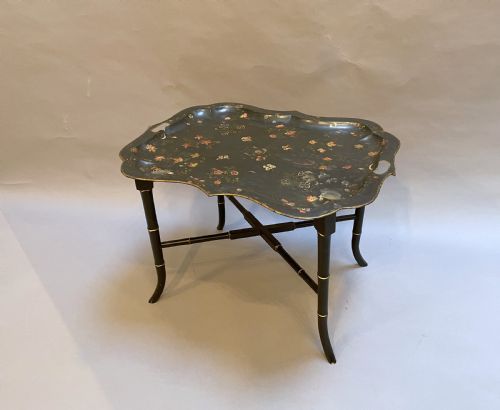
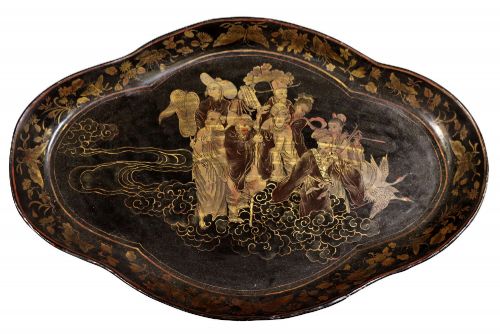


Black Japanned Tray Table
These black japanned tray tables bring rich Chinoiserie ornament and versatile surfaces into a room.
Black Japanned Tray Table
A black japanned tray table combines a decorative serving tray with a supporting stand to create an occasional or side table. The trays themselves take various forms, functioning independently or resting securely upon collapsible or fixed timber bases.
The pieces appearing on this page span several distinct periods, reaching from the 18th century through the Victorian era into the early 20th century. Forms include traditional occasional tables, coffee tables, and serving trays mounted on later or period stands.
Chinoiserie and Regency styles dominate the aesthetic, bringing painted motifs and dark lacquered finishes together. Buyers encounter both authentic period pieces and later Regency style interpretations made around nineteen-ten or nineteen-twenty.
How they were made
Makers utilised papier-mâché, lacquered timber, and metal toleware to form the robust bases of these trays. Papier-mâché construction involved layers of paper pulp compressed and treated to create a durable, smooth surface capable of holding detailed paintwork.
Finishing techniques relied heavily on dark lacquer and gold leaf to achieve the characteristic japanned surface. Artisans applied hand-painted Chinoiserie scenes featuring gilt motifs over the dark ground, sometimes incorporating brass fittings on the accompanying stands.
Black Japanned Tray Table Retail Price Guide 2026
Typical asking prices for black japanned tray table among the pieces listed under this phrase on Sellingantiques today, from the lower quarter to the upper quarter. They describe what is for sale here now, not the wider market.
Henry Clay patented his improved papier-mâché material in seventeen seventy-two, revolutionising tray production.
What varies in quality
The refinement of the hand-painted decoration separates standard examples from exceptional pieces. Superior trays display crisp detail in the gilt Chinoiserie motifs and smooth, even application of the dark lacquer across the papier-mâché or timber ground.
The relationship between the tray and its stand influences the overall character of the piece. Trays paired with contemporary period stands or bearing maker signatures demonstrate greater distinction than those resting on later, mismatched supports.
Jennens & Bettridge·Henry Clay
The Black Japanned Tray Table Glossary
- Japanning
- A European imitation of East Asian lacquerwork involving layered dark varnishes and painted metallic details. This technique produced the glossy black surfaces characteristic of these tables.
- Papier-mâché
- A composite material made from paper pulp or reinforced paper sheets mixed with glue and pressed into moulds. It provided a lightweight yet remarkably strong foundation for painted trays.
- Toleware
- Painted or lacquered sheet metal utensils and decorative objects. These trays offered a durable metallic alternative to timber and papier-mâché.
- Chinoiserie
- The European interpretation of Chinese and East Asian artistic traditions, expressed through painted landscapes, figures, and motifs. It forms the primary decorative vocabulary of these trays.
- Occasional table
- A small, movable table designed for specific, intermittent use within a room. Tray tables function naturally in this role due to their removable tops.
Black Japanned Tray Table: Frequently Asked Questions
Are the trays detachable from the stands?
Many examples feature removable trays resting freely upon folding or rigid wooden stands. This design reflects their original dual purpose as portable serving trays.
Some pieces integrate the tray more permanently onto the base, so checking the specific construction of an individual table is sensible.
How do I care for a lacquered surface?
Keep these tables out of direct sunlight and away from damp environments to protect the delicate lacquer and gold leaf. Dust them gently with a soft, dry cloth.
Avoid using liquid polishes, chemical sprays, or abrasive cleaners which can damage the historic japanned finish.
What is the difference between japanned and lacquered?
Japanning specifically denotes the European craft of mimicking Asian lacquer using resin varnishes and heat-curing methods. True East Asian lacquer relies on the sap of the toxicodendron vernicifluum tree.
In practice, antique British trade descriptions often used these terms interchangeably for black-finished surfaces.
Can these tables be used for daily serving?
While historic trays were built for use, centuries of ageing make antique surfaces sensitive to moisture, heat, and weight. Using coasters and protecting the surface preserves the painted details.
Many owners prefer to use them purely as decorative occasional tables rather than active serving pieces.