
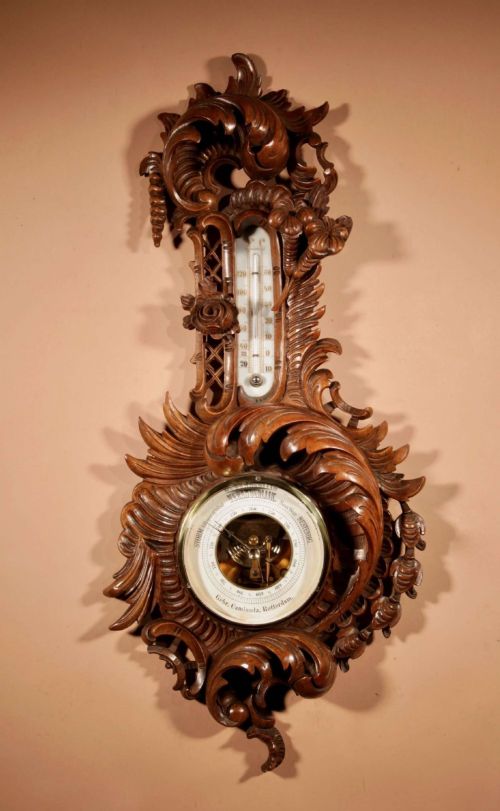
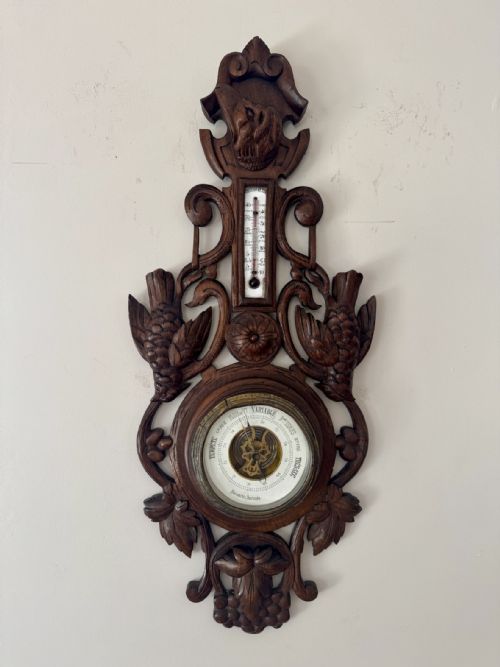
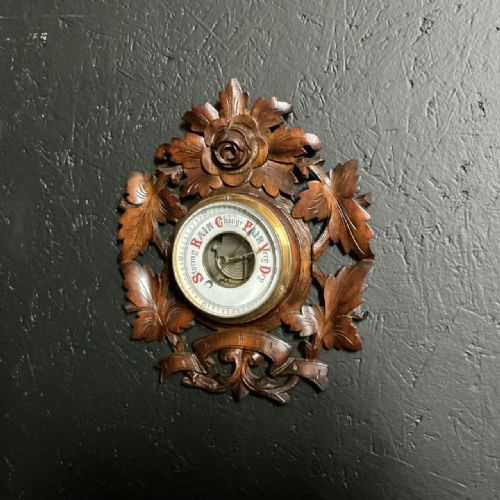


Black Forest Carving Barometer
These black forest carving barometer examples bring rich nineteenth-century wood craft and practical weather measurement directly into a room.
Black Forest Carving Barometer
A black forest carving barometer combines functional atmospheric pressure measurement with intricate woodland-themed woodwork. These pieces originate primarily from the nineteenth century, spanning periods from eighteen sixty to Edwardian times.
The objects take the form of wall barometers and barometer frames designed to hang in domestic interiors. Walnut, golden walnut, and lindenwood serve as the main foundations for these heavily carved decorative instruments.
Buyers encounter items showcasing the distinct Black Forest and Victorian Black Forest styles. Ceramic dials and glass elements frequently integrate into the carved wooden housings.
Materials and construction
Carved wood forms the core of every black forest carving barometer, utilising walnut and lindenwood for deep relief work. Artisans shaped these domestic timbers by hand to create elaborate foliage, animals, and architectural motifs.
Internal mechanical components rely on brass and glass to house and protect the sensitive aneroid barometer movements. Ceramic dials provide a clear, contrasting face for reading atmospheric changes.
One listing playfully misspells the aneroid movement as an android barometer, imagining a futuristic robot inside the nineteenth-century wood.
Assessing quality and craftsmanship
Depth and precision in the wood carving separate standard items from finer examples. Superior pieces display crisp detailing in the foliage and figures without softness in the grain.
The choice of timber influences the overall appearance, with golden walnut and rich walnut providing a warmer tone than plain woods. Integrated ceramic dials and brass bezels also elevate the visual finish of the instrument.
The Black Forest Carving Barometer Glossary
- Aneroid barometer
- An instrument measuring atmospheric pressure without liquid, using a small flexible metal box. This mechanism allows the barometer to hang vertically on a wall.
- Black Forest
- A mountainous region in Germany known for intricate wood carving traditions. Items from this tradition often feature naturalistic foliage and animal subjects.
- Lindenwood
- A pale, fine-grained timber favoured by carvers for its even texture. It takes microscopic detail well without splintering.
- Bezel
- The metal ring that holds the glass cover in place over the barometer dial. Brass is the typical material used for this component.
Black Forest Carving Barometer: Frequently Asked Questions
How do I hang a wall barometer safely?
These wooden instruments require a sturdy wall fixing capable of supporting the combined weight of the carved timber and internal mechanism. Ensure the mounting screw secures firmly into a stud or uses an appropriate wall anchor.
Position the barometer away from direct heat sources and damp areas to protect the wood and sensitive internal aneroid movement.
What is an aneroid barometer?
An aneroid barometer measures atmospheric pressure using a sealed flexible metal capsule that expands or contracts with weather changes. This mechanical movement connects to a pointer on the dial.
Unlike mercury barometers, this design contains no liquid, making it safer and easier to mount securely on a wall.
How do I clean carved wooden frames?
Dust the intricate carvings regularly using a soft-bristled brush to prevent dirt accumulation in the recesses. Avoid using liquid polishes or harsh chemical cleaners on antique timber.
Gentle care preserves the original surface patina and prevents moisture damage to the exposed wood grain.
Are these barometers still accurate?
Many vintage and antique aneroid barometers continue to register atmospheric changes effectively after proper adjustment. Setting the needle against a known local pressure reading helps calibrate the mechanism.
Temperature fluctuations and age can affect internal springs, so treat readings as general indicators rather than scientific certainties.