



Black Carved Screen
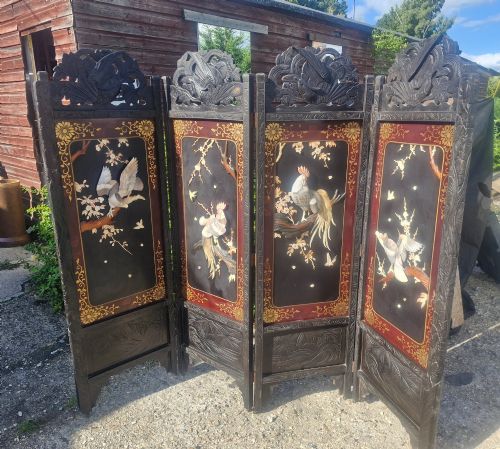
A black carved screen brings weight and shadow to a room, offering deep lacquer surfaces carved with bone, mother-of-pearl, and hardstone.
Black Carved Screen
When you search for a black carved screen, you encounter folding panels, room dividers, and table screens originating from East Asian and European workshops. The folding screen is the most common form on this page, spanning multiple panels that shift the geometry of a space.
The materials and origins range widely, taking in nineteenth-century Chinese Coromandel work, Japanese folding screens with deep carved bone figures, and European interpretations such as Chinese Chippendale and Black Forest oak pieces. Lacquered wood dominates the selection, often enriched with inlay.
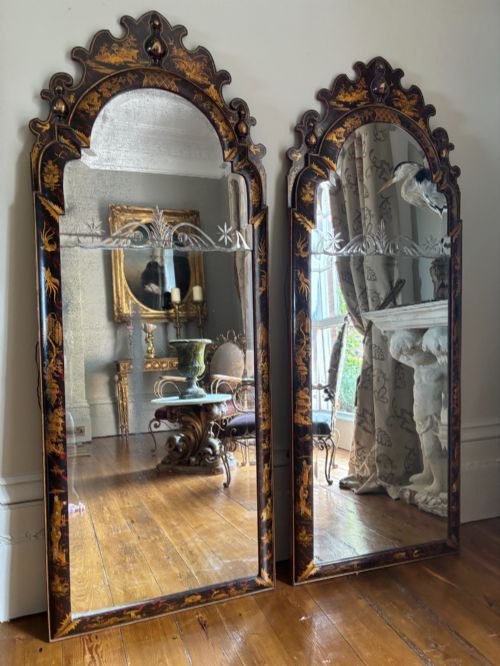
Smaller formats also appear among the larger room dividers, including framed lacquer panels, wall plaques, and fireplace screens designed to stand before an unlit grate. These smaller objects concentrate the dense carving and dark finishes into compact vertical surfaces.
Materials and technique
Lacquered wood forms the structural foundation for the majority of these pieces, providing a smooth, dark ground that accepts detailed carving and inlay. Artisans built up layers of lacquer before cutting into the surface to create relief decoration or incised Coromandel designs.
Bone, mother-of-pearl, abalone, and hardstone provide contrast against the black ground, pinned or set into the wood to depict figures, birds, and foliage. Some surfaces incorporate gold leaf highlights or painted elements to define the intricate scenes.
Black Carved Screen Retail Price Guide 2026
Typical asking prices for black carved screen among the pieces listed under this phrase on Sellingantiques today, from the lower quarter to the upper quarter. They describe what is for sale here now, not the wider market.
Several pieces feature startled birds permanently frozen mid-flight across branches of inlaid mother-of-pearl.
Evaluating the craftsmanship
Quality rests upon the depth of the carving and the precision of the inlay work, distinguishing flat painted surfaces from those with substantial relief in bone, mother-of-pearl, and hardstone. The integration of the inlay into the lacquered wood requires exact placement so that the surface remains stable over time.
The handling of the reverse side and the construction of the folding hinges also signal the standard of manufacture. Superior examples maintain the decorative scheme across all panels and use robust joining techniques that support heavy multi-fold configurations.
The Black Carved Screen Glossary
- Coromandel
- A type of Chinese incised lacquer work where the design is cut into a dark ground and filled with colours or left natural. It is frequently seen on multi-fold screens from the nineteenth and early twentieth centuries.
- Chinoiserie
- European artistic style reflecting Chinese motifs and techniques, often applied to furniture and screens during the eighteenth and nineteenth centuries.
- Meiji
- A period in Japanese history spanning from 1868 to 1912, associated with export art including screens featuring carved bone and lacquer.
- Bantam work
- An alternative term for incised lacquer work similar to Coromandel, used to describe decorative panels with colourful details on a dark background.
- Hardstone
- Dense minerals such as jade or agate carved and applied to lacquer panels to form flowers, birds, and figures.
Black Carved Screen: Frequently Asked Questions
How do I use a folding screen at home?
A folding screen functions as a room divider, a backdrop for furniture, or a freestanding wall art piece that introduces height and texture.
Position the panels at an angle to ensure stability and to catch the light across the carved lacquer surfaces.
What is the difference between Coromandel and standard lacquer?
Coromandel involves incising deep into layered lacquer and filling the recesses, whereas standard lacquer work often relies on surface painting or applied inlay.
This incision technique creates a tactile, recessed relief that defines antique Chinese screens.
How do I care for a lacquered wood screen?
Keep lacquered surfaces away from direct sunlight and excessive heat sources to prevent the wood from warping and the lacquer from cracking.
Dust gently with a soft, dry cloth and avoid chemical polishes that can damage the delicate inlay of bone or mother-of-pearl.
Are all these screens from China?
While many pieces originate from China, the selection includes Japanese export work, Burmese examples, and European pieces influenced by East Asian styles.
Makers in Britain and Europe also produced fireplace screens and decorative panels drawing on Chinoiserie and Black Forest traditions.