




Black Art Deco Glassware
Black art deco glassware brings striking modernist geometry and deep monochrome tones into a room, offering the sharp silhouettes that define the interwar period.
Black Art Deco Glassware
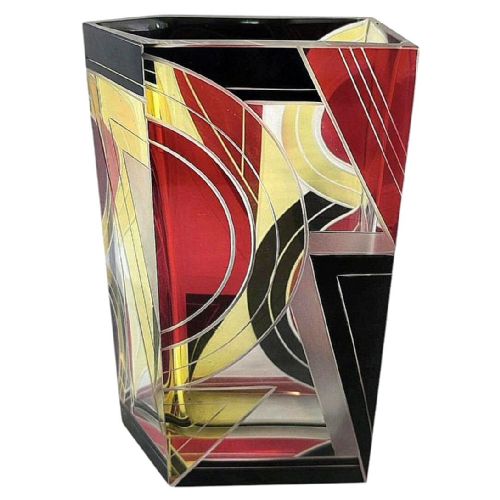
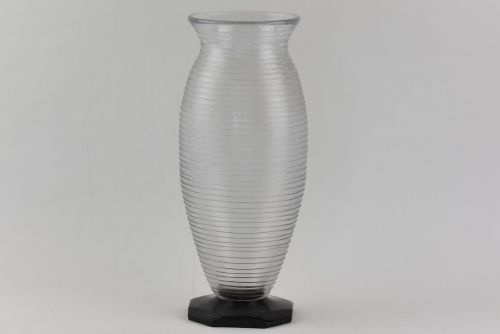
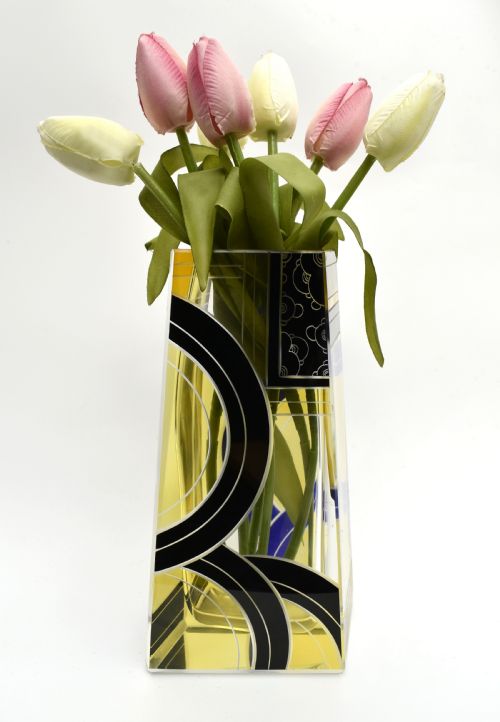
Black art deco glassware centres on striking pieces produced during the 1920s and 1930s, capturing the modernist spirit of the era in deep monochrome tones. These objects take the form of tall vases, elaborate decanter sets with matching glasses, perfume bottles, and complete drinks sets.
The aesthetic leans heavily into geometric patterns and sharp silhouettes, frequently originating from Czech workshops alongside French makers. Buyers will encounter both opaque black bodies and translucent dark glass shaped into distinct angular profiles.
Materials and Techniques
Production relies on heavy glass, lead crystal, and opaque black hyalite glass moulded or blown into sharp geometric shapes. Artisans then applied surface decoration using acid-etching to carve linear motifs into the dark body.
Contrasting enamel work and gold gilding were frequently hand-painted onto the glass, highlighting the geometric patterns and figural scenes such as jazz motifs. These applied finishes create a sharp visual tension against the dark background.
Several decanter sets come equipped with matching glasses small enough to suggest interwar hosts preferred very modest sips of liqueur.
Standards of Execution
Quality rests in the crispness of the glass moulding and the precision of the hand-applied enamel and acid-etching. Finer pieces display sharply defined geometric lines and securely adhered metallic gilding that sits evenly across the surface.
The weight of the lead crystal and the depth of the opaque black glass also separate standard production from superior examples. Master workshops ensured balanced proportions and intricate detailing on complex decanter sets and tall vases.
Karl Palda·Daum·Paul Heller·Booms glass
The Black Art Deco Glassware Glossary
- Hyalite glass
- An opaque black glass developed to imitate stone and popular during the interwar period. This dense material provides a solid dark canvas for bright enamel and gilding.
- Acid-etched glass
- Glass treated with acid to eat away exposed areas and leave a textured design in relief. This technique creates tactile geometric patterns across the dark surface.
- Enamel decoration
- Coloured glass paste fired onto the surface of a vessel to add vibrant patterns. It stands in sharp contrast to the black glass beneath.
- Lead crystal
- A heavy glass variety containing lead oxide, offering increased brilliance and weight. It allows for deep cutting and crisp geometric facets.
Black Art Deco Glassware: Frequently Asked Questions
How do I clean antique black glass?
Wash these pieces gently by hand using lukewarm water and mild soap, avoiding abrasive sponges that can scratch the surface.
Take particular care around areas with gold gilding or enamel decoration, as harsh scrubbing will wear away the historic pigments.
Were these decanter sets meant for daily use?
Most of these sets served a functional role on bar carts and sideboards during the interwar period, holding liqueurs and spirits for guests.
Many owners today choose to display them as decorative art objects rather than putting them into active service.
How do I distinguish 1920s pieces from 1930s work?
Objects from the 1920s often embrace bold tango colours and early modernist abstraction, while pieces from the 1930s lean towards more streamlined geometric forms.
Maker signatures and stylistic markers like jazz motifs help anchor specific production dates within this twenty-year span.
Are all black art deco items opaque?
While the majority utilise dense opaque black or hyalite glass, some pieces employ very dark translucent glass that reveals light when held.
Both variations were produced during the period to achieve different visual effects on display.