
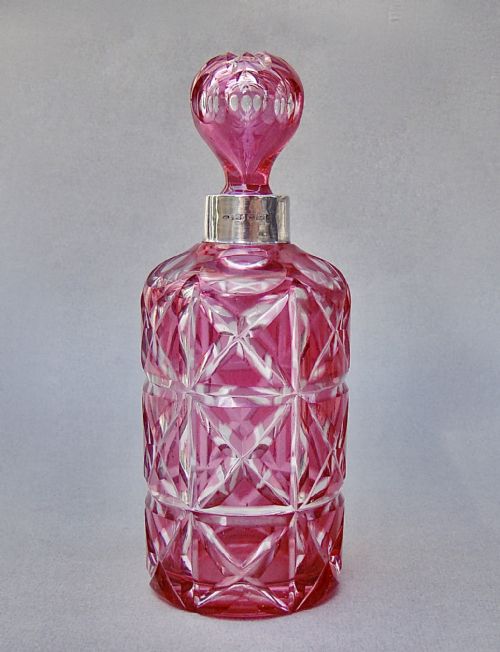


Birmingham Silver Perfume Bottle
A birmingham silver perfume bottle brings together Victorian and Edwardian craft with sterling mounts and glass bodies.
Birmingham Silver Perfume Bottle
When you search for a birmingham silver perfume bottle, you encounter scent bottles and double scent bottles spanning the Victorian, Edwardian, and early twentieth century periods. The pieces on this page pair sterling silver mounts and tops with bodies formed from cut glass, cranberry glass, cut crystal, ceramic, and hand-painted enamel.
Most examples date from the late nineteenth century through the 1920s, reflecting the output of silversmiths operating in the Midlands. You find single pocket specimens alongside matched pairs and portable containers designed for daily carriage.
How they were made
Makers formed the bodies by blowing and cutting glass or shaping ceramic and enamel, while silversmiths constructed matching sterling silver caps, collars, and mounts. Glass bodies feature extensive cutting, etching, or distinct colourations like cranberry, paired with hallmarked silver elements produced in Birmingham workshops.
Artisans applied hand-painting to enamel surfaces and secured screw or hinged lids designed to seal volatile contents securely within the vessel.
Materials recorded on this site include sterling silver, cut glass, cranberry glass, ceramic, and hand-painted enamel across Victorian and Edwardian periods.
What varies in quality
Quality separates through the depth and precision of the glass cutting, the clarity of the crystal or cranberry glass, and the crispness of the hallmarks stamped on the silver mounts. Finer pieces demonstrate substantial sterling weight in the top alongside intricate hand-painting on enamel or complex double-ended glass configurations.
The integration between the silver collar and the glass body marks the standard of construction, where precise fitting distinguishes standard production from notable maker output.
Harold Bushell And Co·Barnsley And Co·Adie Brothers Ltd·George Unite·Horton And Allday·Charles May
The Birmingham Silver Perfume Bottle Glossary
- Sterling Silver
- A silver alloy containing 92.5 percent pure silver and 7.5 percent other metals, typically copper, used for the bottle mounts and caps. This standard metal forms the basis of the Birmingham hallmarked components.
- Cranberry Glass
- A red or pink transparent glass produced by adding gold chloride to the molten batch. It appears frequently in the coloured glass bodies paired with silver tops.
- Double Scent Bottle
- A container featuring compartments at both ends to hold two distinct fragrances simultaneously. These symmetrical vessels often utilise hinged silver caps on each extremity.
- Hallmark
- An official stamp applied by an assay office to indicate the purity of the metal, the year of manufacture, and the maker. Birmingham examples carry the anchor mark alongside date letters and maker initials.
Birmingham Silver Perfume Bottle: Frequently Asked Questions
How do I date a Birmingham silver perfume bottle?
You determine the production date by reading the specific assay office letter stamp located on the sterling silver mount or collar. Birmingham items carry an anchor symbol alongside these date ciphers.
Additional chronological context comes from the overall style, moving from ornate Victorian designs toward Edwardian forms and Art Deco influences in the 1920s.
What is cranberry glass?
Cranberry glass is a deep red or pink transparent material created by introducing gold into the molten glass mixture during production. It gained popularity for decorative vanity items throughout the nineteenth century.
On this page, it forms the striking coloured bodies of scent bottles fitted with sterling silver tops.
How were double scent bottles used?
Double scent bottles held two separate perfumes or smelling salts within a single symmetrical glass or crystal body with a cap at each end. Victorian and Edwardian users carried them to have a choice of fragrance throughout the day.
Their dual-ended construction required precise silver-gilt stoppers to prevent leakage from either compartment.
Are these bottles meant for travel?
Many portable perfume bottles were engineered for carriage in reticules or dressing cases during the Victorian and Edwardian eras. Secure screw caps and fitted collars kept volatile liquids contained during transit.
Robust cut glass and thick silver mounts allowed these personal accessories to withstand daily use.