
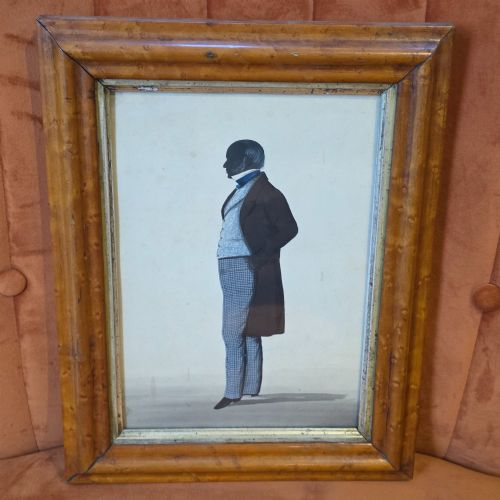


Birdseye Maple Framed Portrait
A birdseye maple framed portrait brings intimate nineteenth-century likenesses and folk art directly to your walls.
Birdseye Maple Framed Portrait
A birdseye maple framed portrait encompasses nineteenth-century silhouettes, watercolours, oils, and conversation pieces housed within distinctive timber surrounds. These works capture gentlemen, ladies, children, and domestic scenes through the mediums of paper, ink, and watercolour.
The objects span Georgian, Regency, William IV, and Victorian periods, often reflecting folk art sensibilities alongside accomplished fine art portraiture. You will most frequently encounter nineteenth-century examples featuring hand-cut profiles or delicate painted miniatures.
Makers and artists range from named practitioners like J F Marie Huet Villiers, Augustin Edouart, and Robert Faulkner to anonymous creators associated with the Royal Victoria Gallery. Each piece merges historical portraiture with the distinctive figuring of maple and maple veneer frames.
Materials and construction
Makers utilised maple and maple veneer to construct the distinctive frames, frequently pairing the figured timber with protective glass panes. The portraits themselves were executed on paper using watercolour, ink, and cut paper silhouettes, sometimes incorporating gold leaf accents.
Canvas served as the base for small oil paintings, while silhouettes relied on precision paper-cutting techniques. These visual elements were then assembled beneath glass within wood frames to preserve the delicate pigments and paper.
A naive oil painting captures a young boy sharing his space with a remarkably attentive dog and a bowl of goldfish.
Distinctions in quality
Quality rests upon the execution of the portrait, whether through the fine brushwork of a miniature watercolour or the crisp, deliberate cutting of a silhouette. Named artists and documented galleries elevate a piece beyond standard domestic craft.
The character and figuring of the maple frame itself contribute significantly to the overall aesthetic appeal. Intact original framing matching the period of the artwork commands greater appreciation among collectors.
The Birdseye Maple Framed Portrait Glossary
- Birdseye maple
- A figure in maple wood resembling small swirling eyes, prized for decorative veneer and framing. This distinctive pattern occurs naturally within the grain.
- Silhouette
- A portrait represented as a solid shape, usually black on a light background, cut from paper or painted. These profiles gained immense popularity during the Georgian and Victorian eras.
- Miniature watercolour
- A small-scale portrait painted in watercolour, requiring exceptional precision and fine detail. Artists produced these intimate likenesses for personal keepsakes and family memorials.
- Conversation piece
- An informal group portrait, often depicting family members or associates engaged in a common activity. These domestic scenes offer insights into nineteenth-century life and fashion.
- Folk art
- Artistic work created by untrained or traditional artisans, prioritising expressive character over academic convention. These naive pieces frequently employ bold compositions and local materials.
Birdseye Maple Framed Portrait: Frequently Asked Questions
What periods do these portraits come from?
The pieces span the Georgian, Regency, William IV, and Victorian eras, predominantly dating across the nineteenth century.
Specific dates within titles, such as eighteen-thirty or eighteen-fifty-two, help anchor individual works to precise decades of production.
Are the frames original to the portraits?
Many examples retain their original maple or maple veneer frames, which were selected by contemporary makers to complement the artwork.
Original framing preserves the historical integrity of the piece and enhances its visual cohesion.
Who made these portrait artworks?
Artists include professional painters and silhouette cutters such as Augustin Edouart, Robert Faulkner, and J F Marie Huet Villiers.
Other works originate from commercial establishments like the Royal Victoria Gallery or represent anonymous folk art creations.
What materials were used in their creation?
Portraits were executed on paper or canvas using watercolour, ink, oil, and cut paper, occasionally featuring gold leaf details.
These artworks are housed behind glass within wooden frames constructed from maple and maple veneer.
How should I display a framed portrait?
Hang the pieces away from direct sunlight to protect delicate watercolours, paper silhouettes, and organic wood frames from fading.
Grouping complementary nineteenth-century silhouettes and paintings creates a cohesive gallery display on interior walls.