



Belle Epoque Desk
These pieces of a belle epoque desk bring together polished wood, gilt metal and refined French design for any room.
Belle Epoque Desk
When you search for a belle epoque desk, you encounter fine French furniture originating from periods such as the nineteenth century and around nineteen hundred, alongside related forms like centre tables and bureau plat desks. The selection also spans smaller items and accessories that share the same aesthetic vocabulary, including mantel clocks, bronze sculptures, table lamps and letter racks.
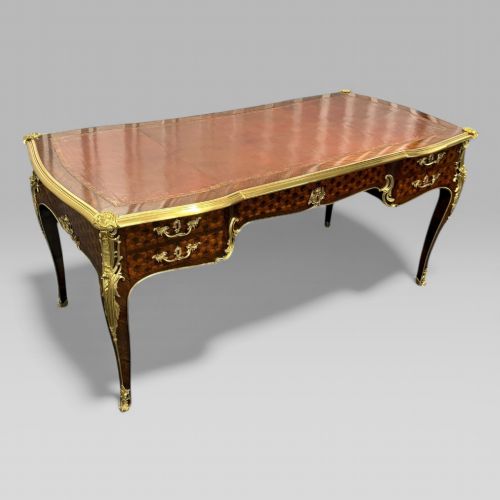
The version you are most likely to meet on this page is a substantial writing table in mahogany or kingwood, often featuring classical revival details or fluid art nouveau lines. These pieces reflect a period of high craftsmanship in France, drawing on styles ranging from rococo revival to louis xvi.
How they were made
The construction relies heavily on select timbers such as mahogany and kingwood, frequently enhanced by parquetry inlay and elaborate brass or ormolu mounts. Makers combined cabinetmaking with metalworking to produce integrated decorative schemes on desks and tables.
Bronze, marble, enamel and glass also appear across the wider selection of items, demonstrating a mastery of mixed media. Ormolu accents and delicate enamel work give these pieces their characteristic sheen and surface texture.
What varies in quality
The distinction between tiers of quality rests upon the crispness of the ormolu chasing and the precision of the parquetry inlay. Finer examples display meticulous attention to detail in every cast bronze mount and every fitted joint.
Another measure of quality is the presence of documented makers and the sophistication of the overall design, whether adhering strictly to louis xvi revival forms or embracing the organic curves of the belle epoque.
L & F Moreau·François Linke·Georges Van Der Straeten·Adrien Gaudez·Emile Langlois
The Belle Epoque Desk Glossary
- Ormolu
- A gilded bronze ornament applied to furniture and clocks. It provides a bright golden finish that catches the light.
- Kingwood
- A dense, richly figured exotic timber used for veneering fine furniture. Its contrasting grain patterns define many bureau plat desks.
- Parquetry
- Geometric wood inlay patterns assembled from small veneer tiles. This technique decorates the surfaces of tables and desks.
- Bureau plat
- A flat-topped freestanding writing desk typically fitted with drawers. It represents the formal writing furniture of the period.
- Garniture
- A set of matching ornamental objects designed to be displayed together on a mantelpiece. These often include a clock flanked by candelabra or vases.
Belle Epoque Desk: Frequently Asked Questions
What defines a belle epoque desk?
A belle epoque desk is characterised by refined French styling from the late nineteenth or early twentieth century, combining rich timbers like mahogany with ormolu mounts.
These writing tables often incorporate elements of louis xvi revival or art nouveau design, reflecting the sophisticated tastes of the period.
How do I care for a mahogany desk?
Keep the wood nourished with appropriate wax and protect the surface from direct sunlight and excessive moisture. Regular gentle dusting preserves the polished finish.
Avoid placing hot or damp items directly onto the timber or the gilded mounts to maintain the integrity of the materials.
Are these desks suitable for daily writing?
Most of these pieces were built for functional use in studies and salons, providing adequate surface area and often drawer storage for writing materials.
Their sturdy construction in hardwoods makes them practical for contemporary workspaces while retaining their decorative appeal.
How can I tell the period of a desk?
Dating relies on examining the construction methods, timber selection and decorative motifs such as ormolu mounts and parquetry patterns. Stylistic cues point toward nineteenth-century revivalism or early twentieth-century manufacture.
Comparing the hardware and finishing techniques with dated examples in the archive helps narrow down the era of production.