

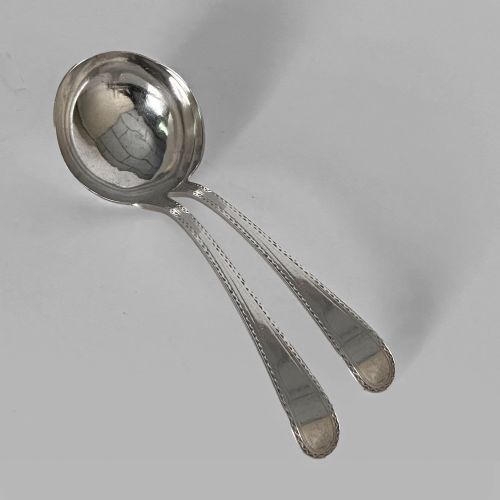


Beaded Silver Tableware
Beaded silver tableware comprises domestic vessels and utensils defined by distinct border ornamentation, offering functional elegance for the dining table.
Beaded Silver Tableware
Beaded silver tableware encompasses functional dining room objects characterised by small, rounded relief decoration running along their edges. The selection spans utilitarian serving pieces and dining accessories created across several centuries.
Buyers encounter forms ranging from cream jugs and salt cellars to entree dishes and ladles. These pieces originate from periods including the Georgian era, Victorian period, Edwardian years and the early twentieth century.
The style manifests in solid sterling silver, silver plate, Old Sheffield Plate and electroplated nickel silver. Neo-Classical and Arts and Crafts influences occasionally appear alongside traditional domestic designs.
How these pieces were made
Makers utilised solid sterling silver and heavy gauge silver plating over base metals like copper to produce durable vessels. Techniques such as Old Sheffield Plate fused a thin sheet of silver to a copper core under high heat.
The characteristic bead border was applied as a separate stamped wire or rolled directly into the metal rim. Silversmiths formed hollowware bodies through raising, spinning or casting before soldering components together.
Object forms span serving dishes, cream jugs, ladles, sauce boats, trays, salt cellars and napkin rings.
What varies in quality
Quality rests upon the weight of the metal and the crispness of the border stamping. Substantial gauge silver and well-defined, evenly spaced beads indicate superior manufacturing standards.
The integrity of applied plating and the precision of assembly distinguish high-grade items from utilitarian wares. Maker attribution and original condition further differentiate pieces within the range.
Hester Bateman·James Welch·Walker Knowles·William Hutton & Sons
The Beaded Silver Tableware Glossary
- Beading
- A decorative border pattern resembling a string of small beads. This ornamentation frequently edges the rims of serving dishes, trays and hollowware.
- Old Sheffield Plate
- An early method of fusing silver to a copper base. This technique creates a distinctive edge where the base metal is subtly visible.
- Entree Dish
- A covered serving vessel used for main courses or side dishes. These items often feature removable handles and beaded borders.
- Hollowware
- Tableware items such as jugs, bowls and dishes that possess depth and volume. Silversmiths traditionally raised these forms from flat sheets of metal.
Beaded Silver Tableware: Frequently Asked Questions
How do I clean silver plate?
Silver plate requires gentle cleaning with a specialised non-abrasive silver polish and a soft cloth. Avoid harsh scrubbing to preserve the thin silver layer over the base metal.
Regular, careful maintenance prevents tarnish buildup without wearing away the underlying plating or antique finish.
What is Old Sheffield Plate?
Old Sheffield Plate is an early plating technique where a thin sheet of silver is fused to a copper core. This method produces durable items with a warm, distinctive appearance.
Pieces made this way often reveal subtle traces of copper along high-wear edges and seams.
Can I use these items daily?
Solid silver and robust silver-plated items function well for regular dining when handled with appropriate care. Hand washing preserves the finish and structural integrity of antique vessels.
Delicate plating or fragile glass inserts require more cautious handling during meal service.
How do I identify a Georgian piece?
Georgian pieces date from the eighteenth and early nineteenth centuries, often displaying classic proportions and hand-wrought details. Makers' marks and hallmarks stamped into the metal help verify the exact period.
Stylistic cues like Neo-Classical motifs also point toward this earlier era of production.