

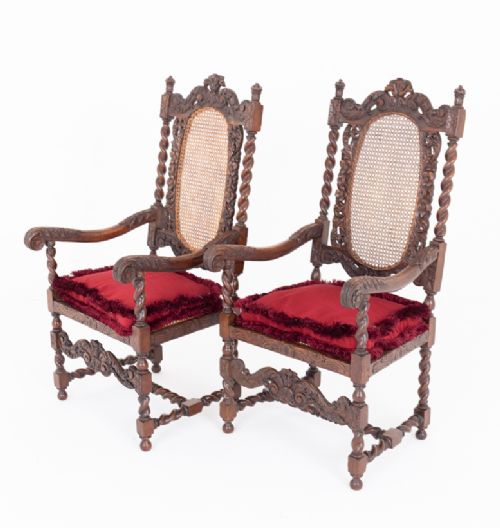


Barley Twist Arm Chair
A barley twist arm chair brings tactile warmth and historic presence to a room through its distinctive spiralled wooden turnings.
Barley Twist Arm Chair
A barley twist arm chair represents a seating tradition stretching from the seventeenth century through to revival periods of the nineteenth and early twentieth centuries. You encounter these chairs in sturdy oak, rich walnut, and mahogany, often featuring upholstered seats, button backs, or woven cane panels. The core defining element across all these eras is the spiralled turned wood that forms the uprights, stretchers, or arm supports.
The versions most common on this page date from the Victorian era and the early twentieth century, spanning historical revivals that imitate seventeenth-century craftsmanship. These pieces function both as fireside reading chairs and as substantial carver seats for dining or occasional use. The scale ranges from compact bedroom chairs to large throne and wing armchairs designed for prominent placement.
Materials and Turning Techniques
Craftsmen built these frames primarily using solid timbers like oak, walnut, and mahogany, shaped by hand or on a lathe to create the signature helical twist. The turning process required precise skill to maintain an even spiral along the length of the wooden leg or arm support. Joinery relied on traditional peg and mortise construction to ensure the structural integrity of the frame over centuries of daily sitting.
Upholstery materials varied widely by period, utilising velvet, leather, tapestry fabric, and woven rattan cane for seat panels and backrests. Brass tacks frequently secured the fabric margins to the wooden framework on Victorian and revival examples. Natural fibres and horsehair stuffing provided the original internal padding for upholstered variants.
Barley Twist Arm Chair Retail Price Guide 2026
Typical asking prices for barley twist arm chair among the pieces listed under this phrase on Sellingantiques today, from the lower quarter to the upper quarter. They describe what is for sale here now, not the wider market.
Listings span from the seventeenth century through to the early twentieth century, showing revival styles in oak and walnut.
Judging Quality in Turned Seating
The distinction between ordinary and superior examples lies in the crispness and depth of the wood turning and the selection of the primary timber. Sharply defined spirals with smooth, symmetrical contours demonstrate superior hand-turning proficiency compared to shallow or uniform machine cuts. Grain configuration in the oak or walnut further separates basic utility furniture from ambitious statement pieces.
Structural harmony and proportion dictate the overall merit of an armchair, particularly when comparing original seventeenth-century construction with later revivals. Higher quality pieces maintain balanced dimensions between the turned elements and the upholstered body, while inferior items may exhibit awkward transitions or heavy-handed carving. The integrity of the original joints and the quality of the secondary materials complete the assessment.
The Barley Twist Arm Chair Glossary
- Barley twist
- A decorative turning technique resembling a spiralled rope or a stalk of barley, popular in furniture framing.
- Carver
- An armchair designed with arms, traditionally placed at the head of a dining table or used as a fireside seat.
- Cane
- Woven rattan material used to form light, flexible panels for chair backs and seats.
- Jacobean Revival
- A nineteenth-century design movement that imitates the heavy, dark oak styles of the early seventeenth century.
- Stretcher
- A horizontal wooden rail connecting the legs of a chair to provide structural support and stability.
Barley Twist Arm Chair: Frequently Asked Questions
How do I spot a true seventeenth-century chair?
Authentic seventeenth-century pieces display hand-cut tool marks, pegged joinery, and timber patination consistent with centuries of age. The species of oak or walnut will show deep oxidation and wear patterns that modern replicas cannot fully duplicate.
Examination of the underside and internal frame reveals construction methods unique to early period joinery, distinguishing them from Victorian revivals.
Were these chairs used for dining?
Many of these pieces served as carver armchairs placed at the ends of dining tables, accompanied by matching side chairs. Their sturdy construction supported upright seating during formal meals.
Other variants functioned as fireside, library, or bedroom armchairs designed for comfort rather than dining use.
How do I care for the twisted wooden frame?
Maintain the wood by applying a quality beeswax periodically to nourish the grain and protect the surface from drying out. Avoid placing the chair in direct sunlight or near heat sources that could cause the timber to split.
Dust the spiralled turnings regularly with a soft brush to prevent grime from accumulating in the recessed grooves.
What is a bergere back?
A bergere back incorporates a tight weave of cane across an enclosed wooden frame, creating a light and resilient support. This technique appeared on various revival models throughout the nineteenth and early twentieth centuries.
It adds textural contrast to the heavy turned wooden members surrounding it.