
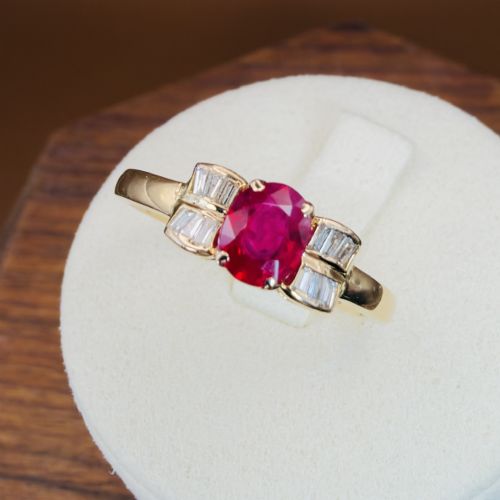


Baguette Shoulder Diamond Ring
A baguette shoulder diamond ring pairs a central stone with linear side steps to give a sharp, geometric profile.

Baguette Shoulder Diamond Ring
A baguette shoulder diamond ring displays a principal gemstone flanked by step-cut side stones that draw the eye inwards along the band. These pieces emerge chiefly from the Art Deco and Mid-Century periods, spanning the decades from the nineteen-tens through to the nineteen-sixties.
The format appears most often as an engagement ring or dress ring configured in platinum or gold. Central stones range from solitaire diamonds to coloured gems such as rubies, emeralds, aquramarines, moonstones, and natural pearls.
Solitaire diamonds set within these designs feature antique cuts including old European, transitional, and brilliant cuts. The shoulder stones utilise baguette cuts to frame the centre with clean architectural lines.
How they were made
Platinum serves as the primary metal for many mountings, prized for its strength in holding delicate step-cut stones securely in narrow channels or prong settings. Yellow gold and white gold also appear across cluster and dress ring configurations.
Gems are hand-set into metalwork that reflects the geometric precision of Art Deco and Mid-Century Modern design principles. Cutters shaped diamonds and coloured stones by hand to fit precisely into the tapered shoulders flanking the main focal gem.
Baguette Shoulder Diamond Ring Retail Price Guide 2026
Typical asking prices for baguette shoulder diamond ring among the pieces listed under this phrase on Sellingantiques today, from the lower quarter to the upper quarter. They describe what is for sale here now, not the wider market.
Even a quiet moonstone engagement ring manages to hold a tiny constellation of baguette diamonds on its shoulders.
What varies in quality
The fineness of a baguette shoulder diamond ring depends on the symmetry of the side steps and the proportion they bear to the central stone. Superior examples maintain crisp lines where the shoulder facets meet the band without crowding the main gem.
The calibre of the materials also dictates the standing of the piece, from the clarity of the platinum or gold work to the brilliance of the centre diamond or coloured stone. Certification from gemmological laboratories often accompanies the finest solitaire and cluster specimens.
The Baguette Shoulder Diamond Ring Glossary
- Baguette cut
- A rectangular step-cut style with straight parallel sides, commonly utilised for shoulder stones in period rings. This cut emphasises linear clarity over fiery sparkle.
- Old European cut
- An early round diamond cut featuring a small table, heavy crown, and a large open culet. These stones display distinct facet patterns characteristic of antique manufacturing.
- Transition cut
- A diamond cut used during the period when cutters moved from old cuts to modern brilliant facets. It bridges older geometric proportions with contemporary light performance.
- Platinum
- A dense, durable white metal widely used in twentieth-century jewellery fabrication. Its strength permits delicate claw settings and secure channel work for small stones.
- Cluster ring
- A ring design featuring a central gemstone surrounded by a group of smaller stones. This arrangement maximises visual impact and combines different gem varieties.
Baguette Shoulder Diamond Ring: Frequently Asked Questions
What defines a baguette shoulder diamond ring?
This style centres on a main gemstone flanked by narrow, step-cut rectangular side stones set into the shoulders of the band.
The layout creates a tapered silhouette that directs attention toward the centre stone while keeping the profile low and geometric.
Which periods do these rings come from?
The pieces span the early twentieth century through to the middle decades, with strong representation from the Art Deco and Mid-Century eras.
Manufacturing dates in this selection stretch from nineteen-ten up to nineteen-sixty, encompassing classic antique and vintage periods.
What metals are used in these mounts?
Platinum is the predominant metal found in these settings, valued for its bright finish and structural rigidity.
Yellow gold and white gold also appear in various ring mountings, particularly in cluster and coloured gemstone combinations.
Are coloured stones common alongside diamonds?
While many examples focus purely on diamonds, several pieces incorporate emeralds, rubies, aquramarines, moonstones, or pearls.
These coloured gems act as central focal points or contrasting accents within platinum and gold settings.