
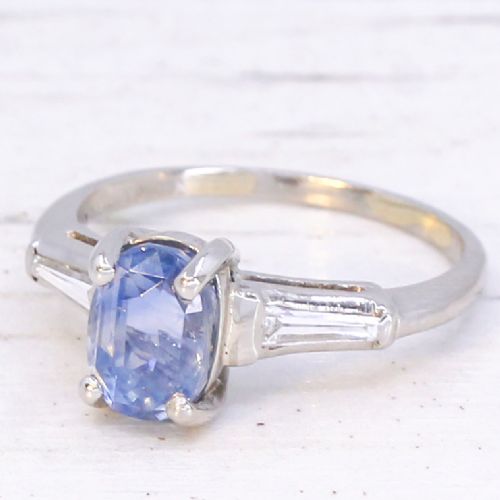


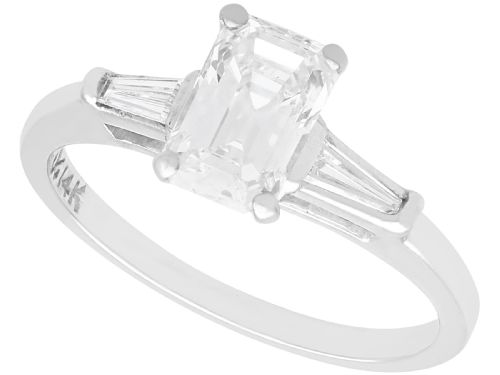

Baguette Diamond Solitaire
When you search for a baguette diamond solitaire, you are looking at rings where step-cut shoulder stones frame a central gem.
Baguette Diamond Solitaire
A baguette diamond solitaire is a ring built around a central stone, typically an old cut, transitional cut, or brilliant cut diamond, flanked by rectangular step-cut side stones. These pieces function primarily as engagement rings and dress rings.
The selections here span from the 1910s through the 1960s, encompassing Art Deco, 1940s Retro, and Mid-Century styles. You will frequently encounter platinum settings alongside examples fashioned in white gold and 14ct white gold.
Beyond diamond solitaires, the category extends to include sapphire, emerald, beryl, and natural pearl pieces that incorporate diamond work. The core form remains centred on the singular main stone paired with structured shoulders.
How they were made
Jewellers of the 1920s and 1930s predominantly utilised platinum to mount these stones, capitalising on the metal's strength to form slender, secure claws and precise channel settings for baguette shoulders. White gold emerged as a frequent alternative in subsequent decades.
Central stones were cut by hand during the earlier periods, resulting in old European cuts and old cut variations that display broad facets. Side baguettes were shaped as straight or tapered step-cut stones to complement the linear geometry of the mount.
Listings span from 1910 to 1960, featuring platinum and white gold alongside diamond, sapphire, emerald, and natural pearl.
What varies in quality
The standard of a baguette diamond solitaire rests upon the harmony between the central gem and its shoulder stones. Superior pieces display matched brilliance and colour grades where the linear steps of the baguettes draw the eye smoothly toward the principal diamond.
Construction integrity defines the upper tier of these rings. Master jewellers achieved precise metalwork where platinum or white gold settings hold every stone flush without excess metal obscuring the facet edges.
Boucheron
The Baguette Diamond Solitaire Glossary
- Baguette cut
- A rectangular diamond cut with step facets and straight or tapered sides, commonly utilised for shoulder stones.
- Solitaire
- A piece of jewellery designed to showcase a single central gemstone.
- Old European cut
- An early brilliant diamond cut characterised by a high crown, small table, and deep pavilion, prevalent in pieces from the early decades of the twentieth century.
- Transitional cut
- A diamond cut bridging the older old European style and the modern round brilliant, seen in mid-century pieces.
- Art Deco
- A design style dominant in the 1920s and 1930s defined by geometric symmetry, clean lines, and linear motifs.
Baguette Diamond Solitaire: Frequently Asked Questions
What is a baguette diamond solitaire?
A baguette diamond solitaire is a ring featuring a single main diamond accompanied by narrow, rectangular step-cut side stones. These designs emerged strongly during the Art Deco period.
The side stones are shaped as baguettes, meaning they have straight or tapered edges that create a geometric silhouette. This layout directs visual focus toward the central gem.
How do I date a platinum solitaire ring?
Dating these rings involves examining the cut of the central diamond alongside the mounting style. Art Deco examples from the 1920s often feature old European cuts set in heavy platinum.
Later pieces from the 1950s and 1960s transition toward modern brilliant cuts and mid-century modern aesthetics. Hallmarks and material shifts, such as the use of white gold, also assist in establishing chronology.
Are these rings suitable for daily wear?
Platinum and white gold mountings combined with diamonds provide the durability required for everyday use. The secure settings typical of these periods protect the girdle of the stones.
Routine checks by a jeweller ensure the claws and channel settings remain tight. Proper care preserves the structural integrity of the metalwork over time.
What is the difference between old cut and brilliant cut diamonds?
Old cut diamonds feature hand-cut facets with smaller tables and higher crowns, producing a distinctive pattern under candlelight. They reflect light in broader flashes compared to modern stones.
Brilliant cut diamonds, found in mid-century examples, utilise standardised facet geometry calculated to maximise modern light return. Both styles offer distinct historical character within the same ring category.