


Autumn Countryside Wall Art
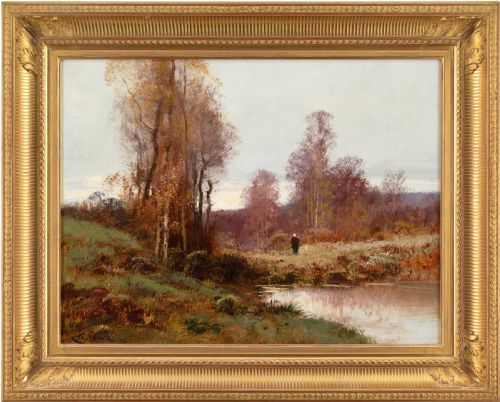
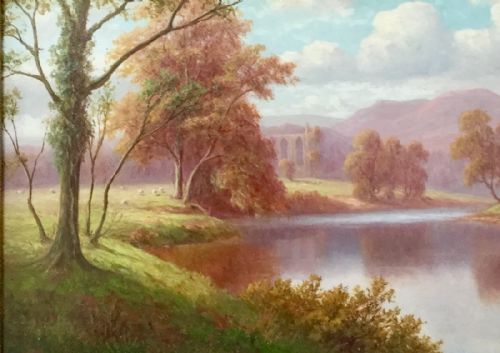
Autumn countryside wall art brings the quiet depth of seasonal rural scenes into a room through oil and watercolour paintings.
Autumn Countryside Wall Art
Autumn countryside wall art captures seasonal rural landscapes through oil and watercolour paintings dating from the Victorian era to the mid-twentieth century. These works depict pastoral scenes, river valleys, and agricultural life rendered in naturalistic and impressionistic styles.
Buyers will most frequently encounter framed oil paintings on canvas and watercolours on paper, often set within wooden or gilded moulding frames. The selection spans traditional country aesthetics, British Impressionism, and mid-century interpretations.
The subjects range from quiet river banks and upland lakes to working shire horses and woodland paths. Each piece reflects the specific palette and mood of the autumn season as interpreted by artists of the period.
Materials and methods
Painters working on these scenes utilised oil on canvas or watercolour on paper, applying pigments to capture the particular light of rural landscapes. Canvas supports provide texture for thicker oil applications, whilst paper allows for the fluid washes typical of traditional watercolours.
Frames are constructed from wood, sometimes enhanced with composite moulding and gilding to complement the artwork. These period frames serve both to protect the painting and to define its visual boundary.
Several canvases feature hardworking shire horses earning their keep long before tractors took over the ploughing.
Assessing quality
Quality in these rural scenes rests upon the artist's handling of light, atmosphere, and spatial depth within the composition. Stronger examples demonstrate confident brushwork and a balanced palette that evokes the specific character of the season.
The integrity of the original support, whether canvas or paper, along with the preservation of the surface pigment, influences the visual impact. Period frames that suit the scale and date of the painting further contribute to the overall standard of the piece.
Charles Clair·Samuel Timmins·George Graham·William Mellor·Charles James Adams·Percy Lancaster·Everett Watson Mellor
The Autumn Countryside Wall Art Glossary
- Oil on Canvas
- A painting technique where pigment suspended in oil medium is applied to a stretched woven fabric support. This method allows for rich colour depth and textured brushwork.
- Watercolour Painting
- Works created using water-soluble pigments on paper supports. This medium produces translucent washes that capture delicate light effects.
- Composite Moulding
- Manufactured framing material shaped from fibrous or plaster compositions over a wooden core. It provides decorative relief details on period frames.
- British Impressionism
- A painting style focusing on light and everyday subjects, often painted outdoors. It is characterised by visible brushstrokes and naturalistic colour palettes.
Autumn Countryside Wall Art: Frequently Asked Questions
How do I hang heavy oil paintings securely?
Heavy framed oil paintings require picture hooks rated for the specific weight of the piece, fixed directly into wall studs or using appropriate masonry fixings.
Using two mounting points on wider frames distributes the load evenly and keeps the artwork level on the wall.
Where should I place these paintings at home?
Select wall spaces away from direct sunlight and heat sources to protect the canvas, paper, and pigments from fading or drying out over time.
Room environments with stable humidity levels help preserve both the artwork and its wooden frame.
How can I tell the period of a landscape painting?
Examine the materials, framing style, and the stretcher or backing boards, which often show the age and manufacturing methods of the era.
Stylistic elements and signature styles of the period also help narrow down the date of execution.
How do I clean antique frames safely?
Dust gilded and wooden frames gently with a dry, soft brush to remove surface particles without disturbing delicate moulding or surface finishes.
Avoid using water or liquid cleaning solutions, as moisture can damage older composite materials and wood.