

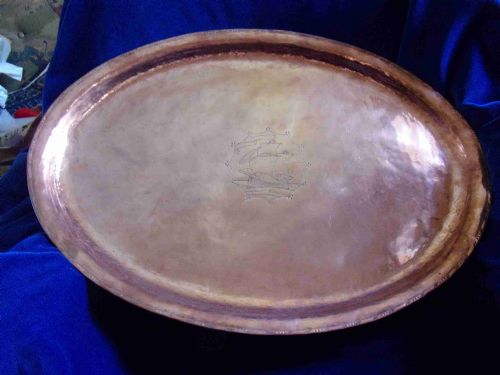


Arts and Crafts Charger
An arts and crafts charger is a circular metal wall plaque or tray that brings hand-worked texture and bold motifs into a room.
Arts and Crafts Charger
An arts and crafts charger takes the form of a broad circular tray or wall plaque, worked by hand with decorative motifs. The examples seen here date from around nineteen hundred and the Edwardian period, capturing an era of reform in design and craftsmanship.
The forms vary between copper and brass, often featuring motifs such as pomegranates, foliage, fishes, and fountains. Makers from Glasgow to Cornwall produced these pieces, encompassing regional styles like the Newlyn school.
Buyers seeking an arts and crafts charger will find both wall plaques intended for display and functional trays that double as decorative centrepieces. They offer a direct link to the metalwork guilds and independent studios of the early twentieth century.
How They Were Made
These chargers are formed primarily from beaten copper or brass, shaped by hand to create tactile, light-catching surfaces. The metal is worked with hammers and punches to raise motifs in relief and impress intricate background textures.
Designs are typically executed through repoussé and chasing techniques, where details like pomegranates, foliage, and fishes are pushed from the reverse and refined from the front. This manual process ensures that every plate bears individual tool marks from the artisan's workshop.
Arts and Crafts Charger Retail Price Guide 2026
Typical asking prices for arts and crafts charger among the pieces listed under this phrase on Sellingantiques today, from the lower quarter to the upper quarter. They describe what is for sale here now, not the wider market.
Design motifs recorded in the inventory include marine life, fountains, and botanical subjects like pomegranates.
What Varies in Quality
Quality in an arts and crafts charger rests upon the ambition of the design and the sureness of the hammer work. Pieces featuring complex iconography, such as three fishes arranged around a central fountain or detailed pomegranates, display a higher level of artisan skill than simpler geometric patterns.
The depth of the relief and the crispness of the chased background texture distinguish the finest studio work from mass-produced interpretations. Furthermore, attribution to known makers or regional groups adds a layer of distinction to the metalwork.
Faulkner Bronze Company·J. F Poole·John Pearson
The Arts and Crafts Charger Glossary
- Repoussé
- A metalworking technique where the design is hammered into relief from the reverse side. This method creates tactile surfaces on copper and brass chargers.
- Chasing
- Working metal from the front side with punches to refine details and sink the background. It is used alongside repoussé to add texture and depth.
- Charger
- A large decorative plate or broad tray used for display rather than dining. In this context, they were frequently hung on walls to showcase metalwork.
- Newlyn
- A Cornish art colony associated with distinctive copper craft. Pieces from this region often feature marine life and bold hand-beaten textures.
Arts and Crafts Charger: Frequently Asked Questions
How do I hang a metal charger?
Most chargers include a rolled rim or can be fitted with a dedicated brass spring hanger that grips the edge securely without damaging the metal.
Ensure the wall fixing is secure, as beaten copper and brass pieces carry a solid weight.
Are these chargers meant for food?
These pieces are primarily decorative wall plaques or display trays rather than tableware. Using them for food can damage the chased surface and the protective patina.
Enjoy them mounted on a wall or displayed flat on a sideboard.
How do I clean copper and brass?
Dust them gently with a soft dry cloth and avoid aggressive metal polishes that strip away the aged patina. Preserving the dark oxidation in the recessed areas is essential for keeping the design legible.
Harsh chemical cleaners will ruin the antique finish.
What is the Glasgow School style?
The Glasgow School developed a distinct aesthetic characterised by stylized natural forms, symbolic motifs, and linear designs. Metalwork from this circle often shows a refined restraint compared to heavier provincial pieces.
It remains one of the most influential design movements of the period.