
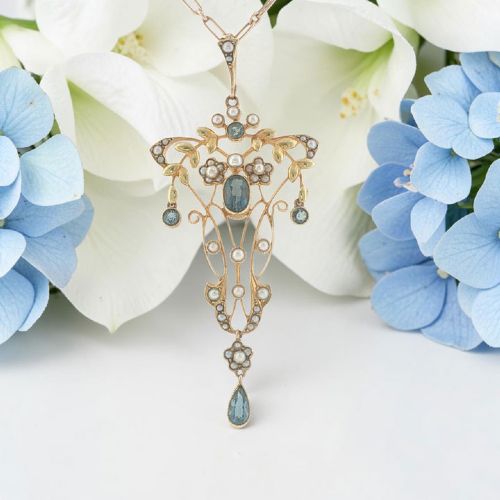
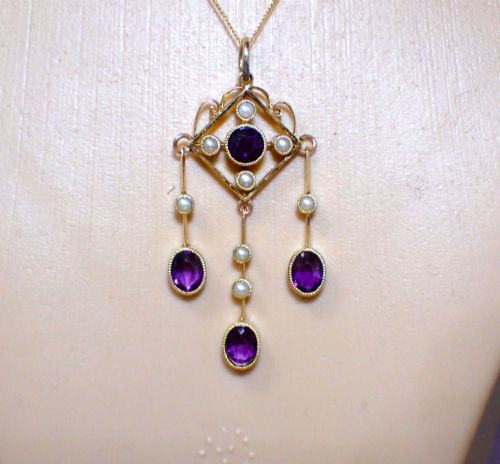


Art Nouveau Pearl Drop
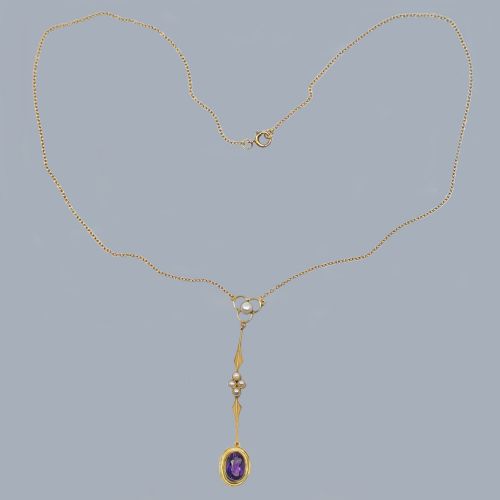
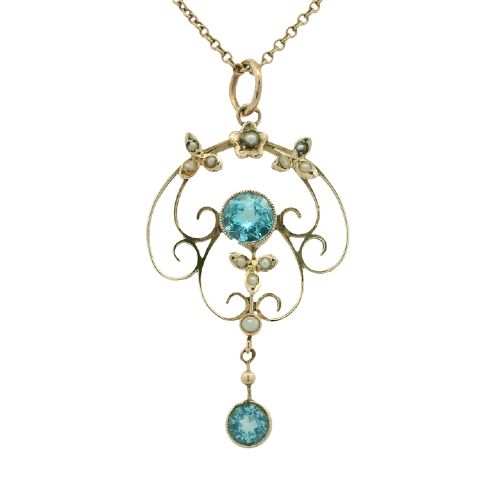
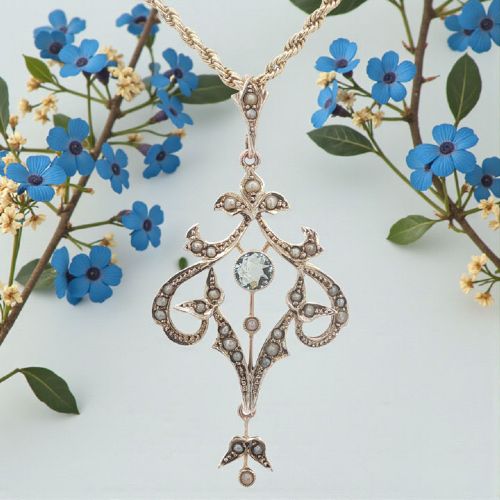
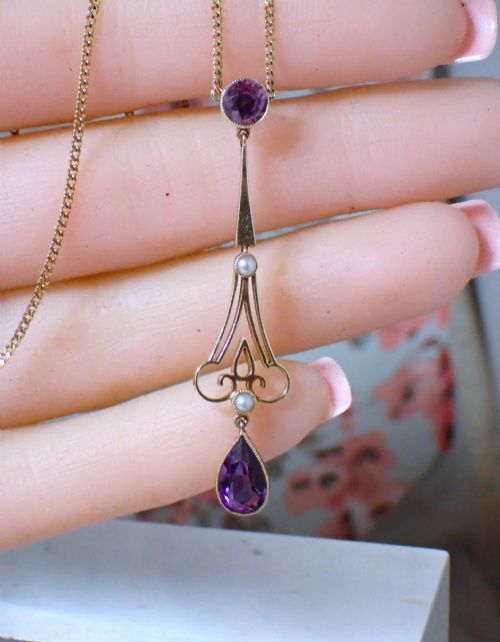
An art nouveau pearl drop captures organic floral motifs and fluid lines, suspended with lustrous pearls.

Art Nouveau Pearl Drop
An art nouveau pearl drop brings together organic botanical motifs, flowing whiplash lines, and delicate suspended pearls characteristic of the turn of the twentieth century. When exploring this selection, buyers frequently encounter pendants and necklaces fashioned from silver and gold, often paired with coloured gemstones.
The objects span late Victorian, Edwardian, and early twentieth-century periods, capturing the shift from traditional revivalism to stylised naturalism. Alongside central pendants, variations include lavalieres, brooches, and earrings that incorporate pearl drops as focal points.
These jewels reflect the collaborative spirit of the Art Nouveau and Arts and Crafts movements, bridging the gap between mass production and individual artisan workshops. Most surviving examples rely on seed pearls or baroque pearls to accent silver, silver gilt, and high-carat gold settings.
How they were made
Metalsmiths shaped nine-carat and fifteen-carat gold alongside silver and silver gilt using traditional casting, wire-twisting, and hand-beating techniques. Settings often utilised delicate bezel or collet mounts to secure central stones while allowing light to pass through.
Plique-a-jour and standard enamelling techniques introduced vibrant colour without a solid backing, mimicking stained glass windows. Seed pearls and larger drop pearls were carefully drilled and secured to wire or jump rings, dangling freely from the main body of the pendant.
Current listings feature pieces spanning the late Victorian period through the nineteen-thirties, executed in silver, gold, and enamel.
What varies in quality
The standard of execution in enamel work and metal chasing separates standard commercial output from master workshop production. Pieces featuring translucent plique-a-jour enamel demand exceptional skill to suspend glass within wire frames without fracturing.
The quality of the pearls themselves, ranging from uniform seed pearls to matched baroque drops with strong orient, dictates the refinement of the piece. Furthermore, the weight and purity of the gold or the integrity of the silver gilt mounting mark the distinction between simpler output and high-end atelier creations.
Archibald Knox·Liberty and Co·Murrle Bennett·Wilhelm Fuhner·Levinger and Bissinger·Otto Prutscher·Eduard Loss·Meyle and Meyer·Artificers Guild·Theodor Fahrner·Dropsy
The Art Nouveau Pearl Drop Glossary
- Plique-a-jour
- An enamelling technique where enamel is applied in cells without a backing, allowing light to shine through transparent coloured glass. This method resembles miniature stained glass and is frequently found in high-grade continental European pieces.
- Seed pearl
- A very small, naturally occurring pearl, typically under two millimetres in diameter. Makers drilled and strung these pearls closely together to create shimmering floral clusters or flexible drapes.
- Lavalier
- A pendant necklace featuring a central stone or ornament that suspends one or more smaller drops below. This style gained immense popularity during the Edwardian period.
- Silver gilt
- Sterling silver that has been coated with a thin layer of gold. This treatment gave jewellers the warm appearance of gold while working primarily in silver.
- Whiplash line
- The characteristic asymmetrical, undulating curved line central to Art Nouveau design, mimicking natural stems and roots.
Art Nouveau Pearl Drop: Frequently Asked Questions
What is an art nouveau pearl drop?
An art nouveau pearl drop is a piece of antique jewellery featuring flowing, organic designs from the turn of the twentieth century, finished with a dangling pearl.
These items primarily take the form of pendants and necklaces, though earrings and brooches also appear within the style.
How do I wear these antique necklaces?
These delicate pendants pair well with simple necklines that allow the intricate metalwork and dangling pearl to remain unobstructed.
Because antique chains can be fragile, some owners choose to pair the pendant with a secure contemporary chain that matches the metal colour.
How can I tell Edwardian pieces apart?
Edwardian and Art Nouveau pieces often overlap in date, but Edwardian designs tend towards lighter, symmetrical garland styles featuring platinum and diamonds.
Art Nouveau examples lean towards asymmetrical naturalism, whiplash curves, and coloured enamel work alongside pearls and semi-precious stones.
Were these drops always made with gold?
While gold was common, many workshops utilised silver or silver gilt to mount their stones and enamel work.
Nine-carat and fifteen-carat gold settings frequently appear alongside silver items, particularly in British Arts and Crafts and continental European designs.