




Art Nouveau Glass Bottle
An art nouveau glass bottle brings flowing floral forms and precious metal mounts straight to the dressing table.
Art Nouveau Glass Bottle
An art nouveau glass bottle encompasses perfume bottles, scent flasks, decanters, and dressing table jars produced primarily during the Edwardian period and around nineteen hundred. These vessels combine organic glass bodies with tactile metal elements, drawing on French Belle Epoque and Arts and Crafts aesthetics.
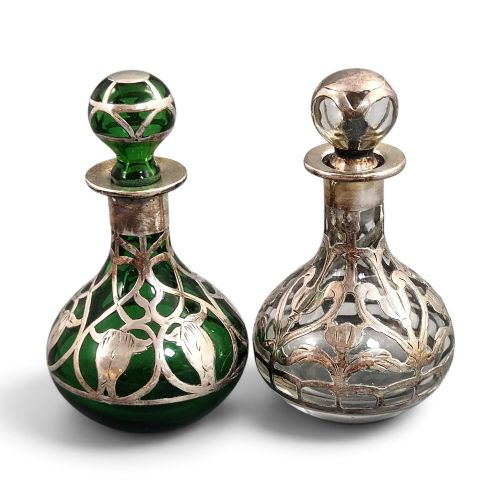
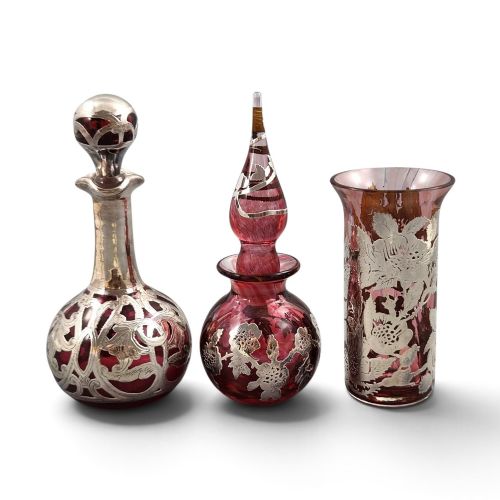
The most common examples encountered here are scent and perfume bottles paired with sterling silver overlay, often rendered in green glass, frosted glass, or ruby glass. Pieces extend to larger decanters, vanity sets, and cameo glass vases bearing distinct floral and natural motifs.
How they were made
Makers shaped glass through blowing and moulding techniques, yielding transparent, frosted, cameo, or iridescent finishes in colours such as green, cranberry, and ruby. Coloured batches and layered glass provided the depth necessary for acid-etched or cameo relief designs.
Craftsmen applied sterling silver, pewter, or enamel mounts directly onto the glass bodies. Silver overlay was pierced and soldered to hug the contours of the bottles, frequently complemented by hallmarked collars, lids, and stoppers.
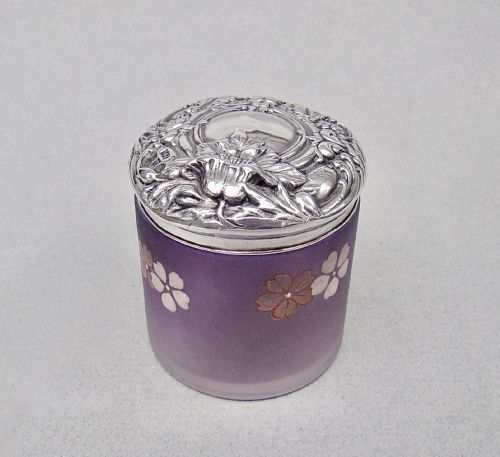
Object forms span perfume bottles, scent flasks, decanters, vanity sets, and dressing table jars.
What varies in quality
Quality rests in the harmony between the glass body and its metal mount, where heavier, intricately pierced sterling silver overlay demonstrates superior craftsmanship. The precision of the glass cutting, the depth of cameo carving, and the retention of original stoppers or matching lids elevate individual examples.
Provenance and maker attribution separate standard production wares from masterworks. Pieces carrying clear hallmarks, documented workshop origins, or specific designer signatures display a refinement in line and material execution.
Gorham·Rene Lalique·Archibald Knox for Liberty·Galle·Daum·Legras and Cie·Robert Pringle·Atkins Brothers·Baccarat·Alvin
The Art Nouveau Glass Bottle Glossary
- Cameo glass
- Glass formed with multiple layers of different colours fused together, allowing outer layers to be carved away to reveal a contrasting design. This technique created high-relief floral and landscape motifs.
- Silver overlay
- Sterling silver cut and applied directly to the exterior of a glass vessel, often depicting intertwining plant stems and organic patterns. The metal grips the glass surface securely.
- Guilloche enamel
- Decorative enamel technique where a precise geometric pattern is mechanically engraved beneath a translucent coloured enamel layer. It appears frequently on scent bottle lids and vanity items.
- Iridescent glass
- Glass treated with metallic salts while hot to produce a shimmering, rainbow-like sheen on the surface. This finish mimics natural patination found in ancient excavated glass.
Art Nouveau Glass Bottle: Frequently Asked Questions
What is an art nouveau glass bottle?
An art nouveau glass bottle is a decorative vessel for scent, perfume, or cologne produced around the turn of the twentieth century. These objects combine organic glass forms with naturalistic metal mounts inspired by plant life.
They serve as functional vanity items and decorative dressing table accessories. Collectors prize them for their distinct synthesis of glassmaking and metalwork traditions.
How do I identify the period?
Dating relies on stylistic markers, engraved signatures, and metal hallmarks stamped on the silver mounts. Pieces commonly date from the Victorian, Edwardian, and nineteen hundred eras.
Assay office marks and maker stamps on the silver components provide precise years of manufacture. Stylistic shifts between French Belle Epoque, Arts and Crafts, and Art Nouveau help narrow the timeline.
Are stoppers usually original?
Original stoppers match the specific glass tint, ground-in fit, and decorative scheme of the bottle. Finding a piece with its matching stopper or lid remains a key consideration for collectors.
Replacements occasionally occur due to the fragile nature of glass necks and stoppers. Inspecting the ground glass joint helps determine if the stopper belongs to the vessel.
How should I display them?
Displaying these bottles involves placing them on stable dressing table trays, in lit cabinets, or near natural light sources. Light passing through coloured, frosted, or cameo glass highlights the tactile qualities of the material.
Keeping them away from direct heat and unstable edges protects both the delicate glass and the applied silver mounts. Secure placement ensures the tall necks and stoppers stay safe.