
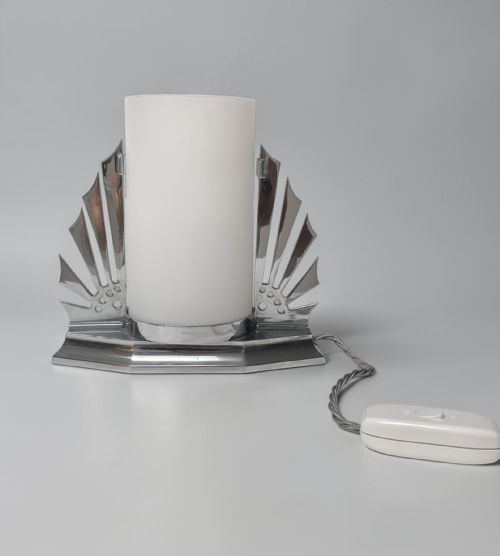
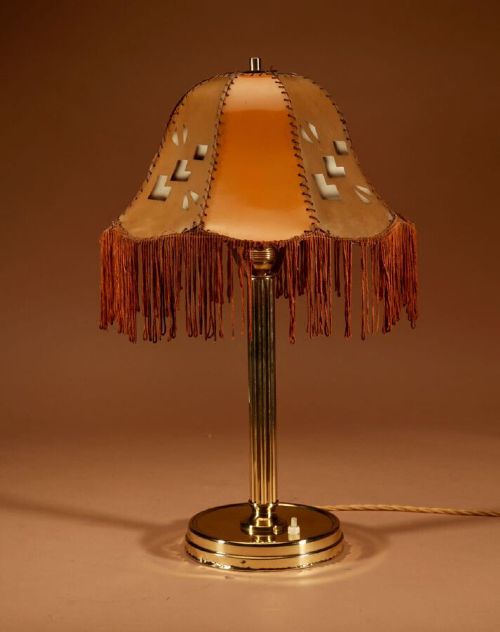


Art Deco Geometric Desk Light
An art deco geometric desk light brings striking lines and period illumination to your workspace.
Art Deco Geometric Desk Light
An art deco geometric desk light brings together the distinctive shapes of the early twentieth century for practical workspace illumination. These pieces range from simple table lamps to complex designs incorporating clocks or figural elements.
The versions most commonly met on this page date from the 1920s and 1930s, reflecting the height of the movement. Examples span from compact celluloid models to substantial pieces in chrome and glass.
Makers such as Eileen Grey, Karl Palda, Walther and Sohne, and Muller Bros represent the standard of design found in this category. Their work defines the visual language of the period through structured forms and directional lighting.
Materials and Construction
The construction relies heavily on metals such as chrome, brass, and nickel, paired with glass components including frosted and peach shades. These materials provide both the structural integrity and the reflective surfaces characteristic of the style.
Early plastics like bakelite and celluloid appear frequently in bodies and fittings, offering smooth finishes and moulded geometric contours. Fabric and leather elements occasionally supplement the primary structure on specific shades and bases.
Listings feature items dated across four distinct decades, spanning from 1910 to 1940.
Assessing Quality
Quality in these desk lights is determined by the precision of the geometric assembly and the integrity of the materials used. Superior examples feature well-preserved metal plating, intact original glass shades, and solid structural joinery.
Attribution to known designers or makers elevates a piece, as seen in signed glasswork or documented models from prominent workshops. The completeness of original components, such as specialised switches and specialised shades, dictates the overall standard.
Eileen Grey·Karl Palda·Walther and Sohne·Muller Bros
The Art Deco Geometric Desk Light Glossary
- Bakelite
- An early thermosetting plastic used for moulded lamp bases and body components. It provides a durable, glossy surface with distinctive tactile qualities.
- Chrome
- A metallic plating applied to steel or brass bases to achieve a bright, reflective finish. This treatment protects the underlying metal while defining the machine age aesthetic.
- Frosted Glass
- Glass treated to diffuse light evenly across a room or desk surface. It softens harsh glare from the bulb while maintaining the geometric silhouette of the shade.
- Celluloid
- An early thermoplastic material utilised for small decorative lamp elements. It offers a lightweight construction with subtle translucency.
Art Deco Geometric Desk Light: Frequently Asked Questions
What periods do these desk lights represent?
The pieces span several decades at the start of the twentieth century, with the majority originating in the 1920s and 1930s. Some examples extend back to the 1910s under Arts and Crafts influences, while others reach into the 1940s.
This timeline captures the evolution of modernist design from early experiments to the established geometric forms of the interwar period.
How were these lamps used originally?
These lights served as functional task illumination on desks, side tables, and workspaces in homes and offices. Certain models incorporated additional items like clocks to maximise utility on a busy surface.
Their directional glow and striking silhouettes also functioned as decorative centrepieces during daylight hours.
What materials should I expect to find?
Construction typically involves a combination of metals such as chrome, brass, and nickel paired with glass elements. Bakelite and celluloid are common for bodies and switches, while fabric and leather appear on specific shades.
Frosted and peach glass shades provide the characteristic diffused illumination associated with the movement.
How do I identify specific design styles?
Look for stark linear forms, zig-zag patterns, and cubist influences that depart from traditional ornamentation. Signed glass shades and marked metal bases often point to specific makers and studios.
The integration of contrasting materials, such as dark bakelite against bright chrome, reinforces the distinct visual vocabulary.