
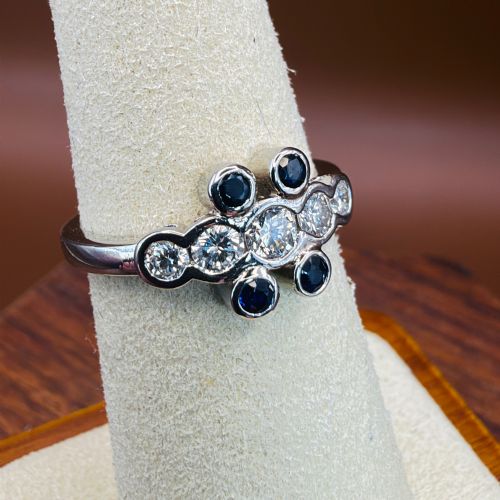


Art Deco Five Stone Ring
An art deco five stone ring brings together a linear row of gems that captures the bold geometric spirit of the interwar years.
Art Deco Five Stone Ring
Most examples showcase diamonds set either entirely across the band or interspersed with rich coloured stones such as sapphires, rubies, and emeralds. Buyers will frequently encounter variations that pair platinum settings with yellow or white gold shanks.
The format originated as a popular choice for engagements and anniversaries during the early twentieth century, engineered to maximise light capture on the hand. Today, these items function equally well as standalone dress bands or stacked wedding bands.
How They Were Made
Jewellers constructed these items using durable precious metals, frequently mounting platinum heads onto 18ct yellow or white gold shanks to ensure secure stone settings while maintaining a bright white backdrop for the gems. Platinum alone also served as the primary structural metal for finer examples, allowing for delicate millegrain edges and openwork galleries.
Gems were cut by hand, predominantly utilising old mine cuts, old European cuts, or early brilliant cuts that yield softer, deeper facets than modern machine-cut stones. Master setters secured these stones using shared claw techniques or precise bezel channels that emphasised clean horizontal lines.
Listings feature platinum, 18ct yellow gold, 14ct yellow gold, and 18ct white gold alongside diamonds, sapphires, rubies, and emeralds.
What Varies in Quality
The overall standard depends heavily on the total carat weight and optical matching of the primary stones, where uniform colour and clarity across all five positions elevate a piece significantly. Graduated stones must scale proportionately from the centre outward without abrupt shifts in size.
Craftsmanship in the metalwork marks the division between standard production and exceptional studio output. Fine examples display crisp, even millegrain decoration and secure claw work that shows minimal wear beneath a loupe.
The Art Deco Five Stone Ring Glossary
- Old cut
- A diamond facet style cut by hand before the advent of modern machinery, typically characterised by a smaller table, higher crown, and open culet. These stones exhibit a distinctive chunky pattern of light return under candlelight.
- Millegrain
- A decorative technique involving a row of tiny raised metal beads along the edge of a setting. This border softens the geometric transitions of the metalwork.
- Platinum
- A dense, strong white metal utilised extensively during the period for secure fine-prong settings. Its durability allows for minimal metal bulk around stones.
- Culet
- The small facet at the very bottom of a gemstone. Older cuts frequently feature a visible flat facet here rather than a pointed tip.
Art Deco Five Stone Ring: Frequently Asked Questions
Can I wear mine every day?
These pieces were built for daily wear, utilising durable platinum and gold alloys alongside robust stone settings. Regular checks by a jeweller ensure the claws remain secure.
To preserve the antique metalwork, remove the band during heavy manual tasks or swimming. Gentle cleaning in warm soapy water restores the sparkle.
How do I check the ring size?
A local jeweller can measure your finger accurately using standard sizing tools. Many antique bands can be adjusted by a professional workshop.
Sizing options depend on the metal type and whether the geometric shoulders carry engraving that might be disrupted during alteration.
Are the diamonds certified?
Most historic pieces enter the market without modern laboratory certificates, as grading standards developed long after their creation. Dealers assess stone parameters by eye and with magnification.
Carat weights listed are typically estimated in the mounting using dimensions and standard mathematical formulas.
How do I tell original pieces from revivals?
Original interwar examples display period-specific hand-cutting styles in the stones and natural wear patterns on the shank. Construction methods match the technological limitations and preferences of the 1920s and 1930s.
Revival pieces from later decades utilise different casting techniques and modern cut stones while copying the historic aesthetic.