


Art Deco Emerald Cut Ring
An art deco emerald cut ring combines geometric symmetry with vibrant gemstones, offering an elegant statement piece from the interwar period.
Art Deco Emerald Cut Ring
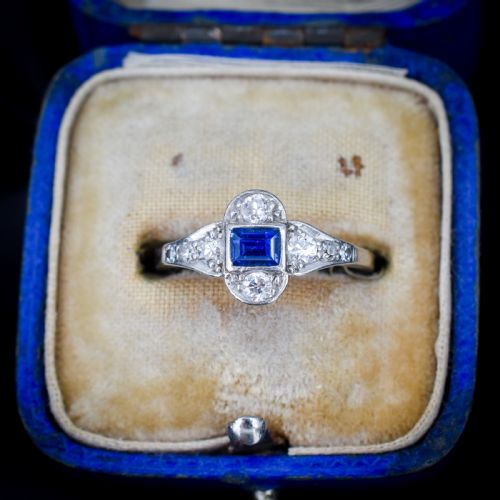
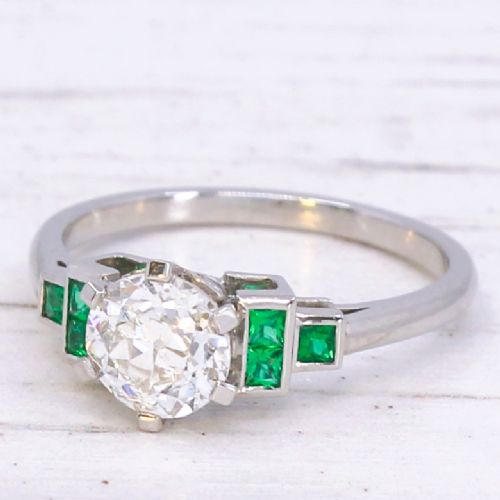
When searching for an art deco emerald cut ring, buyers encounter distinct rings defined by the straight lines and stepped facets characteristic of the 1920s and 1930s. The most common examples combine a central step-cut emerald or aquamarine flanked by brilliant or old-cut diamonds.
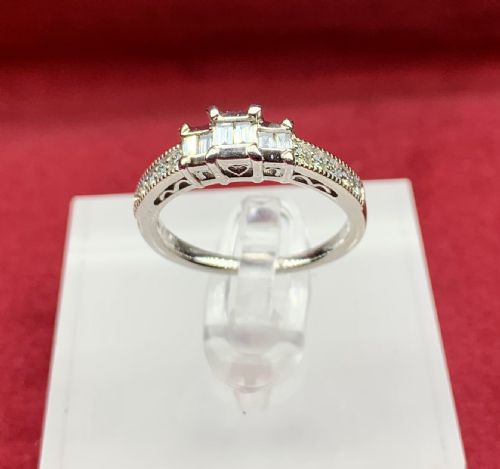
Many surviving pieces from this era utilise platinum or white gold settings to enhance the crisp geometry of the design. Cluster rings and trilogy layouts dominate the available selection, often incorporating calibre-cut accent stones.
Beyond emeralds, the inventory records numerous variants featuring sapphires, tourmalines, and yellow sapphires cut in the same architectural style. These configurations reflect the period preference for bold colour contrasts against neutral precious metals.
How they were made
Master jewellers constructed these mounts primarily in platinum or 18ct white gold, exploiting the high tensile strength of platinum to secure stones with minimal metal obstruction. This metal choice allowed artisans to execute delicate millegrain edges and open-work gallery designs.
Stones were typically step-cut with long, parallel facets to showcase material clarity rather than explosive brilliance. Gemstones were then accented with pavé or old-cut diamonds, hand-set into geometric channel and bezel arrangements.
Listings feature pieces spanning from the 1920s through the 1960s, executed in platinum, yellow gold, and white gold.
What varies in quality
Quality rests upon the natural origin and clarity of the central gem, with untreated Colombian emeralds sitting at the apex of the scale alongside certified sapphires. The precision of the step-cut geometry and the crispness of the hand-carved millegrain work further distinguish finer examples.
The architectural integrity of the platinum or gold mount dictates the structural longevity of the ring. Superior workshops achieved seamless integration between the central emerald-cut stone and the surrounding diamond shoulders without compromising metal thickness.
The Art Deco Emerald Cut Ring Glossary
- Emerald cut
- A rectangular or square stone configuration featuring truncated corners and stepped facets arranged parallel to the girdle. This cut prioritises stone clarity and geometric depth over intense fire.
- Millegrain
- A decorative technique involving a row of tiny raised metal beads along the edge of a setting. It imparts a softened texture to sharp platinum borders.
- Trilogy ring
- A jewellery arrangement featuring three principal stones set in a row. The central gem is traditionally flanked by two matching side stones.
- Old cut
- A vintage diamond cutting style characterised by a smaller table, higher crown, and open culet. These stones exhibit broader facets tailored for candlelight.
- Columbian emerald
- Beryl sourced from specific mines in Colombia known for a distinct, saturated green hue. These stones frequently command higher interest among collectors.
Art Deco Emerald Cut Ring: Frequently Asked Questions
What defines an art deco ring?
These rings are defined by symmetrical geometry, straight lines, and architectural motifs inspired by the 1920s and 1930s design movements. They frequently pair step-cut centre stones with contrasting accent gems.
Settings rely heavily on platinum or white gold, often embellished with intricate filigree or millegrain borders to emphasise linear precision.
How do I care for my ring?
Protect your jewellery by removing it during rigorous physical activities or manual labour to prevent impact damage to the central stone. Regular cleaning with warm soapy water and a soft brush maintains metal brightness.
Avoid harsh chemical dips, particularly with emeralds that may have undergone minor oil treatments to enhance surface clarity.
Are all emeralds treated?
Many emeralds receive minor oil or resin treatments to fill microscopic surface fissures and improve overall visual clarity. Certification documents from gemological laboratories typically state whether treatment is detected.
Untreated stones with natural clarity remain less common and hold distinct appeal for collectors focusing on original condition.
Can I resize vintage rings?
Most precious metal rings can be adjusted by a skilled bench jeweller, though intricate geometric shoulders require careful handling. The presence of continuous channel-set stones around the band may limit the adjustment range.
Consult a specialist who understands antique mounting techniques to ensure the structural integrity of the gallery remains undisturbed.