


Art Deco Calibre Ruby
Art deco calibre ruby pieces are striking jewels defined by tightly set, channel-cut stones, offering a masterclass in geometric elegance.
Art Deco Calibre Ruby
When you search for art deco calibre ruby, you are looking at sophisticated jewellery from the early to mid-twentieth century, specifically drawing on periods like the 1920s, 1930s, and 1940s alongside Edwardian examples.
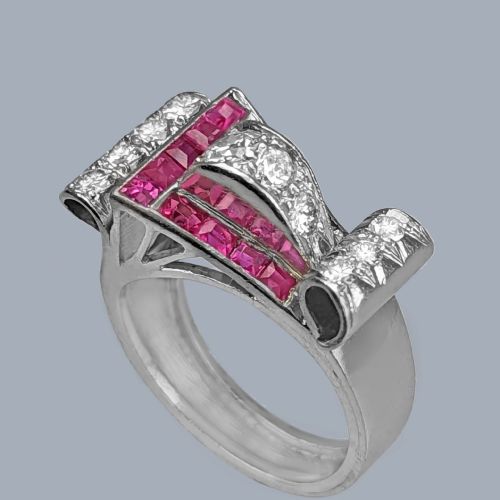
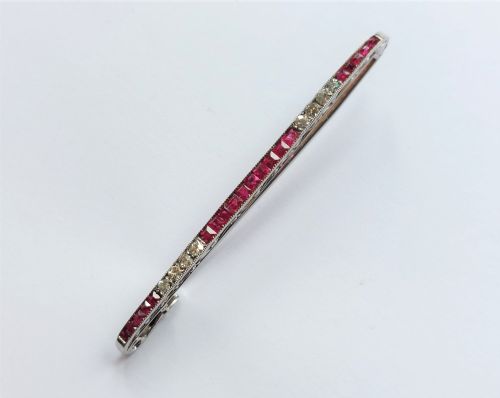
The versions you are most likely to meet on this page take the form of rings, dress rings, and bar brooches.
These items frequently combine deep red rubies with sparkling diamonds, mounted in platinum, 18ct white gold, or 18ct gold.
Materials and Construction
Maker techniques rely heavily on platinum and 18ct white gold to provide a crisp, durable setting that holds intricate stone arrangements securely.
Rubies are shaped into specific geometric cuts, such as french cuts and calibre cuts, allowing stones to sit flush against one another with minimal metal showing.
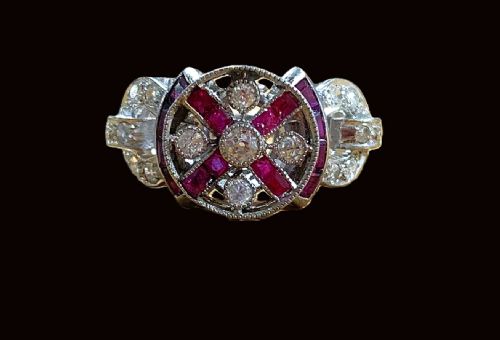
Diamonds, including old cuts, rose cuts, and oval cuts, are integrated alongside the rubies in cluster, target, checkerboard, and buckle formations.
Some rings manage to pack French cuts, rose cuts, and a buckle motif into a single piece of finger-sized architecture.
Assessing Quality and Design
The top of the range is distinguished by the precision of the stone cutting, where closely fitted calibre rubies create an unbroken line of colour.
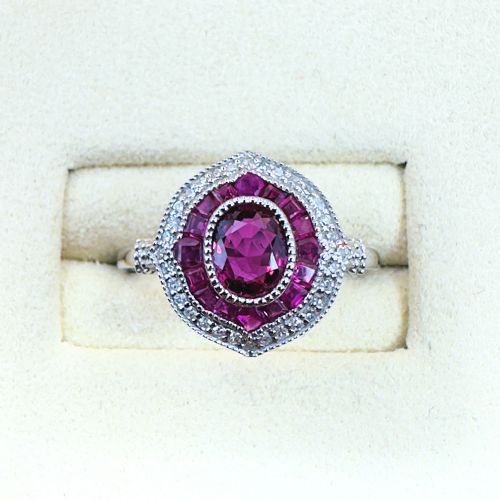
Metalwork execution also separates exceptional pieces, with fine millegrain detailing and substantial platinum or 18ct white gold structures showing superior workshop standards.
The Art Deco Calibre Ruby Glossary
- Calibre cut
- A style of gemstone cutting where stones are tailored in small, uniform shapes to fit tightly into a specific geometric channel.
- Target ring
- A circular cluster ring featuring concentric rings of contrasting gemstones, often centring on a diamond and framed by calibre rubies.
- Old cut diamond
- A precursor to the modern brilliant cut, featuring a smaller table, higher crown, and hand-faceted symmetry typical of earlier periods.
- Marquise cluster
- A boat-shaped gemstone arrangement featuring pointed ends, designed to elongate the appearance of the finger on a ring.
- Millegrain
- A decorative edging technique consisting of a row of tiny, raised metal beads along the bezel or border of a setting.
Art Deco Calibre Ruby: Frequently Asked Questions
What is an art deco calibre ruby ring?
These are period rings featuring rubies cut specifically to fit flush together in geometric channels, surrounded by diamonds and mounted in platinum or white gold.
They represent the architectural and clean lines characteristic of design from the 1920s and 1930s.
How do I care for my ruby and diamond ring?
Protect your jewellery by storing it separately in a lined box to prevent hard stones like diamonds from scratching softer metals or gems.
Have the settings checked periodically by a professional jeweller to ensure the tight-fitting calibre stones remain secure.
Are these rings suitable for daily wear?
Platinum and 18ct gold mountings provide robust daily support, though the precise arrangement of calibre stones requires mindful handling during rigorous manual tasks.
Removing the ring during heavy activity protects the intricate geometric setting from impact.
How can I tell a 1930s ring from a 1950s ring?
Look closely at the mounting style and diamond cuts, as 1930s pieces often feature old cuts and platinum with pronounced geometric motifs.
Mid-century examples from the 1950s frequently incorporate oval cuts and different white gold alloy standards.