
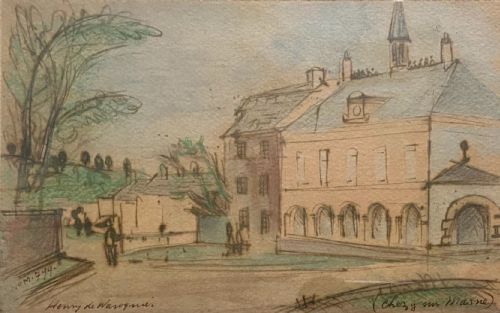


Architectural Watercolour Sketch
An architectural watercolour sketch captures building designs and townscapes with fluid pigment, offering buyers a direct window into historical drafting and artistic observation.
Architectural Watercolour Sketch
An architectural watercolour sketch combines precise structural drawing with fluid washes of pigment, capturing buildings, streetscapes, and grand monuments. When you search for an architectural watercolour sketch, you encounter works ranging from detailed Victorian designs to mid-century topographical studies.
The pieces listed here span several decades from the nineteenth century through the 1940s, frequently utilising paper support framed under glass. Common subjects include continental buildings, English townscapes, and specific historic properties recorded by artists working in pencil, ink, and watercolour.
Materials and technique
Artists typically began these works with graphite pencil or monochrome ink to establish precise perspective, proportions, and structural lines of buildings. Watercolour washes and crayon were then applied over the drawing to introduce tone, shadow, and atmospheric colour.
Finished works on paper were frequently protected beneath glass and housed within giltwood or simple frames to preserve the delicate pigments. Mixed media elements, such as gouache or bodycolour, occasionally appear alongside traditional watercolours to heighten architectural details.
Several drawings preserve the hurried daily observations of busy townscapes and grand Venetian canals.
Evaluating quality and execution
Quality in an architectural watercolour sketch rests upon the surety of the initial draftsmanship and the control of the pigment washes. Stronger examples demonstrate confident perspective and deliberate brushwork that define stone, brick, and foliage without excessive labour.
The distinction between standard topographical records and superior works often lies in the artist's ability to balance rigid architectural geometry with lively, atmospheric composition. Condition also plays a role, particularly the preservation of the paper support and the vibrancy of the ink and watercolour.
Henry de Waroquier·J W Hogley·Hercules Brabazon Brabazon·Pio Panfili·Fred Lawson·Maurice Asselin·Tom Dudley
The Architectural Watercolour Sketch Glossary
- Watercolour
- A paint consisting of a pigment suspended in a water-soluble vehicle, used to create transparent washes of colour on paper.
- Graphite
- A form of crystalline carbon used in pencils for initial sketching and precise underdrawing beneath paint layers.
- Monochrome
- Executed in a single colour or shades of a single colour, often utilising black or sepia ink for historical drawings.
- Giltwood
- Wood that has been treated with gold leaf or a gold-coloured finish, commonly found on traditional picture frames.
- Topographical
- Representing specific places, buildings, or landscapes with an emphasis on accurate geographical and architectural detail.
Architectural Watercolour Sketch: Frequently Asked Questions
What is an architectural watercolour sketch?
An architectural watercolour sketch is a work on paper that combines linear drawing in ink or pencil with fluid paint washes to record buildings and streetscapes.
These pieces served as studies for larger projects, travel records, or finished topographical artworks capturing historic structures.
How were these sketches used?
Artists and designers utilised these drawings to document structural designs, decorative cabinets, and notable townscapes during their travels or commissions.
They functioned both as working documents for architects and as collectible landscape art for domestic interiors.
How should I frame these works?
Because these pieces are executed on paper, they require framing behind glass to protect them from dust, moisture, and handling damage.
Using acid-free mounts ensures the paper and delicate watercolours remain stable and unaltered over long periods.
How do I date an architectural sketch?
Dating relies on stylistic evidence, paper characteristics, inscribed dates, and the known working periods of the recorded artists.
Clothing styles of figures within the scene and architectural modifications to depicted buildings also provide reliable chronological clues.