




Arak Oriental Rug
An arak oriental rug brings heavyweight Persian warmth into a room, offering room-sized presence and enduring textile character.
Arak Oriental Rug
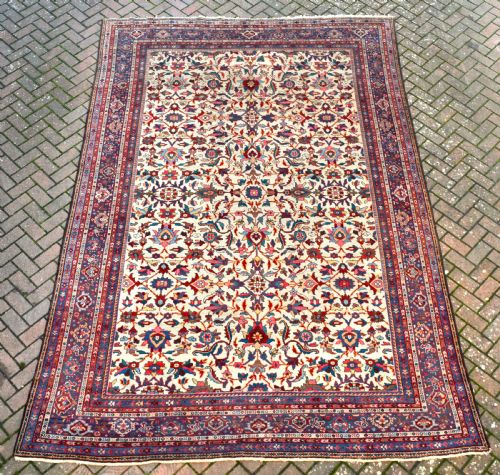
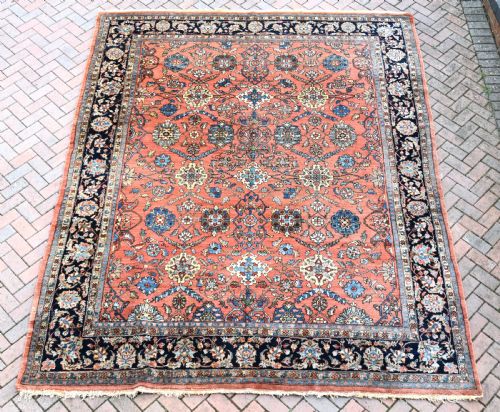
When you search for an arak oriental rug, you encounter substantial room-sized carpets and runners originating from Persian workshops. The examples found here span the Victorian era through to the early decades of the twentieth century, with styles typically categorised as Mahal, Sultanabad, Sarouk and Lilihan.
The pieces on this page are dominated by large room carpets rather than small mats, often displaying traditional Persian motifs such as all-over shrub and Mina Khani designs. These floor coverings were built for country houses and large reception spaces, meaning they easily anchor generous modern interiors.
How they were made
These floor coverings rely on traditional hand-knotting techniques executed using durable wool piles secured on sturdy cotton foundations. The natural resilience of these materials explains why large-scale carpets survive intact across more than a century of heavy use.
Weavers in these Persian districts constructed large formats like runners and room-size carpets with dense pile foundations designed to withstand heavy foot traffic. The structural integrity comes from tightly spun cotton warp and weft threads supporting thick wool surfaces.
Woven with enough wool to survive a century of muddy boots and country house dogs.
What varies in quality
Quality in these carpets rests on the density of the knotting and the crispness of the traditional Persian design execution. Finer examples show greater precision in complex motifs like the Mina Khani pattern, whereas simpler utility rugs present looser geometry.
The overall scale and state of preservation also define the hierarchy within these floor coverings. Grand country house formats with ivory grounds and robust wool piles command attention through their sheer presence.
The Arak Oriental Rug Glossary
- Mahal
- A designation for Persian carpets produced in the region surrounding the town of Sultanabad, known for bold floral designs and room-scale formats.
- Sarouk
- A style of Persian carpet originating from a village near Arak, celebrated for finely woven structures and dense floral sprays.
- Sultanabad
- The historical marketplace and manufacturing centre in western Persia where large commercial carpet production flourished during the nineteenth century.
- Mina Khani
- A repeating traditional Persian pattern composed of interconnected flowers arranged in a symmetrical grid across the field.
- Runner
- A long, narrow carpet format designed specifically for hallways, corridors or staircases.
Arak Oriental Rug: Frequently Asked Questions
What is an arak oriental rug?
These pieces are large Persian hand-knotted floor coverings, including carpets and runners, produced in workshops around the Arak district during the late nineteenth and early twentieth centuries.
They were designed primarily for substantial reception rooms and country house settings, offering durable wool construction and traditional Persian patterns.
Where were these carpets made?
The pieces originate from workshops in the western Persian region surrounding Sultanabad, which later became known as Arak.
This area operated as a major hub for large-scale carpet production destined for Western markets during the Victorian and Edwardian periods.
How do I date an old carpet?
Dating relies on structural characteristics, design style, and the specific village traditions recorded in the weaving. Pieces seen here generally span from the Victorian era up to the 1920s.
Examining the materials, such as hand-spun wool and cotton foundations, helps confirm the approximate period of manufacture.
Are these rugs durable enough for daily use?
The heavy wool piles and sturdy cotton foundations make these carpets exceptionally robust for everyday living spaces. Originally built for busy country houses, they handle floor traffic well.
Placing an appropriate underlay beneath the carpet will help protect the antique foundation during daily use.
What styles of design appear most often?
The designs typically feature traditional Persian motifs, including all-over shrub patterns and symmetrical Mina Khani floral layouts. Ivory grounds and large-scale room formats also frequently occur.
These patterns reflect the commercial workshop output of the region during the late nineteenth and early twentieth centuries.