




Antique Wooden Music Box
An antique wooden music box brings mechanical melody into a room through pinned cylinders and steel teeth.
Antique Wooden Music Box
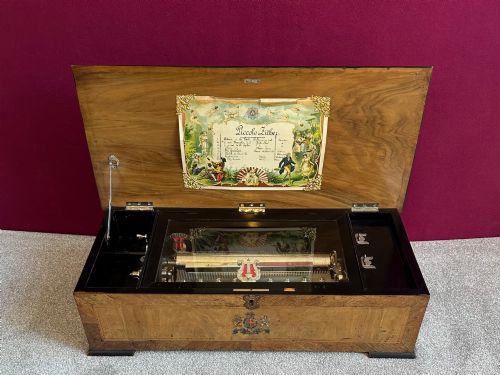
An antique wooden music box is a mechanical instrument housed in a timber case, designed to play pre-set tunes using a revolving pinned cylinder and a tuned steel comb. The pieces met most often on this page date from the nineteenth century, particularly the Victorian era, alongside Edwardian examples and later twentieth-century specimens.
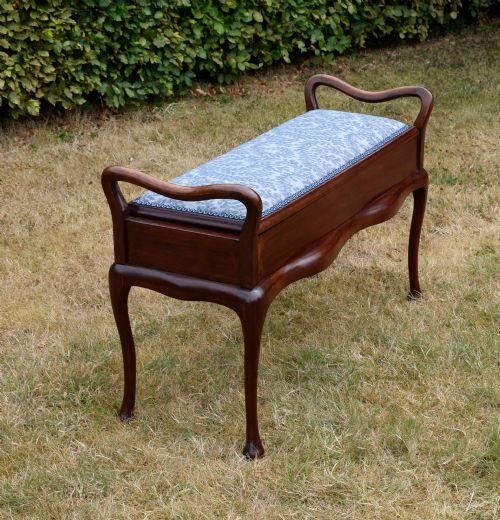
Most examples originate from Swiss workshops, often taking the form of rectangular wooden boxes enriched with marquetry or stringing. Alongside standard table boxes, the selection includes related items such as music cabinets, stools, and musical fruit bowls.
Materials and construction
Maker workshops built the cases using hardwoods such as mahogany, walnut, and rosewood, frequently incorporating ebonised wood and boxwood for decorative contrast and inlay. Glass panels sometimes protect the internal movement, allowing the cylinder and comb to remain visible while playing.
Inside the case, the mechanism relies upon brass gear trains, steel cylinders set with tiny pins, and tempered steel combs that vibrate to produce distinct musical notes. Some elaborate specimens incorporate additional brass bells struck by miniature hammers during playback.
Antique Wooden Music Box Retail Price Guide 2026
Typical asking prices for wooden music box among the pieces listed under this phrase on Sellingantiques today, from the lower quarter to the upper quarter. They describe what is for sale here now, not the wider market.
Listings feature timbers such as rosewood, mahogany, walnut, and ebonised wood across Victorian and Edwardian periods.
Distinctions in quality
The standard of a box rests upon the precision of its musical movement and the maker responsible for its creation. Established workshops like Nicole Freres produced mechanisms with superior tonal clarity and complex arrangements of multiple airs.
Case execution also marks out the better examples, where intricate marquetry inlay, sound choice of timber, and robust internal construction elevate the piece. The richness of the acoustic output and the smoothness of the winding mechanism distinguish finer specimens from simpler variants.
Nicole Freres·Langdorff And Fils·B A Bremond
The Antique Wooden Music Box Glossary
- Cylinder
- The rotating brass barrel set with hundreds of precise metal pins that pluck the teeth of the comb. Each pin must align exactly with its corresponding steel note.
- Comb
- The tuned flat plate of steel cut into individual teeth that vibrate when struck by the cylinder pins. The length and thickness of each tooth determine its pitch.
- Air
- A distinct musical tune or melody pinned onto the cylinder. Boxes frequently play multiple airs in a set sequence.
- Marquetry
- Decorative woodwork formed by fitting thin veneers of different timber species into a prepared surface. Geometric patterns and floral motifs frequently adorn the lids of these boxes.
- Bells
- Small resonant domes added to the interior movement and struck by hammers during playback. They provide an accompanying chime to the main comb melody.
Antique Wooden Music Box: Frequently Asked Questions
How do I wind the movement?
Most cylinder boxes utilise either a side-mounted winding handle or a dedicated key applied to an arbor on the movement plate. Turn the key gently in the direction specified by the mechanism until resistance is felt.
Avoid over-winding the spring, as older steel can weaken under excessive tension. Once wound, release the stop lever to allow the cylinder to rotate and play the pinned melodies.
Where should I place my box?
Position the piece on a stable, level surface away from direct sunlight, radiators, and damp environments. Fluctuations in temperature and humidity cause timber to warp and internal glues to fail.
A quiet corner of a dry room allows the acoustic resonance of the wooden case to project cleanly without competing with household noise.
How many tunes do they play?
The number of melodies depends on the capacity of the pinned cylinder, with standard models typically offering between six and twelve distinct airs. A single cylinder shifts laterally after each rotation to present a fresh sequence of notes to the comb.
Larger concert boxes or interchangeable cylinder systems extend this repertoire considerably. The tune sheet pasted inside the lid usually lists the specific titles assigned to each movement.
What is a symphonium?
A symphonium is a large mechanical instrument that uses perforated metal discs rather than a pinned cylinder to produce music. These table-top models generate a fuller, louder sound than standard cylinder boxes.
They require robust wooden cabinetry to support the heavier disc-spinning mechanism and often feature dual combs for richer harmonic output.