




Antique Wine Roemer Glass
An antique wine roemer glass is a historic drinking vessel defined by its characteristic bowl and stacked foot, prized for its deep tones and tactile presence.
Antique Wine Roemer Glass
When you search for an antique wine roemer glass, you are looking at historic drinking vessels originating across Britain and continental Europe. These pieces span periods from the eighteenth century through to the early twentieth century, including Georgian and Victorian examples.
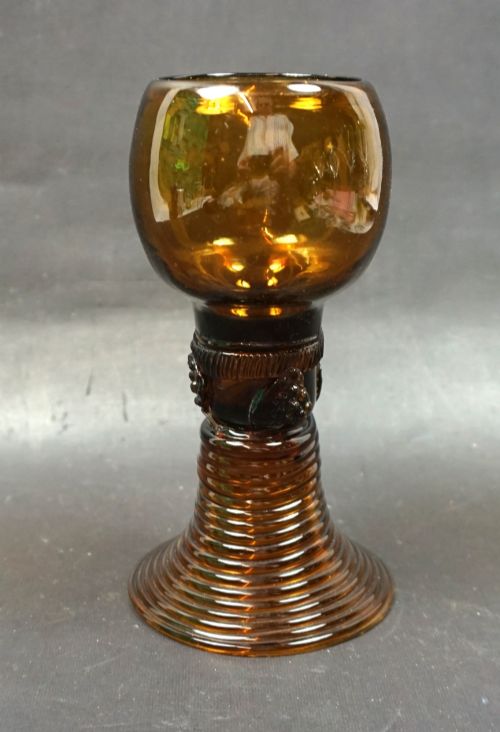
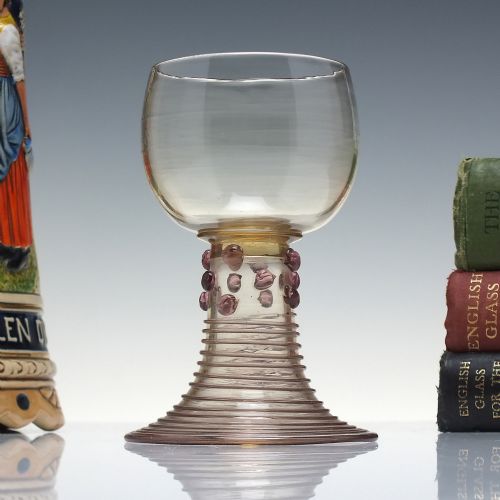
The most common version met on this page is the green glass roemer featuring a hollow stem and a coiled foot. Other variants appear in amber, ruby red, amethyst, and turquoise, alongside styles ranging from German Historicism to Biedermeier and Jugendstil.
Materials and construction
Makers utilised hand-blown glass, lead glass, and cut crystal to shape these goblets. The characteristic hollow stem and coiled foot required precise manipulation while the material remained molten.
Decoration often involved intricate wheel engraving, polychrome enamel painting, and gilding applied to the bowl. Artisans also employed acid-etching and surface cutting to catch the light across coloured glass.
Antique Wine Roemer Glass Retail Price Guide 2026
Typical asking prices for wine roemer glass among the pieces listed under this phrase on Sellingantiques today, from the lower quarter to the upper quarter. They describe what is for sale here now, not the wider market.
Listings feature hand-blown glass, cut crystal, and lead glass across Georgian, Victorian, and twentieth-century periods.
Distinctions in quality
The standard of an antique wine roemer glass rests upon the depth of the colour and the clarity of the blown material. Superior examples display balanced proportions between the wide bowl and the stacked, threaded foot.
Finishing details separate standard vessels from exceptional ones, particularly the crispness of wheel engraving or the precision of enamel heraldic motifs. The weight of the lead glass and the smoothness of the pontil mark also indicate the skill of the original workshop.
Moser Bohemian·Frits Hechert·St Louis Massenet·Lobmeyer
The Antique Wine Roemer Glass Glossary
- Roemer
- A traditional Germanic wine goblet featuring a large bowl, a cylindrical stem applied with prunts or coils, and a wide conical foot formed by coiling a glass trail.
- Prunt
- An applied blob of molten glass melted onto the stem to provide a secure grip.
- Pontil mark
- The rough scar left on the base of the vessel where the iron rod was detached after blowing.
- Historismus
- A nineteenth-century artistic movement that revived historical styles, frequently seen on enamelled German vessels.
- Lead glass
- A heavier type of glass containing lead oxide that increases brilliance and makes cutting easier.
Antique Wine Roemer Glass: Frequently Asked Questions
What is an antique wine roemer glass?
An antique wine roemer glass is a traditional European drinking vessel characterised by a rounded bowl set atop a cylindrical stem and a conical foot.
These glasses date from the eighteenth to the early twentieth century and were traditionally used for white wine and hock.
How were coloured roemer glasses made?
Glassmakers used mineral oxides in the molten batch to achieve shades of green, amber, ruby red, amethyst, and turquoise.
The distinct foot was constructed by wrapping hot trails of glass around a hollow core to create the characteristic stacked appearance.
How do I identify a Georgian roemer?
Georgian examples typically feature a deep forest green or olive tone combined with a hollow stem and a folded or coiled foot.
These pieces often show evidence of a pontil mark on the base and possess a heavier hand-blown feel compared to later factory-produced glassware.
Can I use these glasses for wine today?
Many collectors prefer to use these historic goblets for dining, provided they are hand-washed with care.
The sturdy lead glass and robust construction mean they remain functional centuries after their initial manufacture.