


Antique Wall Weather Gauge
An antique wall weather gauge measures atmospheric pressure and temperature with brass dials mounted in carved wood.
Antique Wall Weather Gauge
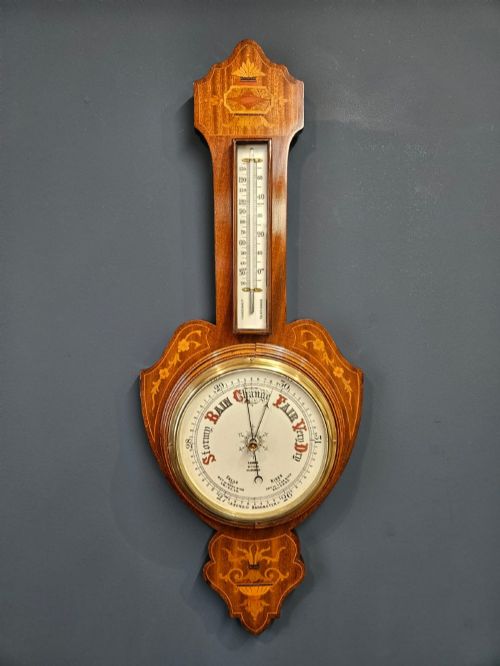
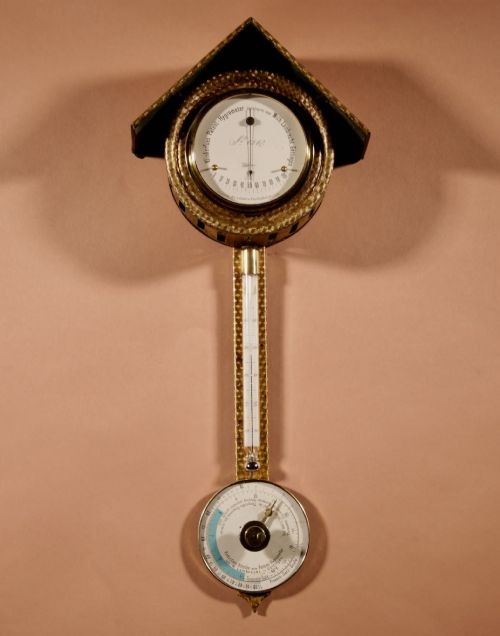
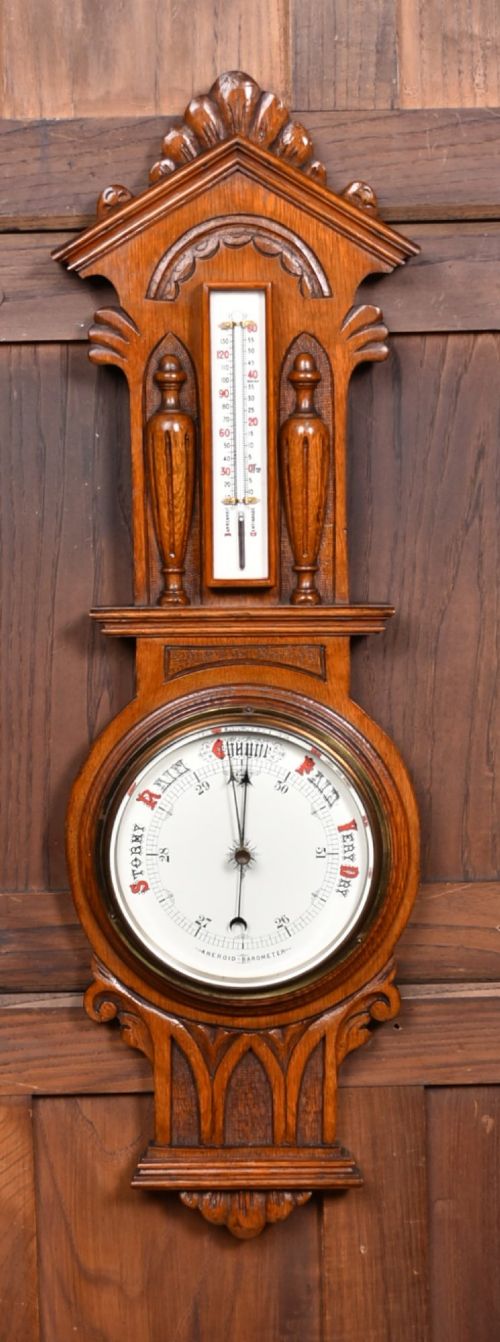
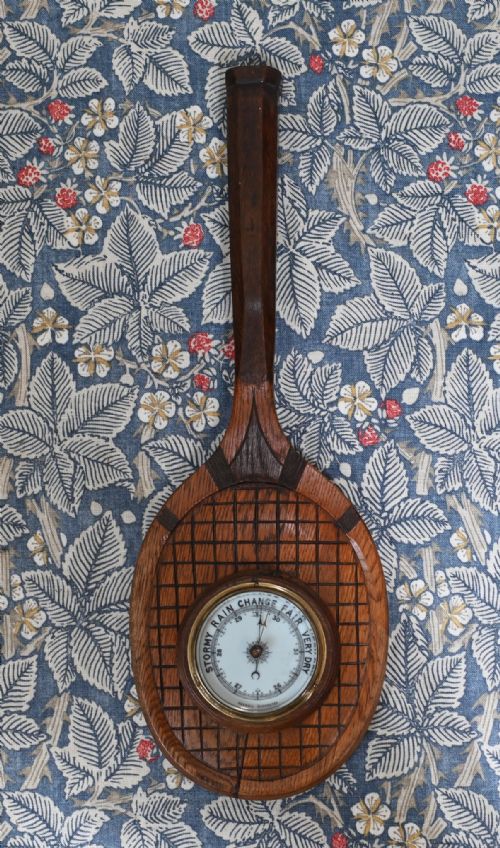
An antique wall weather gauge takes the form of barometers, weather stations, and thermometers designed for domestic or maritime display. The selection spans Victorian banjo shapes, Edwardian models, and 1930s variations mounted on timber panels.
Most pieces date from the Victorian era through the early twentieth century, showing styles from heavy oak carvings to inlaid mahogany and lacquered Chinoiserie. These instruments hung in hallways, libraries, and ship cabins to track meteorological shifts.
The layout typically combines a circular dial with auxiliary thermometer scales or hygrometers, set into woods such as walnut, rosewood, oak, and beechwood.
Materials and construction
Cabinetmakers shaped the wall housings from dense hardwoods like mahogany, oak, walnut, and rosewood, frequently adding marquetry inlays or hand-carved motifs. Black Forest pieces display deep relief carvings of natural foliage and animals.
Instrument makers fitted brass bezels, silvered or porcelain dials, and protective glass plates over delicate internal movements such as aneroid capsules, hair hygrometers, and mercury tubes. Ebonising and Chinoiserie lacquer finishes provided alternative surface treatments.
Periods represented span from the Victorian era and the Edwardian period through to 1930s Art Deco.
What separates the finest examples
The calibre of a wall weather gauge rests upon the crispness of the timber carving and the complexity of the housing, whether simple circular beechwood or elaborate Black Forest foliage. Marquetry inlay work and specialist finishes like maroon Chinoiserie distinguish more ambitious workshop output from standard production.
The reputation of the maker and the legibility of engraved brass or porcelain dials elevate certain barometers above simpler domestic equivalents. Complex multi-instrument weather stations and specialised scientific patents carry greater precision in their execution.
Wilh. Lambrecht·Poulenc Freres·Elliott Brothers·Short & Mason·Negretti & Zambra·James H Kelly·Blake & Son·Dollond of London
The Antique Wall Weather Gauge Glossary
- Aneroid barometer
- An instrument that measures atmospheric pressure using a flexible metal box without liquids. This mechanism allowed makers to build compact wall units.
- Banjo barometer
- A domestic wall barometer shaped like a traditional stringed instrument with an expanded circular head and a tapered trunk. This form dominated nineteenth-century hallways.
- Hygrometer
- A device that measures humidity in the air using organic fibres such as human hair. Saussure and Klinkerfues patented specific variations for scientific observation.
- Stick barometer
- A tall, narrow wall instrument containing a vertical tube of mercury. These pieces offer direct atmospheric readings through exposed columns.
- Thermometer
- An instrument scaled to record ambient temperature. Porcelain and enamel versions frequently accompany barometers on shared mounting boards.
Antique Wall Weather Gauge: Frequently Asked Questions
How do wall barometers work?
An aneroid barometer uses a sealed metal capsule that expands or contracts as atmospheric pressure changes. This movement connects to a pointer visible on the dial.
Traditional stick barometers use a column of mercury balanced against atmospheric pressure. Both designs translate meteorological shifts into visual measurements on the wall.
Where should I hang a barometer?
Hang your barometer on an interior wall away from direct sunlight, radiators, and heavy draughts. Sudden temperature fluctuations can affect the internal mechanical response.
Most wall gauges include a hanging loop or bracket on the reverse for secure placement at eye level.
How do I set my barometer?
Adjust your aneroid barometer to match current local atmospheric readings by turning the small screw on the back of the case. Tapping the glass gently before reading helps settle the pointer.
Historical instruments may require calibration against a known regional baseline to ensure accurate pressure tracking.
What is a weather station?
A weather station combines multiple measuring instruments, such as a barometer, thermometer, and hygrometer, mounted on a single wooden plaque. These composite pieces offered comprehensive domestic monitoring.
Victorian examples often incorporated patent mechanisms by makers like Klinkerfues alongside traditional glass tubes.