




Antique Upholstered Reclining Sofa
These antique upholstered reclining sofa pieces offer adjustable comfort and traditional elegance, combining period frames with soft textiles.
Antique Upholstered Reclining Sofa
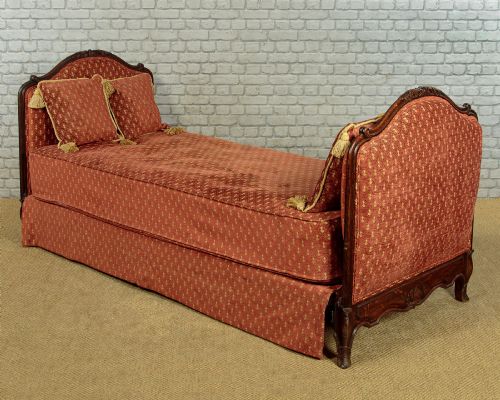
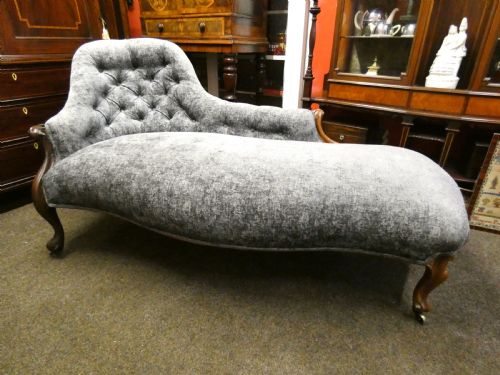
When you search for an antique upholstered reclining sofa, you are looking at nineteenth-century and early twentieth-century daybeds, chaise longues, and couches designed for reclining in domestic parlours and drawing rooms. These seating forms range from Regency mahogany frames to elaborate Victorian double spoonback designs and Edwardian oak pieces.
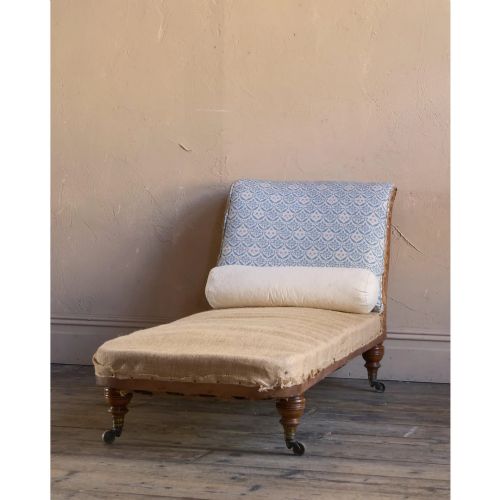
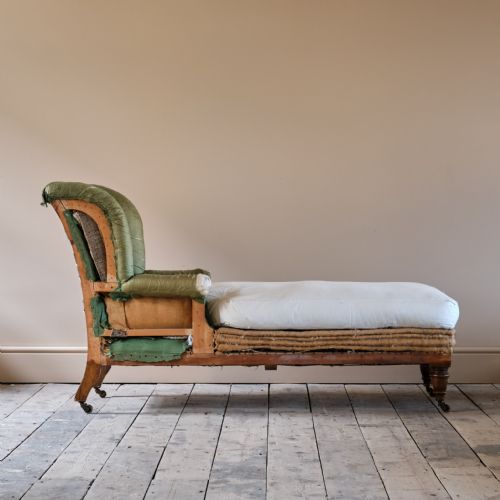
The most common versions met on this page are Victorian and nineteenth-century chaise longues and daybeds, often featuring turned legs and original castors alongside upholstered surfaces. Examples span from Regency models of eighteen twenty-five through to later Edwardian and nineteen-twenty pieces.
Makers and styles vary across English and French origins, including pieces attributed to Howard and Sons and H. Goodall and Sons of Newcastle. Frames incorporate specific stylistic influences such as French provincial and Louis the sixteenth designs alongside traditional English cabinetmaking.
Assessing Quality and Craftsmanship
Quality in an antique upholstered reclining sofa depends on the integrity of the timber frame and the sophistication of the joinery. Dense hardwoods like mahogany and rosewood indicate superior cabinetmaking compared to simpler secondary woods.
The finesse of carved woodwork, the presence of original castors, and attribution to established makers such as Howard and Sons elevate a piece. Evidence of thoughtful proportion and concealed storage solutions further distinguish finer examples.
Antique Upholstered Reclining Sofa Retail Price Guide 2026
Typical asking prices for upholstered reclining sofa among the pieces listed under this phrase on Sellingantiques today, from the lower quarter to the upper quarter. They describe what is for sale here now, not the wider market.
Some nineteenth-century daybeds cleverly hide secret storage compartments beneath the upholstery for stowing away stray novels.
Howard and Sons·H Goodall and Sons
The Antique Upholstered Reclining Sofa Glossary
- Chaise Longue
- A long upholstered chair for reclining, literally translating from French as long chair. These forms combine the functions of a chair and a daybed.
- Spoonback
- A chair or sofa back shaped like the bowl of a spoon, ergonomically curved to fit the human spine. This style is particularly prevalent in Victorian parlour furniture.
- Castor
- A small wheel mounted on a swivel assembly attached to the bottom of furniture legs. Original brass castors help date and authenticate nineteenth-century seating.
- Hessian
- A coarse woven fabric typically made from jute fibres, used historically as a foundational layer beneath top upholstery fabrics. It provides structural tension in traditional daybed construction.
- Regency
- An English stylistic period spanning the early nineteenth century, characterised by classical revival motifs and refined mahogany framing. Pieces from this era often display clean architectural lines.
Antique Upholstered Reclining Sofa: Frequently Asked Questions
What is an antique upholstered reclining sofa?
An antique upholstered reclining sofa is a nineteenth-century or early twentieth-century daybed or chaise longue designed for horizontal lounging. These pieces combine wooden frames in mahogany, walnut, or oak with padded textile upholstery.
They function as versatile seating and resting furniture, originating primarily from English and French workshops during the Victorian, Edwardian, and Regency eras.
How do I style a daybed at home?
Place a nineteenth-century daybed or chaise longue in a living room, study, or large bedroom where its profile can be appreciated from multiple angles. Position it away from direct sunlight to protect vintage velvet and fabric upholstery.
Pair the wooden frame with complementary period furniture, allowing the turned legs and brass castors to remain visible as decorative elements.
How do I tell Victorian pieces apart from Edwardian ones?
Victorian daybeds often feature darker rosewood or mahogany timbers, ornate carvings, and double spoonback profiles. They reflect the heavier, more decorative aesthetic of the mid to late nineteenth century.
Edwardian pieces generally present lighter solid oak frames and simpler structural lines dating from around nineteen-ten to nineteen-twenty, showing a shift towards domestic lightness.
Did these daybeds always recline?
Many nineteenth-century daybeds and chaise longues incorporated adjustable mechanisms or asymmetrical sloping backs designed for resting at various angles. Some variations offered dual function as both a settee and a reclining couch.
Mechanisms varied from fixed architectural forms to articulated daybed frames produced by makers like Howard and Sons.