
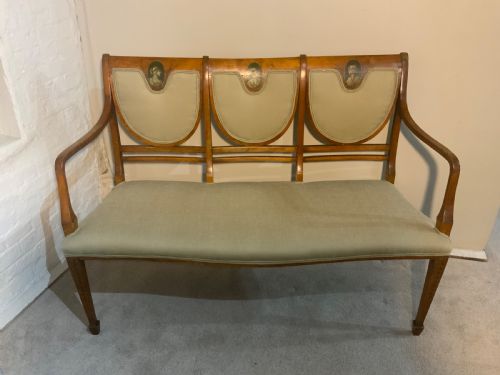
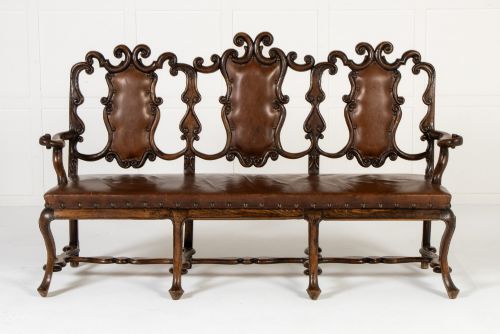


Antique Triple Back Bench
An antique triple back bench brings the elegance of joined chair backs into a single long seating form for the home.
Antique Triple Back Bench
An antique triple back bench comprises a long seating form featuring three distinct chair backs joined together in a single continuous frame. These pieces appear across various periods from the eighteenth century through to the Edwardian era, taking the form of settees and sofas with open or upholstered frames.
The versions most commonly met on this page span the nineteenth century and the early twentieth century, drawing heavily on earlier revival styles such as Hepplewhite, Regency, and Carolean. Makers fashioned them in mahogany, walnut, and satinwood, frequently incorporating painted finishes, inlay, and carved details across the three distinct back sections.
How they were made
Cabinet makers constructed these frames primarily using dense hardwoods such as mahogany and walnut, alongside satinwood for decorative surfaces. They joined the structural timbers using traditional joinery methods to support the wide span of the triple back design.
Surface ornamentation involved intricate wood inlay, painted decoration, and gilding. Artisans also integrated fabric or leather upholstery into the seat pads to balance decorative appeal with practical comfort.
Listings feature pieces spanning the 18th, 19th, and early 20th centuries, executed in mahogany, walnut, and satinwood.
What varies in quality
The standard of timber selection and the crispness of the carving dictate the upper tier of quality. Superior examples display finely figured grain and deeply carved details across the triple back frame rather than superficial surface decoration.
Proportion and structural balance separate the better examples from simpler pieces. A well-designed frame maintains harmonious spacing across the three back sections and integrates the arm supports seamlessly into the base.
The Antique Triple Back Bench Glossary
- Chair back settee
- A long seat featuring a backrest constructed to resemble multiple individual chair backs joined side by side.
- Shield back
- A chair back style shaped in the outline of a heraldic shield, popularised during the eighteenth century.
- Satinwood
- A durable exotic hardwood valued for its pale golden colour and naturally lustrous, reflective grain.
- Carolean
- A seventeenth-century style revived in later periods, characterised by rich carving, scrolling foliage, and turned supports.
- Inlay
- A decorative technique where contrasting pieces of wood or other materials are inserted into recessed cavities in the timber surface.
Antique Triple Back Bench: Frequently Asked Questions
How were triple back settees used historically?
Historically, these settees served as formal seating in grand halls, reception rooms, and parlours. Their design allowed them to sit flat against a wall while offering ample seating for multiple people.
Unlike fully upholstered sofas, chair back settees emphasised woodwork and decorative joinery. They were often placed where guests could admire the craftsmanship of the carved or inlaid backrests.
How do I identify the period of a bench?
Dating relies on examining the timber species, construction methods, and decorative motifs present on the frame. Earlier pieces often utilise solid mahogany or walnut with hand-carved details, whilst Edwardian and later revival items frequently feature satinwood with delicate painted or inlaid decoration.
Stylistic influences also provide clear indicators of origin. Hepplewhite and Regency revivals point towards specific design movements, though nineteenth-century makers frequently reinterpreted these historical styles.
Where should I place a triple back settee?
These settees suit spaces where the backrest remains visible, such as against a long hallway wall or floating in a spacious drawing room. Because the three distinct backs form the main visual interest, keeping them unobstructed allows the craftsmanship to stand out.
Consider pairing the wood tone and finish with existing room decor. Pieces finished with painted surfaces or fine inlay work particularly well as focal points in traditional or eclectic interiors.