
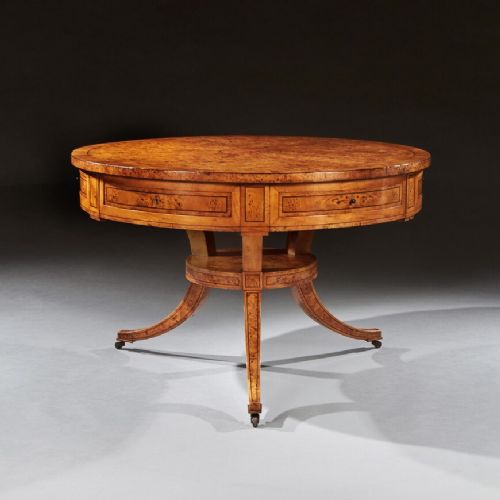


Antique Style Drum Table
An antique style drum table brings circular symmetry and leather inset tops to a room, offering both practical surface space and traditional presence.

Antique Style Drum Table
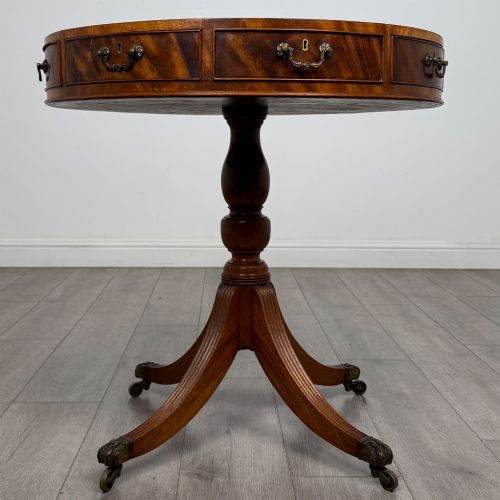
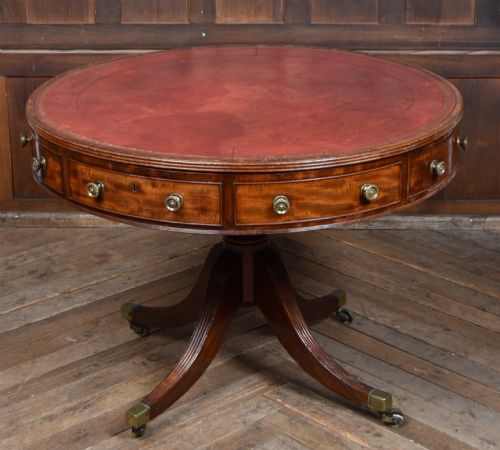
When you search for an antique style drum table, you encounter circular tables designed with deep skirtings and often fitted with drawers beneath the top. The examples on this page span several periods, with mahogany and leather top constructions appearing frequently alongside revival pieces.
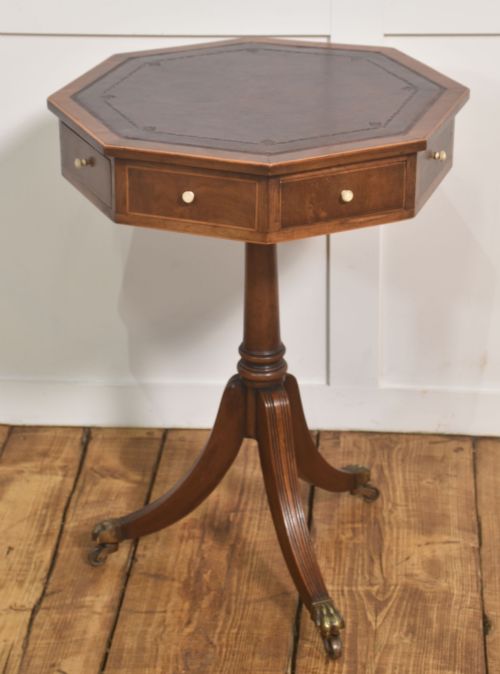
Makers drew on Georgian and Regency precedents to produce tables suited to libraries, studies and central spaces in rooms. The forms include standard circular drum tables as well as occasional variants like octagonal and campaign models.
Originating as library tables for sorting papers, these pieces function today as striking centre tables or lamp tables. Most variants you meet here use mahogany as the primary timber, often paired with tooled leather writing surfaces.
Materials and construction methods
Makers utilised solid mahogany and veneers, applying polished finishes to highlight the grain of the wood. Leather inset tops, frequently decorated with blind tooling, provide the working surface characteristic of the form.
Brass fittings such as drawer pulls, castors and campaign mounts appear across the pieces, combining utility with decorative contrast. Burr wood and maple feature in specific regional examples, adding distinct patterns to the circular tops.
Listings feature mahogany, brass, leather, and marble materials across 19th Century, Edwardian, and Georgian periods.
Distinctions in quality and finish
The choice of timber creates a primary distinction between pieces, with flamed mahogany and figured burr woods marking out superior cabinet work. Finely worked leather inserts and crisp brass hardware indicate greater attention to detail by the maker.
Construction details such as dovetailed drawer construction and stable revolving mechanisms separate robust examples from simpler ones. The proportion of the skirt depth to the overall diameter influences the visual balance of the table.
Charles Stuart Harris·Henry Berkeley
The Antique Style Drum Table Glossary
- Drum table
- A circular library table with a deep top containing drawers, resembling the shape of a drum. They typically stand on a central pillar supported by tripod legs.
- Campaign style
- Furniture designed for portability, featuring recessed brass handles, corner brackets and sturdy construction. These pieces were built for military officers on the move.
- Leather top
- A writing or working surface inset into the timber top of a table, often bordered with gilt tool work. It provides a durable surface for writing and reading.
- Revival
- A design movement where makers recreated historical styles from earlier centuries. Georgian revival and Regency revival pieces emulate the proportions of the original periods.
- Octagonal
- Having eight sides instead of a circular perimeter. Certain drum tables adopt this geometric variation for the top and base.
Antique Style Drum Table: Frequently Asked Questions
What is a drum table used for?
These tables served historically in libraries and studies for sorting papers and holding books. Today they function effectively as central tables or side pieces in living rooms.
Their circular shape allows access from all sides, making them versatile for placement in the middle of a room rather than against a wall.
Are all drum tables round?
While the traditional form is circular, variations do exist within the evidence. Some examples feature octagonal tops while retaining the deep skirt and drawer configuration.
Both round and multi-sided variants share the central pedestal support structure characteristic of the type.
What timber is most common?
Mahogany appears most frequently in the construction of these pieces, often finished with a polished surface. Makers also utilised burr woods and maple for specific decorative effects.
Leather inserts provide the contrasting working surface on the top of the timber framework.
How do I date a drum table?
Dating relies on observing the stylistic markers, timber choices and construction methods present in the piece. Pieces span from the Georgian period through to Edwardian and revival eras.
Comparing the hardware, such as brass pulls and castors, helps place the table within its specific period of manufacture.