




Antique Staffordshire Lustre
Antique staffordshire lustre brings metallic sheen and hand-painted warmth to a room through earthenware jugs and earthenware figures.
Antique Staffordshire Lustre
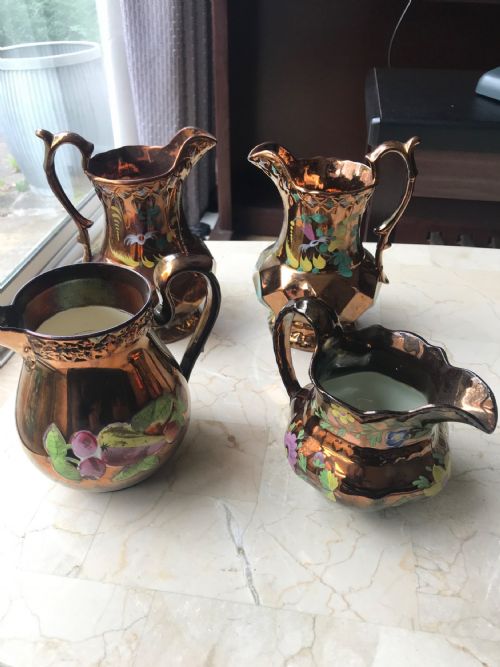
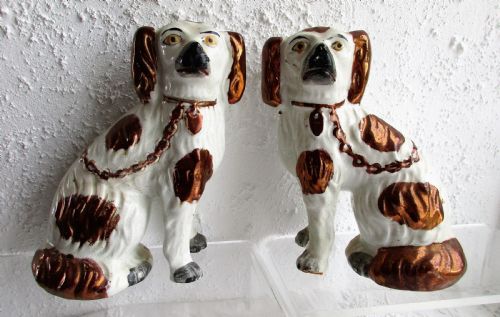
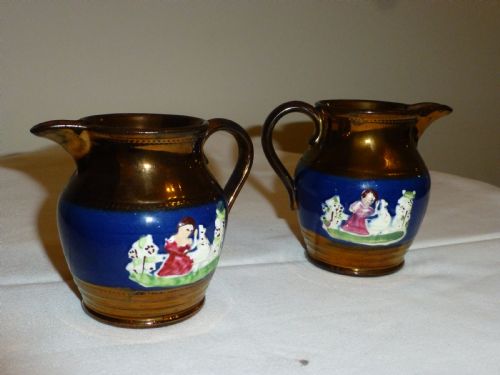
When you search for antique staffordshire lustre, you encounter a distinct group of 19th-century earthenware objects designed for everyday utility and mantelpiece display. These pieces range from robust milk jugs and cream jugs to decorative spaniel figurines finished with characteristic metallic glazes.
The material inventory on this page centres on earthenware and pearlware, carrying copper lustre glaze, enamel, and gilt decoration. Forms span from Georgian jugs with purple transfer decoration to Victorian seated spaniel pairs.
You are most likely to meet utilitarian jugs and ceramic figurines across Victorian, Regency, and Georgian periods. The output reflects both utilitarian kitchenware and ornamental pottery intended for the parlour.
How these pieces were made
Potters shaped these wares from local earthenware and pearlware bodies before applying metallic glazes that created the signature reflective finish. Copper lustre glaze provided the deep, metallic sheen seen on jugs and comforter spaniels alike.
Listings feature 19th Century, Georgian, 1860, 1880, and 1890 periods across earthenware, ceramic, and pearlware bodies.
What varies in quality
Quality rests upon the crispness of the moulded form and the evenness of the metallic glaze across the body. Superior examples display bold, consistent copper lustre without heavy pooling or dull patches.
The Antique Staffordshire Lustre Glossary
- Lustreware
- Earthenware pottery decorated with a metallic glaze that produces an iridescent sheen. This finish mimics precious metals through a thin metallic film applied over the fired glaze.
- Pearlware
- A refined earthenware developed in the late 18th century featuring a bluish glaze that pooled in recesses. It serves as a precursor to Victorian white earthenware.
- Earthenware
- Porous pottery fired at lower temperatures than stoneware or porcelain. It forms the standard ceramic body for Staffordshire lustre jugs and figures.
- Transfer printing
- A decoration technique where an engraved copper plate transfers a design onto paper and then onto the ceramic surface. This method allowed for uniform purple transfer patterns on early jugs.
- Comforter spaniel
- A ceramic figurine modelled after the King Charles spaniel and produced in pairs for the mantelpiece. These Staffordshire animals often feature copper lustre markings.
Antique Staffordshire Lustre: Frequently Asked Questions
What is antique staffordshire lustre?
Antique staffordshire lustre comprises 19th-century earthenware jugs, cream jugs, and ceramic figurines finished with metallic copper glazes and enamel painting.
Potters in the Staffordshire potteries produced these items for domestic use and parlour decoration during the Georgian and Victorian eras.
How were lustre jugs used?
These vessels served practical purposes on the dining table for serving milk, water, and cream.
Larger jugs handled general dairy liquids, while smaller cream jugs accompanied tea service.
What are comforter spaniels?
Comforter spaniels are ceramic dog figurines modelled in pairs to sit on either end of a mantelpiece.
Staffordshire potteries produced these popular ornaments with hand-painted details and copper lustre highlights.
How do you date these pieces?
Dating relies on ceramic body composition, glaze characteristics, and decorative styles spanning the Georgian and Victorian periods.
Pearlware bodies and transfer printing generally point towards earlier 19th-century production, while later Victorian pieces utilise denser earthenware.