

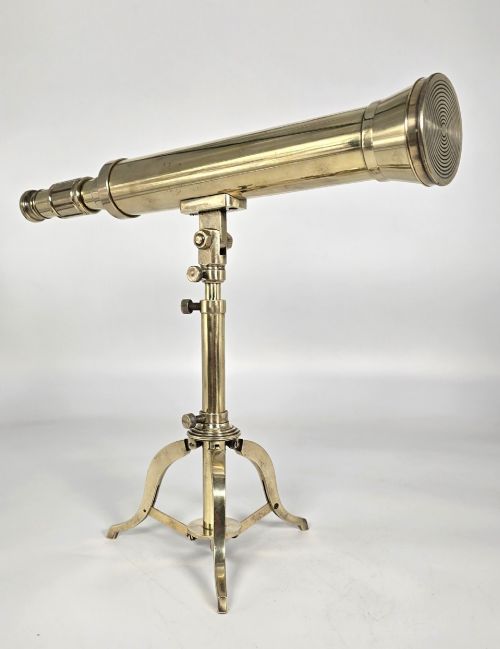


Antique Spyglass on Tripod
An antique spyglass on tripod brings the precision of historical observation right into a room, offering both functional magnification and striking optical design.
Antique Spyglass on Tripod
When you search for an antique spyglass on tripod, you are looking at historical optical instruments designed for terrestrial or celestial viewing, mounted securely on collapsible or fixed stands. These pieces range from Georgian library telescopes to Victorian table top models and military campaign iterations.
You are most likely to meet 19th-century brass examples on this page, alongside earlier Georgian iterations from makers working in London. They appear in both polished and gilt brass finishes, frequently accompanied by wooden components such as mahogany.
The forms encompass scientific instruments intended for serious study as well as library telescopes meant to sit upon a desk or table. Their origins trace back through the Victorian, Edwardian, and Georgian periods, reflecting the era's advancements in optics and metalworking.
Distinguishing quality
The distinction between ordinary and exceptional examples rests upon the precision of the optical maker's signature and the finish of the metalwork. Signed barrels by known London opticians demonstrate a higher level of workshop execution.
The integrity of the original tripod stand and any fitted wooden case separates complete survivals from assembled or later matched components. Heavier gauge brass and crisper engraving on the draw tubes elevate the standing of the piece within its period.
Materials documented across the available inventory include polished brass, gilt brass, glass, mahogany, iron, and steel.
Johnson·W. and T. Gilbert·Clarkson·Steward of London·S and B Solomons·Matthew Berge·G. Adams
The Antique Spyglass on Tripod Glossary
- Gregorian telescope
- A reflective telescope design using a concave primary mirror and a small secondary mirror to direct light back through a hole in the main mirror. This configuration was common in the eighteenth century.
- Library telescope
- A large optical instrument designed for indoor use on a table or stand rather than handheld outdoor carriage. These often featured substantial brass barrels and high magnification.
- Terrestrial telescope
- An optical device configured to present an upright image for viewing land-based objects. They include erecting lenses inside the tube to correct the inverted view typical of basic astronomical setups.
- Campaign telescope
- A portable instrument engineered for military or travel use, often featuring collapsible sections and protective casing. These prioritize durability and compactness in the field.
Antique Spyglass on Tripod: Frequently Asked Questions
What is an antique spyglass on tripod used for?
These instruments were originally built for terrestrial viewing, astronomy, and navigation, allowing observers to magnify distant objects with precision. In a modern setting, they serve primarily as decorative focal points and historical conversation pieces.
Their substantial brass construction and mechanical stands make them well suited for placement in studies, libraries, or rooms with expansive window views.
How do I date a brass telescope?
Dating relies on the style of the engraving, the form of the mounting tripod, and the signature of the maker inscribed on the draw tube. Stylistic markers shift from the clean lines of the Georgian period to the heavier ornamentation of the Victorian era.
Makers often recorded their working addresses on the barrel, which provides a reliable chronological anchor when cross-referenced with trade directories.
Are these telescopes still functional?
Many surviving examples retain their original glass lenses and can focus on distant objects, though optical standards differ significantly from modern coatings. Dust accumulation or age-related hazing inside the barrel can affect clarity.
Careful cleaning of the exterior brass and preservation of the internal lens assembly maintains their historic operation without compromising the antique material.
How should I display a tripod telescope?
Position the instrument on a stable table or desk away from high-traffic areas where the folding legs might be disturbed. Ensuring the weight rests evenly across the tripod prevents tipping.
Keep the piece out of direct sunlight to protect any accompanying mahogany cases and to prevent extreme temperature fluctuations from affecting the brass and glass.