




Antique Roemer Goblet
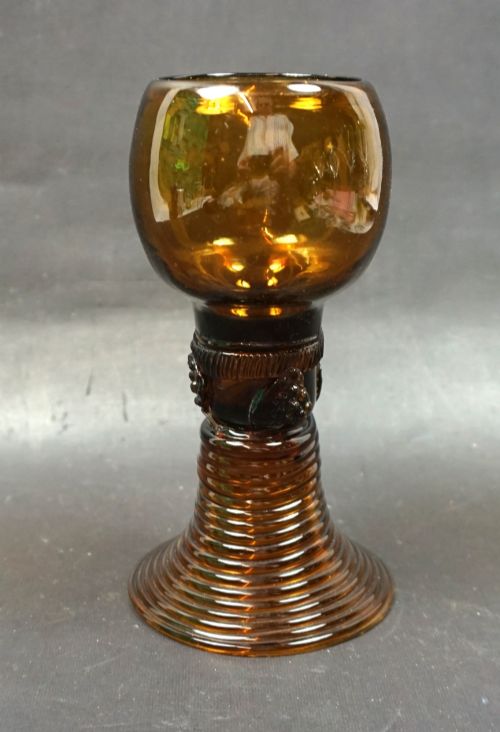
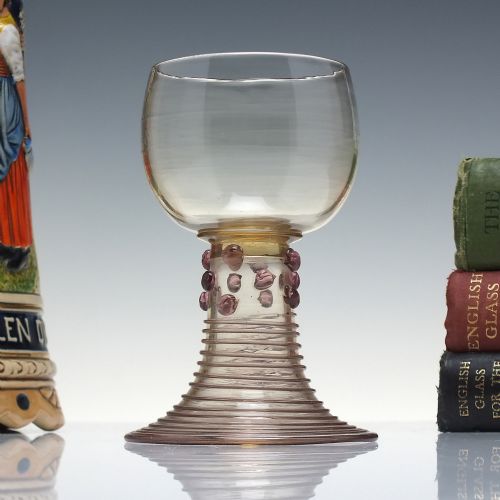
An antique roemer goblet is a traditional drinking vessel defined by its characteristic bowl and coiled or hollow stem, prized for adding historic character to a table.
Antique Roemer Goblet
An antique roemer goblet is a distinctive form of drinkware rooted in European tradition, most commonly encountered in green glass alongside variations in amber, amethyst, and pale tones. These pieces span periods from the Georgian era through to the Victorian period, 19th Century, and early twentieth-century decades like 1910 and 1920.
The objects take various functional forms including wine glasses, hock glasses, cordial glasses, and larger goblets originating from makers and regions across Germany, Bohemia, France, and England. Collectors encounter both single examples and matched sets numbering four, six, or eight pieces.
Moulded or hand-blown vessels appear alongside cut crystal examples, showcasing styles that range from German Baroque and German Historicism to Biedermeier, Art Nouveau, and Art Deco. Export glass and traditional continental forms predominate across the available selection.
Materials and production methods
Production relies heavily on blown glass and hand-blown glass techniques, forming the characteristic bowls and stems that typify the antique roemer goblet. Artisans utilised coloured glass in shades of green, amber, and amethyst, occasionally employing cut crystal methods to shape the material.
Decoration often involved surface enamel, hand-enamelled polychrome motifs, heraldic designs, and gilding applied to the glass body. Stems frequently incorporated coiled or hollow constructions integral to traditional glassblowing practices of the period.
Antique Roemer Goblet Retail Price Guide 2026
Typical asking prices for roemer goblet among the pieces listed under this phrase on Sellingantiques today, from the lower quarter to the upper quarter. They describe what is for sale here now, not the wider market.
Some nineteenth-century drinkers relied on coiled glass stems to maintain their grip after a generous pour of hock wine.
Factors influencing quality
The level of craftsmanship in the glassblowing process shapes the structural integrity and visual weight of each antique roemer goblet. Consistency across sets of multiple glasses demonstrates greater workshop discipline than is found in disparate individual pieces.
The complexity and preservation of surface decoration, such as detailed polychrome enamelling, heraldic motifs, and fine gilding, distinguish standard utilitarian drinkware from high-status artistic productions. The clarity of coloured glass and the precision of cut crystal facets likewise separate simpler vessels from masterworks.
Moser Bohemian·Lobmeyer·Frits Hechert·St Louis Massenet·Theresienthal
The Antique Roemer Goblet Glossary
- Roemer
- A traditional continental European drinking goblet, typically featuring a large rounded bowl atop a cylindrical or coiled stem.
- Historismus
- A nineteenth-century revival style that drew inspiration from earlier Germanic and Renaissance artistic traditions, frequently seen in enamelled glassware.
- Biedermeier
- A Central European style spanning the mid-nineteenth century characterised by clean lines, functional elegance, and restrained ornamentation.
- Hock glass
- A tall-stemmed wine glass traditionally used for German white wines, often produced in green or coloured glass.
- Coiled foot
- A stem formation created by wrapping a continuous glass thread around a central core to provide grip and decorative texture.
Antique Roemer Goblet: Frequently Asked Questions
What is an antique roemer goblet used for?
These vessels served primarily as wine glasses and hock glasses for formal dining and social gatherings in European households.
Today, collectors utilise them as decorative dining accessories or display them as examples of historic glassmaking artistry.
Why are many antique roemers green?
Early European glass production naturally incorporated iron impurities in the raw materials, producing a distinct green hue that eventually became a traditional aesthetic choice for regional drinkware.
Glassmakers continued to utilise green glass for roemers through the Victorian period and into the twentieth century to maintain historical continuity.
How do I identify a German Historicism roemer?
German Historicism pieces, dating around 1900, often feature elaborate heraldic motifs and polychrome enamel decoration inspired by Renaissance and Baroque traditions.
These goblets combine traditional green or amber blown glass forms with heavy decorative detailing characteristic of revivalist workshops.
Are antique roemers found in sets?
Surviving examples appear both as individual antique roemer goblets and as matched sets ranging from four to eight pieces.
Sets often originate from Bohemian or French glasshouses of the nineteenth and early twentieth centuries, preserved together for formal table service.