


Antique Repeating Timepiece
An antique repeating timepiece sounds the hours and quarters on demand, bringing precise French and English engineering into the domestic interior.
Antique Repeating Timepiece
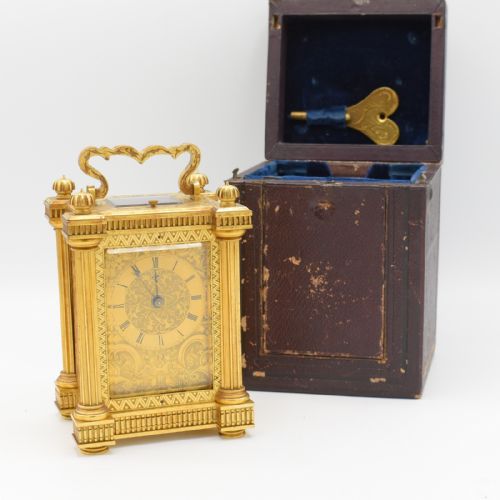
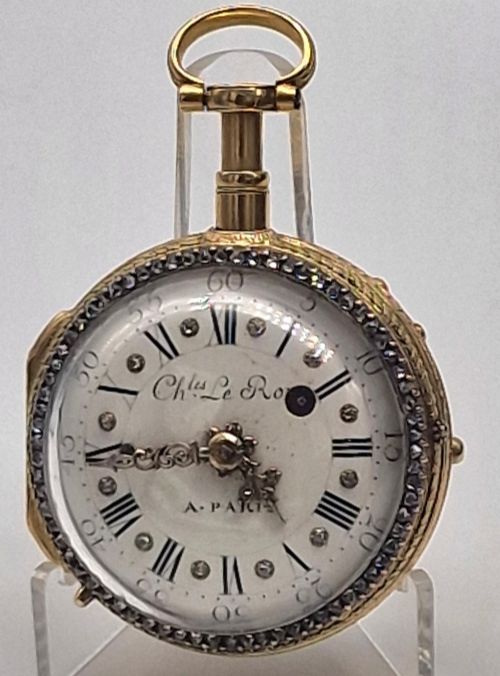
When you search for an antique repeating timepiece, you encounter portable mechanical clocks designed to sound the time at the press of a button or pendant. The versions most commonly met on this page are French carriage clocks and pocket watches housed in brass, gilt bronze, or silver gilt cases.
The objects span the nineteenth century, including Victorian examples and French pieces from the 1850s to the early 1900s. Makers and retailers such as Howell & James London, Charles Le Roy, Dwerrihouse & Bell, J.W. Benson, and John Walker appear alongside specialised makers like Drocourt and Henri Jacot.
Cases vary widely in form, ranging from standard gorge frames to doucine and anglaise silhouettes. Many feature enamel dials, painted enamel flower designs, or fully engraved brass and glass panels that reveal the movement within.
How they were made
Makers constructed these mechanisms using brass, steel, and gold, enclosing the intricate gear trains within heavy bevelled glass plates. Cases were cast and subsequently gilded or polished, with select examples receiving extensive hand-engraving across the brass masks and exterior frames.
Dials were formed from white enamel with painted Roman or Arabic numerals, sometimes complemented by subsidiary alarm dials or intricate enamel paintings. The repeating complication required specialised steel levers and hammers to strike internal bells or gongs on demand.
Listings feature materials such as brass, gilt bronze, silver gilt, glass, and enamel across nineteenth-century styles.
What varies in quality
Quality rests in the complexity of the striking train and the finish of the case. Grand sonnerie and petite-sonnerie movements, which strike the hours and quarters automatically in addition to the repeating function, represent higher standards of watchmaking than simple bell-strike repeaters.
The refinement of the exterior housing defines the upper tiers of the range. Heavy gorge cases with original gilding, fully engraved brass work, and signed movements by makers like Alfred Drocourt or Henri Jacot separate standard production pieces from exceptional works.
Charles Le Roy·Dwerrihouse & Bell·Alfred Drocourt·Henri Jacot·J.W. Benson·John Walker·Howell & James London
The Antique Repeating Timepiece Glossary
- Repeating movement
- A mechanical complication that strikes the last elapsed hour and quarters when a button or plunger is pressed. This allows the user to tell the time in total darkness.
- Grand Sonnerie
- A striking train that sounds both the hours and the quarters automatically as time passes, as well as repeating them on command. It is a highly complex mechanism found in superior carriage clocks.
- Gorge case
- A distinct carriage clock case style featuring a stepped top and base with reeded pillars at the corners. It is characteristic of nineteenth-century French manufacture.
- Anglaise case
- A rectangular carriage clock case design with flat top plates and columns, popular in late nineteenth-century French export pieces. It provides a clean architectural profile.
- Platform escapement
- The tiny horizontal assembly holding the balance wheel and hairspring visible near the top of carriage clock movements. It regulates the timekeeping of the portable clock.
Antique Repeating Timepiece: Frequently Asked Questions
How do I operate the repeater?
Press the button or depress the plunger on the top of the case to activate the repeating mechanism. The internal hammers will strike the bell or gong to sound the hours and quarters.
Allow the striking sequence to finish completely before moving or setting the clock. Forcing the mechanism during a strike can damage the delicate internal steel racks.
What is a carriage clock?
A carriage clock is a small, portable spring-driven timepiece designed for travel during the nineteenth century. They typically feature brass and glass cases with handles on top.
Most examples include a platform escapement to maintain accurate time while in motion. They were originally transported in fitted leather travel cases.
How do I tell the periods apart?
Examine the case style, engraving depth, and dial materials to determine the era of manufacture. Mid-nineteenth-century pieces often feature simpler gorge cases, while late-nineteenth-century examples frequently incorporate elaborate enamel paintings or fully engraved brass masks.
Signatures on the backplate or dial provide direct attribution to specific makers active during the Victorian period. Patent dates and serial numbers stamped on the movement further narrow down the decade.
Where should I place it at home?
Position the timepiece on a stable, level surface away from direct sunlight, drafts, and sources of excessive heat. Mantels, desks, and secure tables allow the sound of the striking mechanism to resonate clearly through the room.
Keep the clock out of high-traffic areas where it might be easily knocked over. The bevelled glass panels require careful placement to prevent accidental impact.